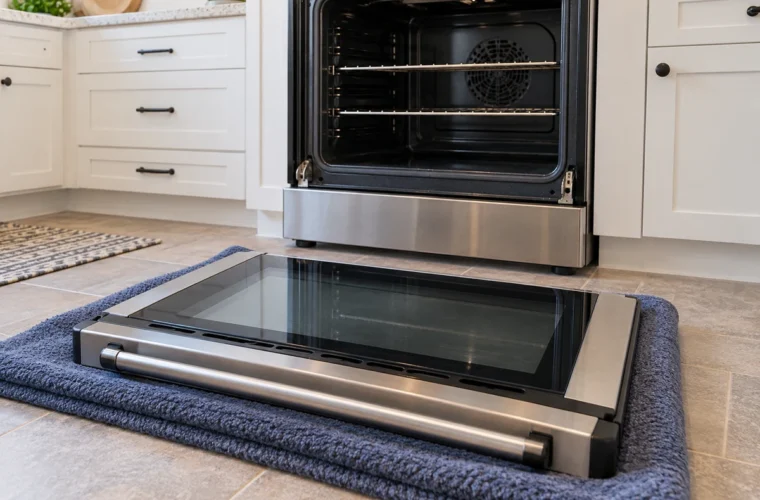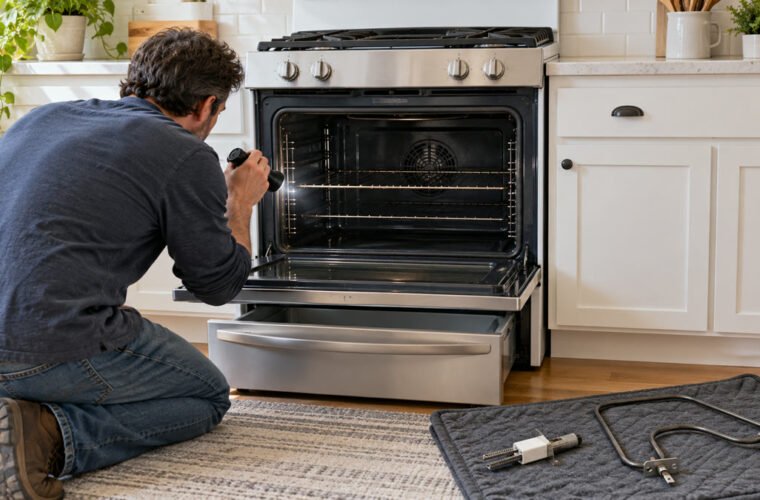
Gas oven not heating? The usual culprit is a worn igniter that glows but can’t open the gas valve, so no flame ever lights. Don’t buy one yet.
Rule out the free causes first. A clock you never set, a tripped breaker or a gas lever knocked off behind the drawer can all leave your oven cold.
The fastest way to tell them apart costs nothing. Set the oven to Bake and watch for one minute, through the window or the drawer opening. What you see decides where you look next.
What the oven does when you press Bake
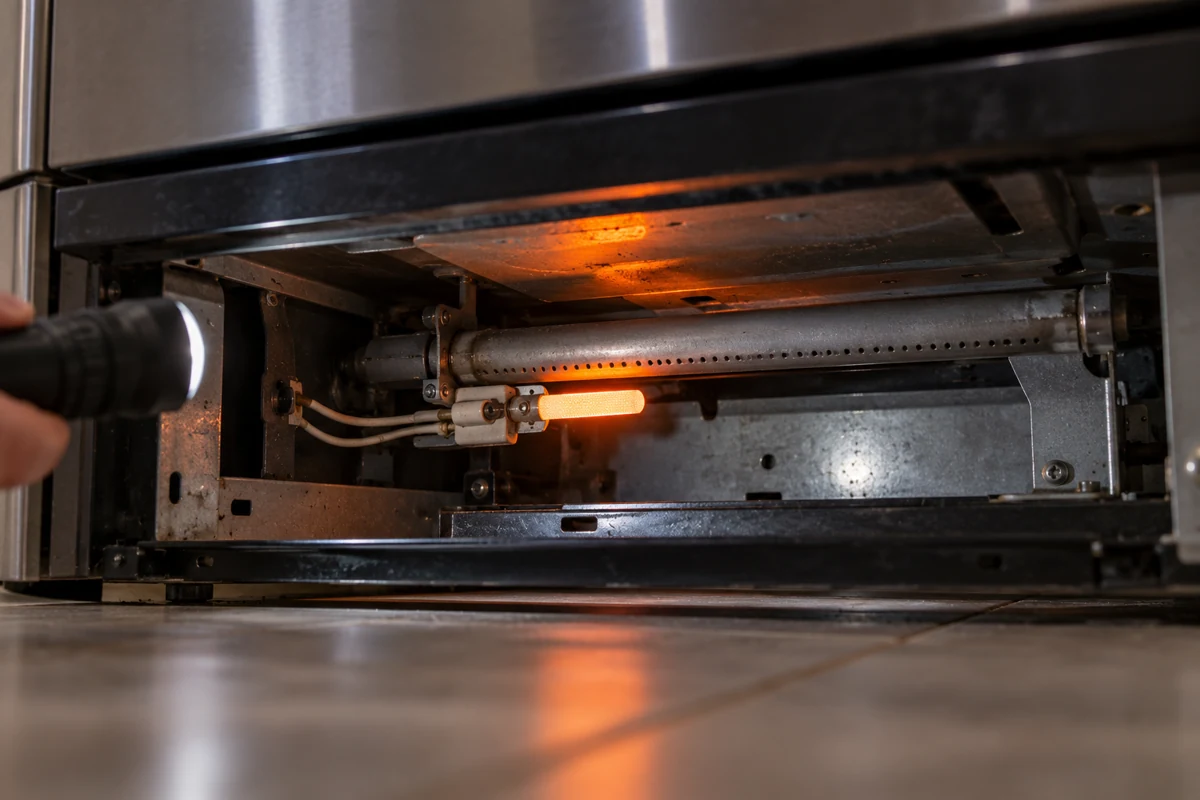
Press Bake and a healthy gas oven shows a glow under the floor, then a flame. Anything else you see sorts the cause into one of four groups. Match yours below before you order a part, because each group points to a different fix and only one of them needs an igniter.
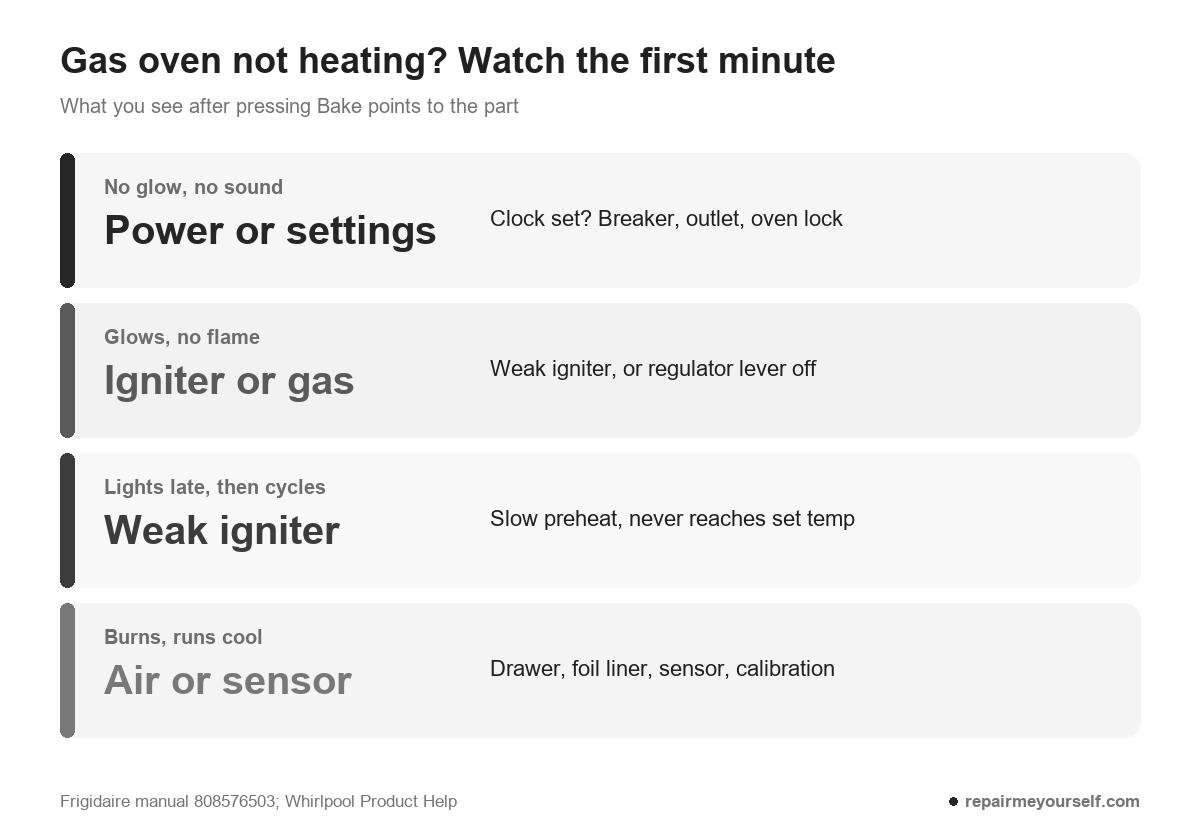
- No glow, no sound, nothing. The control never called for heat. Think power, the clock, a lock or the wrong mode.
- A glow that never turns into a flame. Either the igniter is too weak to open the valve, or no gas is reaching the oven.
- A flame that shows up late, then goes out and relights. Classic weak igniter. Preheat drags and the oven may never reach the number you set.
- A good flame, but food comes out underdone. Look at airflow and the temperature sensor before anything else.
Some newer ranges hide the burner completely. Then you listen instead. When yours lights, you’ll hear a soft whoosh a short while after you press Bake.
Burners work but the oven doesn’t?
Working burners prove the house has gas, not that the oven gets it. On a gas range, the cooktop and the oven are fed and lit differently, so one can work while the other sits cold. Two causes explain most of these calls, and neither needs a part.
The oven needs electricity, and the burners don’t. Frigidaire’s gas range manual says the surface burners “may be lit manually” with a match during a power outage. The oven can’t be.
The same manual says not to run the appliance during a power failure at all. So a dead outlet or a tripped breaker can leave you cooking on the cooktop while the oven does nothing.
A lever on the pressure regulator can shut off only the oven. Whirlpool’s product help page explains that when this shut-off valve is OFF, gas still flows to the cooktop burners but not to the oven. It’s separate from the main gas valve on your wall.
Whirlpool lists three ways it gets turned off: handling, shipping, or a utensil in the storage drawer hitting the lever.
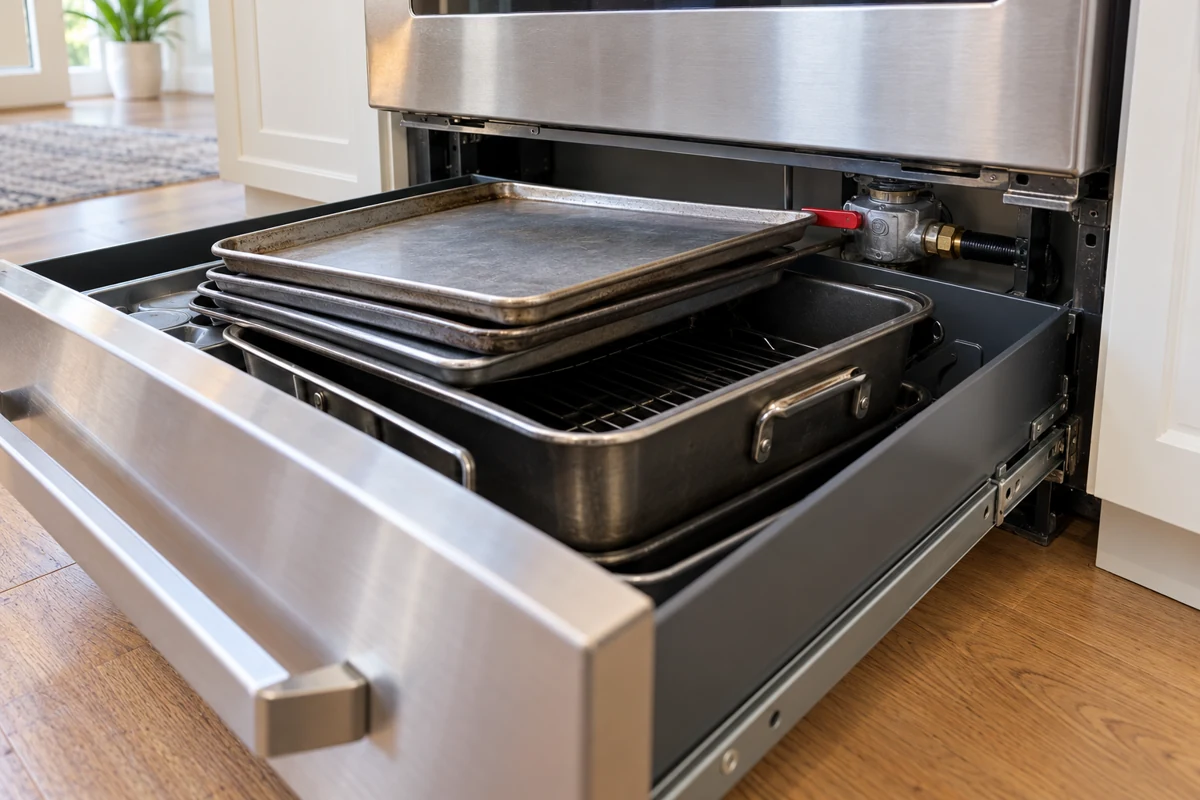
That last one surprises people. On service calls, a baking sheet shoved to the back of the drawer was the whole repair more than once. If you just installed or moved the range, look at that lever first.
Your installation instructions show where the regulator sits. If you can’t find it, or you’d have to pull the range out against a gas line to reach it, leave it for a technician.
Free checks, in the order I’d do them
Start with the checks that cost nothing and take you a minute each. They come straight from two manufacturers’ troubleshooting pages. Together they clear plenty of “dead” gas ovens before anyone opens a panel.
- Set the clock. Frigidaire’s troubleshooting table says it plainly: “The clock must be set in order to operate the oven.” After a power blip the display may be flashing and the oven won’t start.
- Confirm power. The range plugs into a 120-volt outlet. Make sure the cord is in all the way and the breaker hasn’t tripped. Whirlpool wants a grounded outlet, with no two-prong adapter or extension cord.
- Look at the mode. Rule out a control lock, a delayed start or Broil picked by mistake. Some ovens won’t heat with the door open, either.
- Empty the drawer. Whirlpool says an overloaded storage drawer can interfere with the igniter. Take everything out and try again.
- Pull any foil or liner off the oven floor. Both brands warn it can block air or gas flow to the burner. Frigidaire adds a carbon monoxide warning.
- After a new install, bleed the line. Whirlpool suggests turning on any surface burner to push air out of the gas line, then trying the oven again.
Most gas ovens don’t have a reset button. To reset yours, turn the breaker off for a minute and back on. Then set the clock and the oven function again, the way Frigidaire’s manual describes after a power failure.
Glows but won’t light: the igniter
A glowing igniter isn’t proof of a good one. The gas valve on most ovens only opens once the igniter draws enough current, and a worn igniter can glow orange for minutes without ever getting there. That’s why you see light but no flame.
Here’s how one repair tech on r/appliancerepair explained it to a Kenmore owner whose oven crept up to 287°F on a 375°F setting:
“The hot surface ignitor (the glowing part) probably needs to be replaced. When they go bad, the gas valve doesn’t fully open and may pulse between open and closed. The oven will take forever to heat and may not reach its set point at all.”
– r/appliancerepair, December 2025 (12 upvotes)
Signs it’s the igniter:
- It glows dull orange for a long time before the flame appears, or never lights at all.
- Preheat takes much longer than it used to.
- The flame goes out partway through and the oven cools before it relights.
To prove it, measure it. Clamp a meter around one igniter wire while the oven calls for heat, and you’ll see the current it draws.
Then compare that number with the rating for your part number. Igniters come in families: one maker sells a 3.2 to 3.6 amp version and a separate 2.5 to 3.0 amp line, so a reading that’s fine for one is a failure for the other. Our Whirlpool oven not heating guide walks through the amp test.
Before you condemn it, look for anything touching the igniter wire. A pan in the drawer can short it out:
“Check and make sure nothing is touching the wire for the igniter which could be grounding it out. Like too many pans in the drawer on the bottom and one of them happens to be touching it.”
– r/appliancerepair (3 upvotes)
The tech in that first thread called the swap easy: two wires and a screw or two, with the range unplugged. Yours may differ. If the igniter is mounted to the gas valve, or you’d have to loosen a gas fitting to reach it, stop there.
Heats, but slowly or not all the way
When the flame lights but your oven runs cool, look at air and the temperature sensor next. A burner starved of air burns weak. A sensor that reads wrong shuts the flame off too early, and neither one is fixed by a new igniter.
- Airflow. Clear the drawer and pull out any foil or floor liner, the same checks as above. Both cut the air the burner needs.
- The sensor. It’s the thin probe on the back wall of the oven. Make sure it isn’t bent against the wall or caked with grease.
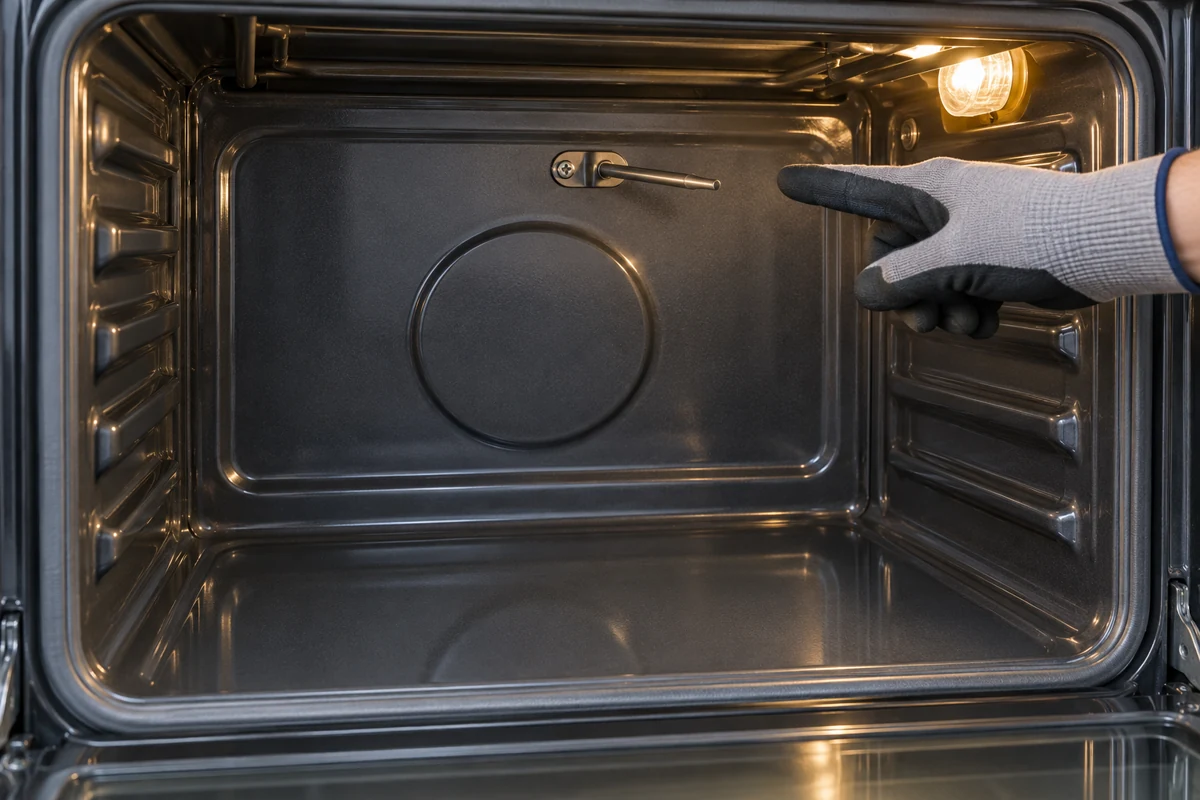
Illustration: the temperature sensor is the thin probe on the back wall; it should stand clear of the wall. - Normal swing. No oven holds one exact number. The burner cycles off and on, so a thermometer will read above and below the setting through a bake.
- Calibration. If the oven is steady but always a little cool, most models let you adjust the offset from the control. Frigidaire allows up to 35°F either way on its gas ranges.
One owner in r/Appliances replaced the bake element first, only to find that wasn’t the fault. On a gas oven, do the first-minute watch before you order anything.
A gas oven heats with its burner. A bake element only matters on electric models, and for those you’ll want how to replace an oven heating element.
Stop and call a pro if
Some gas oven faults are past the point where you should keep going. Stop and call a licensed technician, or your gas utility, if any of these happens. I’m not licensed for gas-line work myself, and I pass these jobs on too.
- You smell gas. Turn the oven off, don’t flip switches, get everyone out and call the gas company from outside.
- The burner lights with a loud whoomp. Delayed ignition means gas built up before it caught. Stop using the oven.
- The igniter tests good and still nothing lights. That points at the gas valve, and the valve sits on the gas line.
- The breaker trips again after you reset it. That’s an electrical fault, not a setting.
- You can’t reach the regulator lever without moving the range against its gas connector.
Gas oven not heating: quick answers
Here are short answers to what people ask once the oven works again, or while they wait for a part. Each one points back to the section that goes deeper.
How do I reset my gas oven? Turn the breaker off for about a minute and back on. Then set the clock, because Frigidaire’s ovens won’t run until it’s set.
Can a gas oven heat without electricity? No, not on ranges with a glow-bar igniter. The burners can be lit with a match, but the oven can’t.
Brand-specific steps. We have model-specific pages for Frigidaire ovens not heating and Samsung ovens not heating, alongside the Whirlpool guide.
Watch the first minute, then clear the drawer and set the clock. Plenty of cold ovens get fixed before anyone buys a part.