
When your Whirlpool dishwasher starts flashing error codes or blinking lights in cryptic patterns, it’s communicating exactly what’s wrong through a diagnostic language designed to expedite repairs. These alphanumeric codes and LED sequences aren’t obstacles—they’re shortcuts that identify specific failures, from water supply problems to heating malfunctions. Understanding this language separates a five-minute DIY fix from an unnecessary $200 service call.
This Whirlpool dishwasher troubleshooting guide translates every common Whirlpool dishwasher error code into actionable solutions. You’ll discover which codes resolve through simple resets, which require basic maintenance like filter cleaning, and when professional intervention becomes genuinely necessary. Master these diagnostic messages and you’ll restore your dishwasher to peak performance while avoiding the frustration of guessing what’s actually broken.
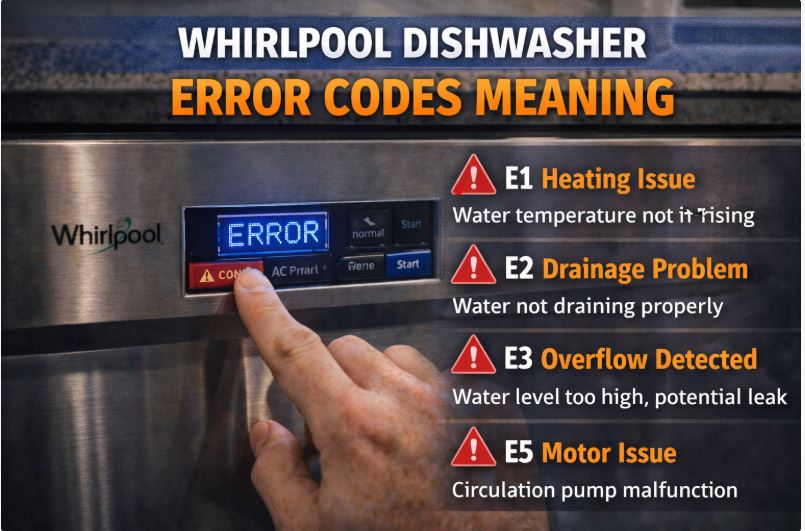
Whirlpool Dishwasher Error Codes: Fast Fixes & Meanings
| Error Code | System Affected | Primary Meaning | DIY Solution Difficulty |
|---|---|---|---|
| E1 / F1 | Water inlet | Water supply failure or low pressure | Easy – Check valves and hoses |
| E2 / F2 | Drainage | Cannot drain properly | Easy – Clean filters and hoses |
| E3 / F3 | Heating | Temperature regulation failure | Medium – May need element replacement |
| E4 / F4 | Overflow protection | Excessive water detected | Medium – Check for leaks or float switch |
| E6 / F6 | Water temperature | Incoming water wrong temperature | Medium – Thermostat or flow meter issue |
| E7 / F7 | Flow meter | Water flow measurement error | Hard – Flow meter replacement likely |
| F8 | Water turbidity | Water too dirty/cloudy | Easy – Clean optical sensor and filters |
| F8E4 | Leak detection | Water in base pan drip tray | Medium – Find and repair leak source |
| F8E5 | Door switch | Door not properly closed or latched | Easy – Check door latch and alignment |
| F9E1 | Drain pump | Drainage system obstruction | Easy – Remove blockages |
| F9E2 | Drain pump | Secondary drainage fault | Medium – Pump or sensor issue |
| H2O | Water supply | Insufficient incoming water | Easy – Verify supply valve open |
| 6-1 blinks | Water inlet | Electronic control detects no water | Easy – Same as E1/F1 troubleshooting |
| 8-1 blinks | Heating | Temperature sensor failure | Hard – NTC thermistor replacement |
Whirlpool Dishwasher Water Supply Error Codes: E1, F1, F6, F7, and H2O
Water inlet failures prevent your dishwasher from accessing adequate water for wash cycles. These codes specifically diagnose supply-side problems rather than drainage issues.
E1 and F1 Errors: Primary Water Inlet Failure
The E1 and F1 codes indicate your dishwasher cannot fill with water within expected timeframes. The electronic control monitors fill duration, triggering these codes when water doesn’t reach required levels.
Immediate Troubleshooting Steps: Verify the water supply valve under your sink is fully open. This valve must be turned completely—a partially open position restricts flow enough to trigger errors without completely blocking water.
Check household water pressure meets Whirlpool specifications. Pressure must exceed 20 PSI minimum for proper operation. Low pressure throughout your home indicates broader plumbing issues requiring professional assessment.
Inlet Valve Filter Screen Maintenance: Disconnect power and water supply to your dishwasher. Remove the inlet hose from the water valve connection and examine the small mesh filter screen inside the valve opening. Sediment, mineral deposits, and rust particles accumulate here progressively over months of use.
Clean this screen thoroughly using an old toothbrush under running water. For stubborn mineral buildup, soak in white vinegar for 15 minutes before scrubbing. This simple maintenance resolves most E1/F1 codes.
F6 Error: Water Temperature Detection Failure
The F6 code signals incoming water temperature is either incorrect or undetectable. This happens when water temperature falls below -3°C or exceeds 85°C, or when the flow meter cannot verify proper temperature.
Diagnostic Approach: Check your water heater temperature settings. Excessively hot incoming water above 65°C can trigger F6 errors. Residential hot water should remain between 50-60°C for safety and appliance compatibility.
Verify the water inlet hose isn’t blocked or kinked, as restricted flow affects temperature measurement accuracy. The flow meter depends on consistent water movement to properly gauge temperature.
Component Failure Considerations: Persistent F6 codes after verifying inlet conditions typically indicate failed NTC temperature sensors or faulty flow meters. The flow meter measures both water volume and temperature—when it malfunctions, temperature readings become unreliable. Professional diagnosis determines which component failed.
F7 Error: Flow Meter Malfunction
F7 codes specifically identify flow meter failures distinct from general water supply problems. The flow meter monitors incoming water volume and temperature, communicating this data to the control board.
Troubleshooting Sequence: First eliminate simple causes—ensure the water tap is fully open and inlet hoses aren’t kinked. Blockages in the water inlet valve can prevent adequate flow through the meter even when water pressure is normal.
If basic checks reveal no issues, the flow meter itself likely failed. Flow meter failures are relatively common on Whirlpool dishwashers after several years of operation. You’ll typically find the flow meter behind the right-hand side panel. Replacement requires moderate technical skill but saves significant service call expenses.
H2O Display: Water Supply Paused
The H2O code appears as text on digital displays, pausing cycles when water supply issues are detected. This straightforward message indicates insufficient water is reaching the dishwasher despite the inlet valve being open.
Follow the same troubleshooting steps as E1/F1 errors—verify supply valve position, check for kinked hoses, and inspect the inlet filter screen. The H2O code essentially provides a more readable version of the same diagnosis as numeric error codes.
Whirlpool Dishwasher Drainage System Error Codes: E2, F2, F9E1, and F9E2
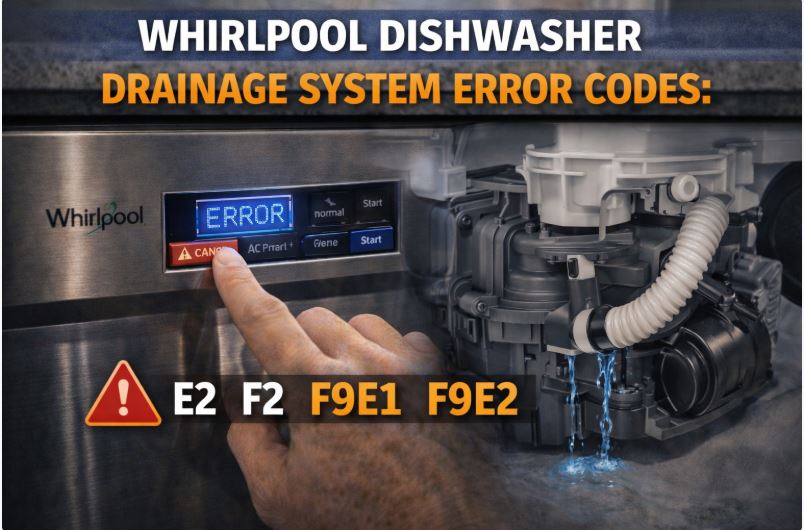
Drainage errors prevent your dishwasher from evacuating water properly, leaving standing water that compromises cleaning performance and can cause odors.
E2 and F2 Codes: Primary Drainage Failure
These interchangeable codes indicate water remains in the tub after drain cycles should have emptied it. The control board detects this standing water through level sensors.
Primary Troubleshooting Sequence: Start with your kitchen sink drain and garbage disposal. Whirlpool dishwashers typically share drain lines with sink plumbing. Run your disposal for 30-60 seconds with cold water flowing to clear any accumulation blocking the shared drain.
Clean the dishwasher’s internal filter assembly located at the tub bottom. Remove the lower rack, twist the cylindrical filter counterclockwise, lift it out, and disassemble components. Rinse thoroughly under warm water, removing trapped food particles, grease buildup, and debris.
Garbage Disposal Knockout Plug: If your dishwasher connects to a garbage disposal, verify the knockout plug was removed from the disposal’s dishwasher inlet port during installation. Installers occasionally forget this critical step, leaving a solid plug that completely blocks drainage. The dishwasher appears severely malfunctioned when it’s actually just an installation oversight.
F9E1 Error: Drain Pump Obstruction
F9E1 specifically indicates the drain pump cannot evacuate water due to blockages or pump failure. This code is more specific than general E2/F2 drainage errors.
Resolution Steps: Power cycle the dishwasher by disconnecting power for 30 seconds. This reset often clears temporary electronic glitches that falsely trigger drainage errors.
Check for food debris or objects caught in the drain pump area beneath the filter assembly. Remove the filter and shine a flashlight into the drain opening—look for broken glass, toothpicks, twist-ties, or food particles blocking the impeller.
Inspect the drain hose under your sink for kinks, sharp bends, or compression from stored items. The hose must maintain proper elevation—Whirlpool specifies the drain hose end should be positioned appropriately to prevent siphoning.
F9E2 Code: Secondary Drainage Fault
F9E2 relates to drainage problems but indicates different sensor readings or component failures than F9E1. This distinction helps technicians diagnose whether the issue involves the pump itself, level sensors, or control board communication.
If basic drainage troubleshooting (filter cleaning, hose inspection, disposal verification) doesn’t resolve F9E2 codes, the drain pump motor may have failed mechanically or the control board lost communication with pump components. Professional diagnosis becomes necessary to pinpoint which element malfunctioned.
Whirlpool Dishwasher Heating and Temperature Error Codes: E3, F3, F8, and 8-1 Blinks
Temperature regulation ensures proper sanitization and detergent activation. These codes alert you to thermal system failures.
E3 and F3 Errors: Heating System Failure
E3 and F3 codes appear when the dishwasher cannot heat water to required temperatures within 25 minutes of cycle start. Proper water temperature is essential—most cycles need temperatures above 50°C, with sanitization cycles exceeding 70°C.
Common Causes: Failed heating elements are the primary culprit. The heating element at the tub bottom physically burns out over time, especially in hard water areas where mineral deposits accumulate on element surfaces.
Faulty NTC thermistor prevents accurate temperature readings. Even with a functioning heating element, a malfunctioning temperature sensor cannot verify when target temperature is reached.
Thermostat failures disrupt temperature regulation. The thermostat works in conjunction with the NTC sensor to control heating element operation.
Testing Procedure: Testing requires a multimeter (View on Amazon) to check heating element resistance. Disconnect power, access the element (typically requires tipping the dishwasher or removing bottom panels), and measure resistance between element terminals. A functioning element shows specific resistance ranges—consult your model’s technical specifications.
If the element tests properly, the NTC thermistor or thermostat likely failed. These components require professional replacement for most homeowners due to access difficulty and electrical expertise requirements.
F8 Error: Water Turbidity Fault
The F8 code indicates the Optical Water Indicator (OWI) detects excessively high water turbidity—essentially, the water is too dirty and cloudy for effective cleaning.
Resolution Approach: Thoroughly clean everything around and below the filters in the dishwasher basin. Food particles, grease, and debris accumulating here cloud the water and confuse turbidity sensors.
Locate the optical indicator in the dishwasher basin—it appears as a small black grid or sensor. Gently clean this component, taking extreme care not to damage the delicate optical sensor surface. Even minor scratches can affect its ability to accurately measure water clarity.
OWI Sensor Calibration: After cleaning, run the diagnostic test cycle so the electronic control board recalibrates the OWI sensor on the next cycle. This ensures accurate turbidity readings going forward. If F8 errors persist after thorough cleaning and recalibration, the OWI sensor itself failed and requires professional replacement.
Whirlpool Dishwasher Critical Leak and Safety Error Codes: E4, F4, and F8E4
These codes indicate potentially serious conditions involving water overflow or leak detection.
E4 and F4 Codes: Overflow Protection Activated
E4 and F4 signals the dishwasher detects excessive water in the tub. This overflow protection prevents water damage by stopping fill cycles when levels exceed safe thresholds.
Immediate Actions: Check whether you used regular dish soap instead of dishwasher detergent. Hand dishwashing liquid creates excessive suds that confuse water level sensors. The foam registers as water, triggering overflow protection even when actual water levels are normal.
Verify the dishwasher sits perfectly level. Use a level tool across the front edge—unlevel installation causes water to pool incorrectly, triggering premature overflow sensors.
Mechanical Failures: If overflow codes persist without visible overfilling, the water inlet valve may be stuck open, continuously filling beyond programmed limits. This mechanical failure requires valve replacement. Alternatively, the float switch that detects water levels may have failed or become stuck in the “full” position.
F8E4 Error: Leak Detection and Flood Protection
The F8E4 code is among the most serious Whirlpool dishwasher errors. It indicates water has been detected in the drip tray or base pan beneath the dishwasher—meaning you have an actual leak somewhere.
Critical Response Protocol: The dishwasher automatically begins draining when F8E4 appears, preventing further water accumulation. Press Cancel to silence alarms, but keep the door closed and allow drainage to complete. This process can take 15-30 minutes.
Turn off the water supply valve under your sink to prevent additional water entering while you investigate the leak source.
Leak Source Investigation: For recently installed dishwashers, check all connection points. Ensure rubber washers are properly seated in fittings. The 90-degree elbow fitting requires hand-tightening followed by an additional quarter to half turn using pliers to properly compress gaskets.
Verify the float switch is properly connected. Loose connections can cause false F8E4 alerts even without actual leaks.
Finding Hidden Leaks: Remove the kick plate at the dishwasher front to access the base pan area. Use towels or a wet/dry vacuum to dry all water from the base pan. This eliminates the immediate trigger allowing you to observe where water accumulates during the next cycle.
Common leak sources include door seals, inlet hose connections, drain hose connections, and internal component gaskets. Water accumulating in specific base pan areas helps identify which connection is leaking.
Whirlpool Dishwasher Door and Control Error Codes: F8E5 and Stuck Button Faults
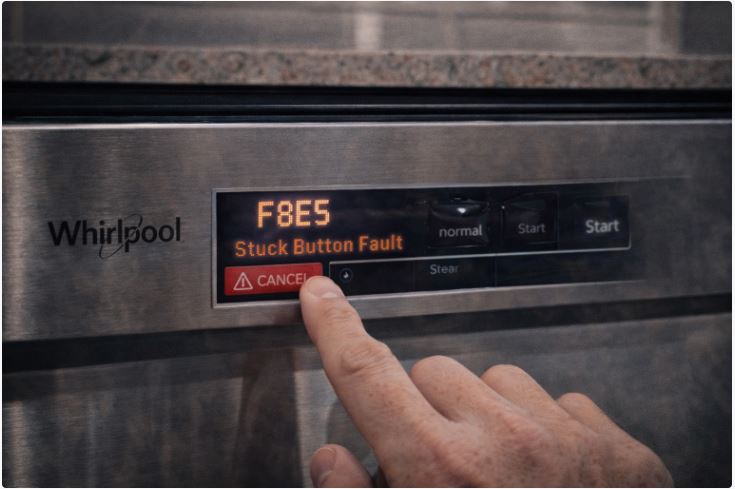
These codes indicate mechanical or electronic issues with control systems.
F8E5 Error: Door Latch Failure
F8E5 signals the electronic control cannot verify the door is properly closed and latched. Cycles cannot start without confirmed door closure for safety reasons.
Troubleshooting Steps: Inspect the door latch mechanism for visible damage, wear, or obstruction. The door should click audibly when closed, indicating the latch engaged properly.
Check door alignment—if the dishwasher shifted or wasn’t installed level, the door may not align correctly with the latch mechanism. Adjust leveling feet to ensure proper door closure.
Verify nothing obstructs the door from closing completely—large items protruding from racks can prevent full door closure even when they’re not obviously blocking the latch.
Electrical Considerations: F8E5 can also indicate the door switch wiring harness disconnected or the switch itself failed. Testing requires verifying electrical continuity in the door switch circuit with a multimeter (View on Amazon).
Whirlpool Dishwasher LED Blinking Pattern Error Codes
Whirlpool dishwashers without digital displays communicate errors through blinking LED light sequences.
Understanding Blink Patterns
Models using LED indicators flash the Clean light in specific patterns representing error codes. The light first flashes the Function code, pauses for 2 seconds, then flashes the Problem code. After a 5-second pause, the pattern repeats.
Example Pattern Interpretation: 6 flashes followed by 1 flash (6-1 pattern) means Function 6 “Inlet Water,” Problem 1 “The electronic control doesn’t detect water entering the dishwasher tub.” This translates to the same issue as E1/F1 codes on display models.
Common Blink Code Translation: 8-1 pattern indicates heating issues—Function 8 relates to temperature systems, Problem 1 signals the temperature sensor (NTC thermistor) failure.
10-5 pattern indicates wash motor problems—the circulation pump isn’t operating correctly.
Count the blinks carefully through several complete cycles to ensure accurate identification. The control console becomes disabled when diagnostic codes are flashing, preventing normal operation until the issue is resolved.
Also Read: LG Dishwasher Error Code List & Fixes
Frequently Asked Questions
What does the F8E4 error code mean on my Whirlpool dishwasher and is it serious?
The F8E4 error is one of the most serious Whirlpool dishwasher codes because it indicates water has been detected in the drip tray or base pan beneath your dishwasher—meaning you have an actual leak somewhere in the system. The flood sensor in the base pan triggers this code to protect your floor from water damage.
When F8E4 appears, the dishwasher immediately begins draining and prevents further operation until the leak is found and repaired. Press Cancel to silence the alarm tone, but keep the door closed and allow the drain pump to run for 15-30 minutes to evacuate water from the base pan.
For recently installed dishwashers, the most common cause is improperly seated rubber washers in inlet hose connections or failure to adequately tighten the 90-degree elbow fitting. For older units, check door seals, inlet hoses, drain hoses, and internal component gaskets. Remove the front kick plate to access the base pan, dry all water completely, then observe where accumulation occurs during the next cycle to identify your leak source.
How do I fix the F9E1 drainage error on my Whirlpool dishwasher?
F9E1 indicates a drainage system obstruction preventing water from properly evacuating from the tub. Start by power cycling the dishwasher—disconnect power for 30 seconds then restore it, as temporary electronic glitches sometimes falsely trigger drainage errors.
Next, run your garbage disposal for 30-60 seconds with cold water flowing, as Whirlpool dishwashers share drain lines with kitchen sinks and disposal blockages prevent proper drainage. The critical step many people miss is verifying the knockout plug was removed from the garbage disposal’s dishwasher inlet port during installation—forgetting this leaves a solid barrier completely blocking drainage.
Clean your dishwasher’s filter assembly at the tub bottom by twisting counterclockwise, lifting out, disassembling, and rinsing thoroughly under warm water to remove trapped food and grease. Inspect the drain hose under your sink for kinks or compression, and verify it maintains proper elevation to prevent siphoning.
If these steps don’t resolve F9E1, the drain pump itself may have failed or become obstructed with debris that passed through the filter.
What’s the difference between E1 and F1 error codes on Whirlpool dishwashers?
E1 and F1 are essentially identical error codes indicating the same water inlet failure—Whirlpool simply uses different code designations across various model series. Both codes mean the dishwasher failed to fill with sufficient water within the expected timeframe, typically indicating the electronic control doesn’t detect water entering the tub.
The troubleshooting approach remains identical regardless of whether your specific model displays E1 or F1. Verify your under-sink water supply valve is fully open, check that household water pressure exceeds the 20 PSI minimum requirement, and inspect the inlet valve filter screen for sediment or mineral buildup.
Clean the small mesh screen inside the water valve connection using an old toothbrush, as accumulated deposits progressively restrict water flow. If basic checks reveal no issues but codes persist, the water inlet valve itself may have failed mechanically and requires replacement.
Some Whirlpool models also display these codes as 6-1 blinking patterns on LED-only control panels, which represents the exact same diagnosis communicated through light sequences rather than alphanumeric displays.
Can I reset my Whirlpool dishwasher to clear error codes or do I need to fix the actual problem?
Resetting your Whirlpool dishwasher clears error codes from memory and resolves issues caused by temporary electronic glitches, but won’t eliminate codes caused by genuine mechanical or electrical failures. To perform a complete reset, disconnect power for 30 seconds—either unplug the unit if it uses a standard outlet, or turn off the circuit breaker if it’s hard-wired.
After restoring power, if the error code immediately returns or reappears within the next few cycles, you haven’t resolved the underlying problem and the code will persist until you address the actual mechanical issue. For example, resetting might clear a false F9E1 drainage error caused by electronic communication problems, but won’t help if your drain pump genuinely failed or your filter is clogged with debris.
Many homeowners waste time repeatedly resetting without fixing causes, allowing minor problems to escalate into major failures. Reset first to eliminate temporary glitches, but if codes recur, use the troubleshooting steps appropriate to your specific error code rather than continuously power cycling.
Why does my Whirlpool dishwasher show F6 error and how urgent is the repair?
The F6 error indicates incoming water temperature is either incorrect or undetectable, occurring when water is colder than -3°C, hotter than 85°C, or when the flow meter cannot verify proper temperature. This prevents optimal cleaning since detergent activation and sanitization depend on appropriate water temperature.
The urgency depends on your usage needs and the root cause. If your water heater is simply set too hot (above 65°C) and triggering F6 codes, this is easily corrected by adjusting your water heater temperature down to 50-60°C. If the issue involves a failed NTC temperature sensor or faulty flow meter, you can temporarily continue using the dishwasher on shorter cycles with cooler water for lightly soiled dishes, though heavily soiled items and proper sanitization require correct heating.
The repair itself typically involves replacing either the temperature sensor or flow meter, which requires moderate technical skill but is within DIY capability for mechanically inclined homeowners. Professional service costs vary but expect $150-300 for sensor replacement including labor, making it worthwhile to attempt basic troubleshooting before calling for service.
Command Your Whirlpool: Error Code Fluency Means Faster Repairs
Whirlpool dishwasher error codes transform from frustrating obstacles into precise diagnostic tools once you understand their meanings and appropriate responses. Each code identifies specific system failures, allowing targeted troubleshooting rather than random parts replacement or expensive diagnostic service calls.
Many codes resolve through simple maintenance you can complete in under 10 minutes—cleaning filters, checking valves, or removing disposal knockout plugs. Even when codes indicate component failures requiring professional repair, understanding what they mean empowers informed decisions about urgency, parts needed, and whether DIY repair makes sense.
Keep this guide accessible for quick reference when display symbols or codes appear. The difference between a five-minute filter cleaning and a $200 service call often comes down to simply understanding your dishwasher’s diagnostic language. Whirlpool engineered these codes to help you—now you’re fluent.

Hi, I’m Barlgan! I created Repair Me Yourself to empower homeowners to tackle appliance repairs with confidence. From decoding error codes to fixing cooling issues, I break down complex repairs into simple, actionable steps that save you time and money.