
If you’ve ever stared at a dead dryer or a refrigerator that won’t cool, you already know the frustration of not knowing where to start. A multimeter changes that. It takes the guesswork out of appliance diagnosis by giving you real, measurable data — whether a component has continuity, whether a circuit is getting voltage, or whether a part has failed entirely.
But walk into any hardware store or browse Amazon and you’ll find multimeters ranging from $10 to over $400. Which one actually makes sense for home appliance work? This guide breaks it down clearly — what to look for, which models stand out, and how to match the right tool to your actual needs.
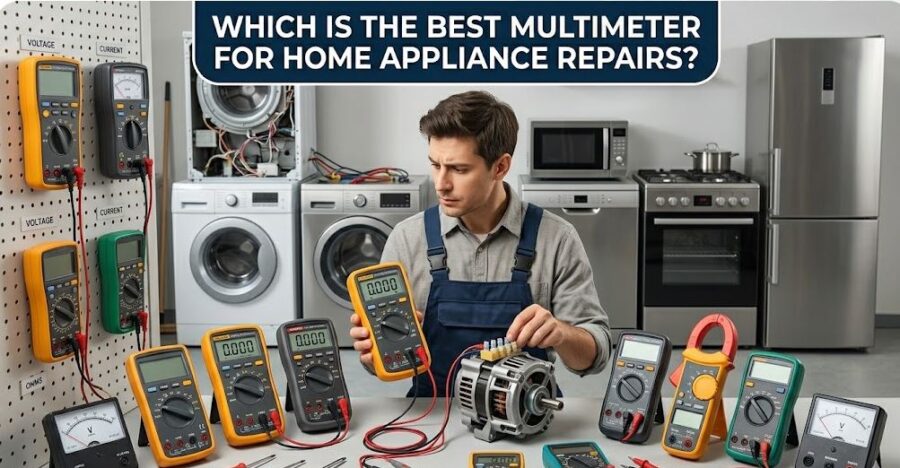
Why a Multimeter Matters for Appliance Repair
Before getting into specific models, it’s worth understanding exactly what a multimeter does in the context of appliance diagnosis — because this shapes which features actually matter.
When an appliance fails, the problem is almost always one of three things: a component that’s no longer conducting electricity (failed continuity), a circuit that isn’t receiving the right voltage, or a part that’s drawing too much or too little resistance. A multimeter tests all three.
Common appliance tests where a multimeter is essential include checking a dryer heating element for continuity, verifying that a washing machine lid switch is functioning, testing a refrigerator defrost thermostat, measuring voltage at an outlet to confirm supply, and diagnosing a dishwasher door latch switch. Without a multimeter, you’re either replacing parts blindly or calling a technician for something you could resolve in 10 minutes.
What to Look for in a Multimeter for Appliance Work
Not all multimeter specs matter equally for home use. Here’s what actually makes a difference.
Safety Rating (CAT Rating)
This is the most important spec most buyers overlook. CAT ratings (Category I through IV) indicate how much transient voltage the meter can safely handle. For home appliance work involving 120V or 240V circuits, you need at minimum a CAT III rating. CAT II is acceptable for low-power testing only. Avoid any multimeter with no visible CAT rating — it’s a sign of poor build quality.
Auto-Ranging vs. Manual Ranging
Auto-ranging multimeters automatically select the correct measurement range for you. Manual-ranging meters require you to set the range yourself before measuring. For most DIYers, auto-ranging is a significant practical advantage — especially when you’re learning or working quickly. Manual ranging is faster once you know what you’re doing, but auto-ranging is more forgiving.
Continuity Beeper
Essential for appliance work. A continuity test tells you whether current can flow through a component — like a thermal fuse, heating element, or switch. The audible beep means you can keep your eyes on the probes rather than the display, which matters a lot when working in tight spaces.
True RMS vs. Average Responding
True RMS meters measure AC voltage accurately even when the waveform isn’t a perfect sine wave — which is the case with many modern appliances that use variable speed motors and inverter technology. For basic appliance work, average responding meters are usually fine. But if you’re testing inverter-driven washing machines, variable speed dryers, or modern refrigerator compressors, a True RMS meter gives you accurate readings where an average responding meter may not.
Display Readability and Backlight
You’ll often be working in dark spaces — behind appliances, inside cabinets, under countertops. A bright, high-contrast backlit display is a genuine quality-of-life feature, not a luxury.
Input Protection and Fusing
A good multimeter has internal fuses that protect it (and you) if you accidentally apply more voltage than the meter is rated for. Check that replacement fuses are available and reasonably priced for any model you consider.
The Best Multimeters for Home Appliance Repair
Here’s a practical guide to eight multimeters currently listed on Amazon, covering a range of budgets and use cases — from budget-friendly home tools to professional-grade meters used by licensed electricians and industrial technicians.
1. KAIWEETS HT208D Digital Clamp Meter Multimeter
KAIWEETS has built a strong reputation as a budget-to-mid-range brand that consistently punches above its price point. The HT208D is a clamp meter-style multimeter — meaning it can measure current without breaking the circuit — making it particularly useful for appliance diagnostics.
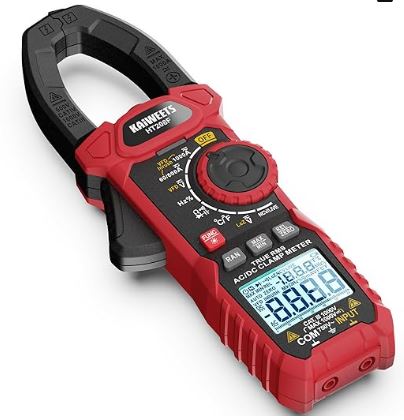
Key features:
- True-RMS, 6,000-count display
- Measures AC/DC voltage, current (up to 1,000A), resistance, capacitance, frequency, temperature, and NCV
- Inrush current measurement — useful for diagnosing motor startups in HVAC, washing machines, and fridges
- Built-in NCV detector and flashlight
- CAT III 600V / CAT IV rated
- VFD mode for accurate readings on variable-speed drives
- 3 AAA batteries included
The clamp form factor means it’s not a traditional handheld multimeter, so users who need milliamp-level measurements or precise component testing may prefer a probe-based unit. For home appliance troubleshooting and current diagnostics, it’s outstanding value.
2. Milwaukee 2216-20NST Digital Multimeter (NIST)
Milwaukee’s 2216-20NST is a heavy-duty professional meter aimed squarely at commercial and industrial electricians. The “NST” suffix is significant — it includes a NIST Certificate of Calibration with Data, which many organizations and contractors require as documented proof of calibration accuracy.
Key features:
- True-RMS measurement
- CAT III 600V rated
- AC voltage 6mV–600V, DC voltage 600mV–600V
- Current to 10A AC/DC
- Resistance 600Ω–40MΩ
- Frequency 10Hz–50kHz, continuity at <30Ω
- Min/Max/Hold functions with digital bar graph
- Black-on-white backlit display
- Rugged over-molded casing, proprietary rail system for accessories
- 5-year Milwaukee warranty
This is not a budget buy — it’s a professional instrument. The NIST certificate commands a premium, and unless your work demands documented calibration, the extra spend may not be necessary for home or light commercial use.
3. Amprobe 37XR-A True-RMS Digital Multimeter
Amprobe is a Fluke-owned brand with over 75 years in the test equipment industry — a meaningful trust signal. The 37XR-A is one of the most feature-complete handheld meters in this group, and a favourite among electronics engineers, avionics technicians, and industrial maintenance professionals.
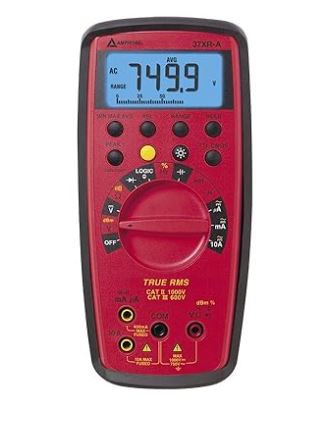
Key features:
- True-RMS, 10,000-count (4½ digit) display with blue backlight
- Measures inductance (up to 40H) — rare in a handheld meter
- Logic and component testing (CMOS and TTL)
- Capacitance up to 400µF, frequency to 40MHz
- dBm measurement for RF and audio work
- DC voltage to 1,000V, AC to 750V, current to 10A
- CAT III 600V / CAT II 1,000V safety rating, UL listed
- Magne-Grip holster, magnetic hanging strap, included alligator clips
- 3-year Amprobe warranty
The lack of temperature measurement is a notable gap versus some competitors. The display is also relatively small. But for electronics troubleshooting, component analysis, and any work involving inductance or RF, this is hard to beat.
4. Greenlee DM-860A Industrial Digital Multimeter
Greenlee is a long-established American brand trusted in professional electrical and utility work. The DM-860A is the most technically sophisticated meter in this group, offering a 500,000-count display in DC voltage mode — well beyond what most multimeters offer — and dual-display capability for simultaneous readings.
Key features:
- True-RMS, 50,000-count dual display (500,000 in DC voltage mode)
- VFD (variable frequency drive) mode for accurate readings on noisy waveforms
- Beep-Jack audible and visual input alert to prevent blown fuses
- 41-segment analog bar graph for fast signal tracking
- Records max, min, avg, and max-min with crest capture
- Dual temperature measurement (two Type K thermocouples) up to 1,832°F / 1,000°C
- Measures resistance, capacitance, frequency, duty cycle, conductance, diode/continuity
- RS-232 PC interface for data logging
- Lifetime limited warranty from Greenlee
- Carrying case, protective boot, and bead temperature probe included
The DM-860A is overkill for casual home use, but for professionals doing panel work, VFD diagnostics, or detailed data logging, it’s a serious instrument that justifies its price. The Greenlee lifetime warranty is a meaningful edge over the competition.
5. UNI-T UT61E+ Digital Multimeter
UNI-T (Uni-Trend) has been manufacturing test equipment since 1988 and is respected in the electronics community, particularly among hobbyists and engineers. The UT61E+ is the top of UNI-T’s UT61 series — a high-resolution, data-logging multimeter that appeals to electronics enthusiasts and bench technicians.
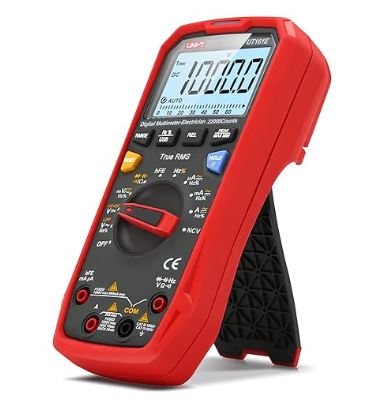
Key features:
- True-RMS, 22,000-count display with analog bar graph
- USB transmission for PC data logging (cable and software included)
- Measures AC/DC voltage up to 1,000V, current to 20A
- Capacitance, frequency up to 220MHz, duty cycle, NCV, hFE transistor testing
- CAT III 1,000V / CAT IV 600V rated
- Lightning-fast continuity buzzer
- Auto-hold, Min/Max, relative mode
- Backlit display
One widely noted limitation: the original UT61E lacked a backlight, though the UT61E+ addresses this. The USB data logging capability is a genuine differentiator at this price point, making it an excellent second bench meter or primary tool for electronics work.
6. Fluke 117 Electrician’s True-RMS Multimeter
Fluke is the gold standard in professional multimeters — trusted by electricians, engineers, and technicians worldwide for decades. The 117 is Fluke’s purpose-built electrician’s meter, and while it’s priced at the premium end of this group, it’s the only meter here that electricians consistently reach for on demanding commercial and industrial sites.
Key features:
- True-RMS for accurate measurement on non-linear loads
- VoltAlert NCV (non-contact voltage) detection built in
- AutoVolt — automatically selects AC or DC measurement
- LoZ (low impedance) mode to eliminate ghost voltage false readings
- CAT III 600V safety rated
- Measures voltage, resistance, continuity, frequency, capacitance, AC/DC current to 10A (20A for 30 seconds)
- Min/Max/Average recording
- Large backlit white LED display
- Compatible with optional ToolPak magnetic hanger for hands-free use
- Fluke 3-year warranty with legendary durability
The 117 lacks temperature measurement (the Fluke 115 has it) and is not designed for low-current electronic work. It doesn’t measure milliamps or microamps. But for electricians doing residential and commercial work, it’s the most dependable option in this lineup.
7. Klein Tools MM720 Auto-Ranging Digital Multimeter
Note: The Amazon link provided resolves to the MM720, not the MM600 — we’ve reviewed the correct listed product. Klein Tools is a respected American brand with over 160 years of history in professional hand tools. The MM720 is an upgraded version of the popular MM600, adding True-RMS measurement — a meaningful step up.
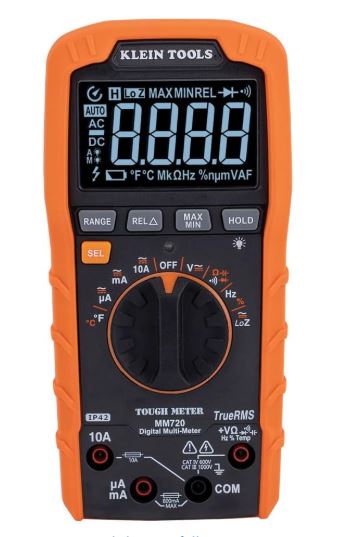
Key features:
- True-RMS, auto-ranging
- Measures AC/DC voltage to 1,000V, AC/DC current to 10A, resistance to 40MΩ
- Temperature, capacitance, frequency, duty cycle, diode test, continuity
- CAT IV 600V / CAT III 1,000V safety rating
- Built to withstand a 2-meter (6.6 ft) drop
- Backlit display, low battery indicator
- Accessible battery and fuse compartment
- Comes with carrying case
Klein’s durability and field-first design make the MM720 a strong choice for electricians and contractors who want a step up from budget meters without Fluke’s premium price. The drop resistance and high safety rating are meaningful for job site use.
8. AstroAI CM600 Inrush Digital Clamp Meter
AstroAI has grown a solid following among DIYers and hobbyists for delivering feature-rich meters at accessible prices. The CM600 is a clamp meter multimeter hybrid — like the KAIWEETS HT208D, it uses a clamp jaw to measure current non-invasively, while also supporting traditional probe measurements.
Key features:
- True-RMS, 6,000-count display
- Measures AC/DC voltage, AC/DC current (clamp), resistance, capacitance, frequency, temperature, NCV
- Inrush current capture — useful for diagnosing motor-driven appliances
- VFD mode and LoZ mode for ghost voltage suppression
- Bright backlit display with built-in work light
- Probe holder for hands-free positioning
- 3 AAA batteries included, 4.5-star Amazon rating from ~100 reviews
Reviewers with trade backgrounds rate it highly for the price, with one automation technician noting it delivers functions that cost far more on professional brands. For occasional home appliance use or as a second meter, it’s a well-rounded buy. Long-term durability data is still limited given its newer vintage.
Comparison Table for the Best Multimeters for Home Appliances on Amazon
| Feature | KAIWEETS HT208D | Milwaukee 2216-20NST | Amprobe 37XR-A | Greenlee DM-860A | UNI-T UT61E+ | Fluke 117 | Klein MM720 | AstroAI CM600 |
|---|---|---|---|---|---|---|---|---|
| Form Factor | Clamp Meter | Probe | Probe | Probe | Probe | Probe | Probe | Clamp Meter |
| True-RMS | ✅ | ✅ | ✅ | ✅ | ✅ | ✅ | ✅ | ✅ |
| Display Count | 6,000 | N/A | 10,000 | 50,000–500,000 | 22,000 | 6,000 | 6,000 | 6,000 |
| NCV Detection | ✅ | ❌ | ✅ (VolTect) | ❌ | ✅ | ✅ VoltAlert | ❌ | ✅ |
| Temperature | ✅ | ❌ | ❌ | ✅ Dual | ❌ | ❌ | ✅ | ✅ |
| Inductance | ❌ | ❌ | ✅ (40H) | ❌ | ❌ | ❌ | ❌ | ❌ |
| Data Logging | ❌ | ❌ | ❌ | ✅ RS-232 | ✅ USB | ❌ | ❌ | ❌ |
| NIST Cert | ❌ | ✅ | ❌ | ❌ | ❌ | ❌ | ❌ | ❌ |
| Safety Rating | CAT III/IV | CAT III 600V | CAT III 600V / CAT II 1kV | CAT III/IV | CAT III 1kV / CAT IV 600V | CAT III 600V | CAT IV 600V / CAT III 1kV | CAT III/IV |
| Warranty | Not specified | 5 years | 3 years | Lifetime | Not specified | 3 years | Limited lifetime | Not specified |
| Brand Pedigree | ✅ Good | ✅ Excellent | ✅ Excellent (Fluke-owned) | ✅ Excellent | ✅ Good | ✅ Industry gold standard | ✅ Excellent | ✅ Good |
| Est. Price | ~$40–60 | ~$250–300 | ~$150–200 | ~$200–280 | ~$50–80 | ~$200–230 | ~$80–100 | ~$40–60 |
Our picks by use case:
- Best for home DIY: AstroAI CM600 or KAIWEETS HT208D — both offer clamp capability, inrush current, and great value for appliance diagnostics
- Best for electricians: Fluke 117 — the professional standard, no debate
- Best for electronics bench work: Amprobe 37XR-A or UNI-T UT61E+ — high count, inductance, and data logging
- Best for industrial/commercial pros: Greenlee DM-860A — dual display, VFD, RS-232, and a lifetime warranty
- Best if you need documented calibration: Milwaukee 2216-20NST — NIST certificate included
How to Use a Multimeter on Common Appliances
Testing a Dryer Heating Element
Unplug the dryer. Access the heating element (typically behind the back panel). Set your multimeter to continuity mode. Touch one probe to each terminal of the heating element. A beep means it’s intact. No beep means it’s open and needs replacing. This test takes about five minutes and saves you from buying parts blindly.
Testing a Refrigerator Defrost Thermostat
Unplug the fridge and locate the defrost thermostat (usually clipped to the evaporator coil). Set to continuity mode. At room temperature, the thermostat should show continuity (beep). If it doesn’t, it’s failed in the open position and needs replacing.
Checking Outlet Voltage
Set your multimeter to AC voltage (VAC), 200V range or auto-range. Insert the black probe into the larger slot (neutral) and the red probe into the smaller slot (hot). A US standard outlet should read 110–125V. A 240V appliance outlet should read 220–250V. Readings significantly outside these ranges point to a supply issue rather than an appliance fault.
Testing a Washing Machine Lid Switch
Unplug the machine and locate the lid switch assembly. Disconnect the switch from the wiring harness. Set to continuity mode. With the switch actuator in the closed position (pressed in), you should get a continuity beep. If not, the switch has failed — a common cause of washers that won’t spin.
Multimeter Comparison: Key Specs Side by Side
| Feature | AstroAI AM33D | Klein MM400 | Fluke 117 | Uni-T UT61E+ |
|---|---|---|---|---|
| Price | ~$18 | ~$50 | ~$150 | ~$60 |
| Auto-Ranging | Yes | Yes | Yes | Yes |
| True RMS | No | Yes | Yes | Yes |
| CAT Rating | CAT III | CAT III | CAT III | CAT III |
| Continuity Beep | Yes | Yes | Yes | Yes |
| Backlit Display | Yes | Yes | Yes | Yes |
| Display Count | 2000 | 4000 | 6000 | 6000 |
| Temperature Probe | No | Yes | No | No |
| VoltAlert Built-in | No | No | Yes | No |
| Best For | Budget starters | Regular DIYers | Frequent use | Accuracy focus |
Frequently Asked Questions
What multimeter do I need for home appliance repair?
For most home appliance work, any auto-ranging digital multimeter with a CAT III safety rating and a continuity beeper will do the job. The AstroAI AM33D is a solid entry-level choice, while the Klein Tools MM400 is a better long-term investment if you plan to use it regularly.
Is a True RMS multimeter necessary for appliance repair?
For most standard appliance tests — continuity checks, basic voltage measurements, resistance testing — a non-True RMS meter is perfectly adequate. True RMS becomes important when testing appliances with inverter motors or variable-speed drives, such as newer washing machines and high-efficiency refrigerator compressors.
Can I use a cheap $10 multimeter on household appliances?
You can, but it carries real risks. Very cheap multimeters often lack meaningful safety ratings and can fail dangerously when exposed to voltage spikes or transient surges — which are common in household circuits. Spend at least $15–20 on a CAT III–rated unit. The price difference is minor; the safety difference is not.
What does continuity mean on a multimeter?
Continuity means there is an unbroken electrical path between two points. When you test a component — like a fuse, switch, or heating element — in continuity mode and the multimeter beeps, current can flow through it. No beep means the component is broken or open, and needs replacing. It’s the most commonly used function in appliance diagnosis.
What is a safe voltage range for a household outlet?
A standard 120V US outlet should measure between 110V and 125V AC. A 240V outlet (used for dryers, ovens, and EV chargers) should read between 220V and 250V AC. Readings consistently outside these ranges suggest a wiring or supply issue that warrants an electrician — not an appliance repair.
Can a multimeter tell me what’s wrong with my appliance?
A multimeter tells you whether specific components are working — it doesn’t interpret symptoms automatically. You use it to confirm or rule out suspected faulty parts one at a time. Combined with error code lookup and a systematic approach, it’s extremely effective. Think of it as your diagnostic instrument, not a self-contained diagnostic system.
How do I know if my multimeter is accurate?
Test it on a known voltage source first — a standard AA battery should read 1.5V DC, a fresh 9V battery should read close to 9V. If your readings are in the right ballpark, the meter is functioning. For appliance work, ±2% accuracy is more than sufficient. If you need higher precision, move up to a 6000-count meter like the Uni-T UT61E+ or Fluke 117.
Also Read:
- What Safety Tools to Use to Fix Home Appliances?
- What are the Best Diagnostic Tools for Home Appliances?
Conclusion
For home appliance repair, you don’t need the most expensive multimeter on the market — but you do need one that’s safe, reliable, and has the right features for the job. A continuity beeper, auto-ranging, and a CAT III safety rating are the non-negotiables.
Start with the AstroAI AM33D if you’re new to this and want to spend as little as possible. Move up to the Klein Tools MM400 if you expect to use it regularly. If you want something that will last for years and handle anything you throw at it, the Fluke 117 is worth every penny.
Whichever you choose, the right multimeter turns appliance troubleshooting from guesswork into a structured, confident process — and that pays for itself the first time you diagnose and fix a problem that would have cost $200 in service fees.
Browse multimeters on Amazon and pick the one that fits your budget and how often you plan to use it.

Hi, I’m Barlgan! I created Repair Me Yourself to empower homeowners to tackle appliance repairs with confidence. From decoding error codes to fixing cooling issues, I break down complex repairs into simple, actionable steps that save you time and money.