
There’s a moment every DIY repairer faces before opening up an appliance — that brief pause where you wonder: is the power actually off? Flipping a breaker feels reassuring, but it’s not a guarantee. Wiring errors, mislabeled panels, and shared circuits mean that assumption alone can get you seriously hurt.
A voltage tester removes that uncertainty entirely. It’s the one tool that stands between you and a potentially dangerous mistake, and yet it’s also one of the cheapest, easiest, and safest tools to use. You don’t need electrical experience. You don’t need to interpret readings. Most voltage testers give you a single, clear answer: live or safe.
This guide covers the different types of voltage testers, which features actually matter for appliance work, and which specific models are worth buying — so you can work confidently and safely every time.

Voltage Tester vs. Multimeter: What’s the Difference?
This is one of the most common points of confusion for new DIYers, so it’s worth addressing directly.
A multimeter measures — it gives you a precise numerical reading of voltage, resistance, or continuity. A voltage tester simply detects — it tells you whether voltage is present, usually with a light, beep, or both. It gives you a yes/no answer rather than a specific number.
For safety checks before touching wiring or terminals, a voltage tester is actually faster and more intuitive than a multimeter. You’re not looking at a screen or interpreting digits — you’re getting an instant, unmistakable signal. Many experienced repair technicians carry both: a voltage tester for quick safety confirmation and a multimeter for detailed diagnostics.
The practical rule: use a voltage tester to confirm it’s safe to proceed, then use your multimeter to figure out what’s wrong.
Types of Voltage Testers Explained
Non-Contact Voltage Testers (NCV)
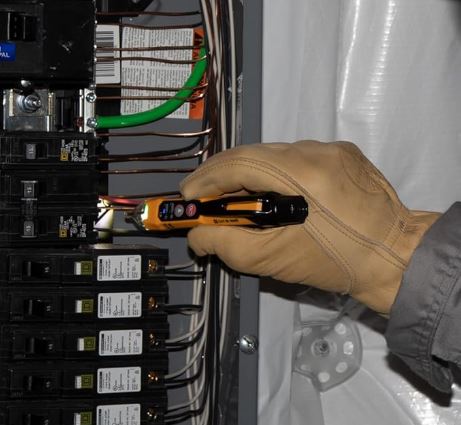
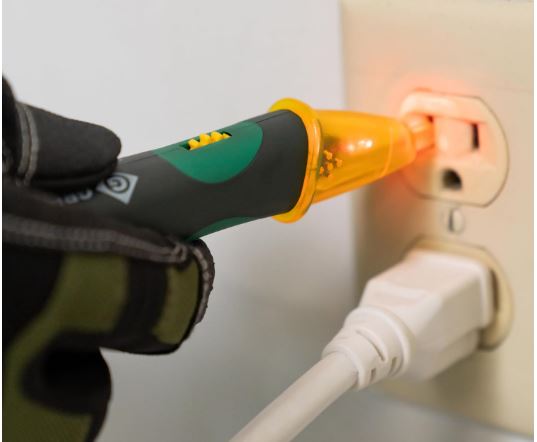
Non-contact testers are the most popular type for DIY use and for good reason. You simply hold the tip near a wire, outlet slot, or terminal — without touching anything — and the tester lights up and beeps if voltage is present. No probes to insert, no contact required.
They work by detecting the electromagnetic field generated by live AC voltage. Most residential models detect from 50V or 90V upward, which covers every standard household circuit. Their key advantage is speed and safety: you can scan a wire bundle or outlet in seconds without any risk of accidental contact.
The limitation is that they only detect AC voltage and can occasionally give false positives near strong electromagnetic fields. They’re not suited for DC voltage detection, which matters if you’re working on battery-powered components.
Contact Voltage Testers (Two-Probe)
Contact testers require you to touch two probes to different points in a circuit to complete the measurement. They can detect both AC and DC voltage and often include continuity testing as well, making them more versatile than non-contact models.
The trade-off is that you’re making physical contact with the circuit, which requires more care. They’re best used after a non-contact tester has already confirmed that no unexpected voltage is present.
Outlet Testers
Outlet testers are purpose-built for a specific job: diagnosing wiring problems at standard household outlets. You plug them in like a device and indicator lights tell you whether the outlet is correctly wired, has a reversed polarity, a missing ground, or an open neutral.
They’re not general-purpose voltage testers, but for appliance repair they serve a useful role — because a misswired or faulty outlet is sometimes the root cause of an appliance behaving unexpectedly. If your appliance powers on intermittently or displays unusual behavior, an outlet tester is a fast first check.
Solenoid Voltage Testers (Wiggy)
The solenoid tester — nicknamed the “Wiggy” — is the old-school standard used by electricians for decades. It works through electromagnetic coils rather than electronic circuitry and is extremely robust and immune to false readings. It draws enough current to confirm voltage is genuinely present rather than just stray capacitance.
They’re less common in consumer DIY kits but remain widely respected among tradespeople. For most home appliance work, a modern NCV tester is more practical.
What to Look for in a Voltage Tester
Detection Range
Standard US household circuits run at 120V or 240V AC. Any tester with an upper range of 600V or higher has you covered. The lower detection threshold matters too — some testers only kick in above 90V, while others detect from 12V or 50V. If you ever work with lower-voltage systems (doorbells, HVAC control circuits, EV charging equipment), a tester with a lower threshold gives you broader coverage.
Audible and Visual Alert
Both matter. An audible beep lets you keep your eyes on your hands and the work area rather than the tester display. A bright LED indicator adds a visual confirmation, especially useful in noisy environments or when wearing ear protection. Models with dual alert — sound and light — are always preferable.
Auto Power-Off
Testers left on drain batteries quickly. Auto power-off after a period of inactivity is a small but practical feature that keeps your tester ready when you need it.
Slim Tip Design
Appliance work often means probing around terminal blocks, behind panels, and through small access points. A slim, tapered tip fits into tighter spaces than a bulky one — and the difference becomes obvious the first time you’re trying to test a terminal buried behind a wiring harness.
CAT Rating
Just like multimeters, voltage testers carry CAT safety ratings. For home appliance and residential electrical work, CAT III is the minimum you should accept. CAT IV is better if it’s available at a similar price.
Battery Indicator
Some models include a low-battery indicator. It sounds minor, but a tester with a dead battery that you assume is working is actively dangerous. Any indication of battery status — even just a self-test LED on startup — adds a meaningful layer of safety assurance.
The Best Voltage Testers for DIY Appliance Repair
Fluke 1AC-A1-II VoltAlert — Best Overall
The Fluke 1AC-A1-II VoltAlert Non-Contact Tester (View on Amazon) is the benchmark non-contact voltage tester that most professionals reach for. It detects AC voltage from 90V to 1000V, has a bright tip LED and loud audible alert, and is built to Fluke’s typically robust standards. The slim pencil design fits easily into tight spaces behind appliance panels.
It powers on automatically when you pick it up and powers off when you set it down — no button to press, no battery drain to worry about. At a budget price, it’s one of the best value safety tools you can own. There’s a reason it appears in the toolkit of electricians, HVAC techs, and experienced DIYers alike.
Klein Tools NCVT-1 — Best Runner-Up
The Klein Tools NCVT-1 Non-Contact Voltage Tester (View on Amazon) is the closest competitor to the Fluke VoltAlert and trades almost identically in terms of features. It detects from 50V to 1000V AC — giving it a slightly lower detection floor than the Fluke — and has a similar slim design with both LED and audible alert.
Klein Tools is a deeply trusted brand in the electrical trade, and the NCVT-1 reflects that pedigree. If the Fluke is out of stock or you find the Klein at a better price, it’s an equal choice for appliance work.
Klein Tools NCVT-3P — Best for Low-Voltage Detection
The Klein Tools NCVT-3P Dual-Range Voltage Tester (View on Amazon) is the upgraded version of the NCVT-1, and its standout feature is detection down to 12V AC — making it useful for low-voltage circuits like HVAC control boards, doorbell transformers, and some appliance control panels that operate below 50V. It also includes a built-in LED flashlight, which is genuinely useful when working in dark appliance cavities.
If your appliance work extends to HVAC systems, smart home wiring, or any low-voltage components, the NCVT-3P is worth the extra $10 over the standard model.
Sperry Instruments STK001 — Best Outlet Tester
The Sperry Instruments STK001 (View on Amazon) is a plug-in outlet tester that immediately diagnoses the most common outlet wiring faults. Three indicator lights cover correct wiring, open ground, open neutral, open hot, hot/ground reversed, and hot/neutral reversed — all in about two seconds.
It’s not a replacement for a full voltage tester, but it’s a fast first-pass check that can save you from misdiagnosing an appliance problem that’s actually an outlet problem. At under $15, it earns its place in any appliance repair kit.
Greenlee GT-16 — Best for Tight Spaces
The Greenlee GT-16 (View on Amazon) has an exceptionally slim tip profile — slimmer than either the Fluke or Klein — which makes it particularly well suited to appliance work where you’re probing around densely packed terminal blocks, pushing through small panel openings, or testing individual wires in a bundled harness. It detects from 5V to 1,000V AC with both audible and visual alerts.
If you find yourself regularly working in cramped appliance interiors, the GT-16 deserves serious consideration over the more common options.
Voltage Tester Comparison: Key Features Side by Side
| Feature | Fluke 1AC | Klein NCVT-1 | Klein NCVT-3P | Sperry STK001 | Greenlee GT-16 |
|---|---|---|---|---|---|
| Type | Non-contact | Non-contact | Non-contact | Plug-in outlet | Non-contact |
| AC Detection | 90–1000V | 50–1000V | 12–1000V | 110–125V | 5V – 1000V AC |
| DC Detection | No | No | No | No | No |
| Audible Alert | Yes | Yes | Yes | No | Yes |
| LED Alert | Yes | Yes | Yes | Yes (3 lights) | Yes |
| Built-in Flashlight | No | No | Yes | No | No |
| Auto Power-Off | Yes | Yes | Yes | N/A | No |
| CAT Rating | CAT III/IV | CAT III | CAT III | N/A | CAT IV |
| Approx. Price | $24 | $20 | $32 | $14 | $38 |
How to Use a Voltage Tester Safely on Appliances
The technique is simple but the habit has to be consistent. Before you open any panel, remove any cover, or touch any wiring inside an appliance, run through this sequence every time.
First, unplug the appliance or switch off the dedicated breaker at the panel. Second, hold your non-contact tester near the power cord at the point where it enters the appliance — if there’s any residual voltage present, it will alert here. Third, once inside the appliance, scan the tester along any visible wiring before touching anything. Fourth, for outlets, plug in your Sperry outlet tester before connecting the appliance to confirm the supply is correctly wired.
The two minutes this process takes are worth it unconditionally. Experienced technicians don’t skip this step — they’re experienced precisely because they never have.
Also Read:
Frequently Asked Questions
What is the best voltage tester for a beginner doing appliance repair?
The Fluke 1AC-A1-II VoltAlert is the best starting point for most beginners. It’s simple to use — no settings, no buttons, no interpretation required — and it’s built to a safety standard that professionals trust. If budget is a constraint, the Klein Tools NCVT-1 is an equally reliable choice at a slightly lower price.
Can a non-contact voltage tester give a false reading?
Yes, and it’s worth knowing when. Non-contact testers can occasionally trigger near strong electromagnetic fields — such as large motors, fluorescent lighting ballasts, or power cables running close together inside walls. If you get an unexpected positive reading, confirm it by testing from a different angle or distance. A genuine live wire will alert consistently regardless of position.
Do I need a voltage tester if I already have a multimeter?
Yes, for safety reasons. A multimeter requires you to insert probes into terminals and read a display — which takes more time and attention than an NCV tester. The voltage tester gives you an instant, hands-free safety check before you start any work. They complement each other rather than replace one another.
What’s the difference between CAT II and CAT III voltage testers?
CAT ratings describe how much transient overvoltage a tool can safely withstand. CAT II is rated for equipment plugged into standard outlets — lower protection. CAT III covers distribution panels, fixed appliance installations, and wiring systems — much higher protection against voltage spikes. For appliance repair involving wiring, terminals, and junction boxes, CAT III is the minimum safe standard.
Can a voltage tester detect DC voltage?
Most non-contact voltage testers only detect AC voltage, because they work by sensing electromagnetic fields that AC generates. DC voltage doesn’t produce the same field, so NCV testers won’t alert to it. If you need to test DC components — such as appliance control boards, sensors, or battery systems — use a contact-type tester or your multimeter set to DC voltage mode.
Is it safe to use a voltage tester on a 240V appliance circuit?
Yes, provided your tester is rated for it. Most quality non-contact testers detect up to 1000V AC, which covers 240V circuits used for dryers, ovens, and air conditioning units comfortably. Always verify your specific tester’s upper voltage range before use and confirm it carries at least a CAT III rating.
How do I know if my voltage tester is working properly?
Most non-contact testers perform a self-test on startup — LEDs flash and the device beeps to confirm it’s operational. You can also do a quick functional check by holding it near a known live outlet slot. If it alerts, it’s working. Make this a habit every time you pick it up — especially if the tester has been sitting unused for a while, as batteries can drain.
Conclusion
A voltage tester is arguably the most important safety tool in any DIY appliance repair kit — not because it’s the most technically sophisticated, but because it protects you before any work begins. No diagnosis, no repair, no part replacement is worth skipping this step.
For most people doing home appliance work, the Fluke 1AC-A1-II or Klein NCVT-1 covers everything you need at a price that makes the decision a no-brainer. If you want low-voltage coverage and a built-in light, step up to the Klein NCVT-3P. Add a Sperry outlet tester to your kit for under $15 and you’ve covered outlet-level diagnosis as well.
The right voltage tester doesn’t slow you down — it gives you the confidence to work faster, because you’re not second-guessing whether it’s safe to proceed.
Browse voltage testers on Amazon and pick the one that fits how and where you work.

Hi, I’m Barlgan! I created Repair Me Yourself to empower homeowners to tackle appliance repairs with confidence. From decoding error codes to fixing cooling issues, I break down complex repairs into simple, actionable steps that save you time and money.