
Opening your Samsung refrigerator to find warm milk and spoiling food is more than frustrating. It’s a crisis that threatens your groceries and demands immediate attention.
The most common reasons a Samsung fridge stops cooling include dirty condenser coils, a failed evaporator fan, defrost system problems, bad door seals, or compressor failure. Most of these issues can be diagnosed and fixed at home with basic tools, though compressor and refrigerant problems require professional help.
If your Samsung refrigerator isn’t cooling properly, don’t panic yet. Many cooling problems have simple solutions that cost little or nothing to fix.
This guide walks you through systematic troubleshooting to identify why your Samsung fridge isn’t cooling. You’ll learn which fixes you can do yourself and when to call a professional.

Quick Diagnostic Table For a Samsung Fridge Not Cooling
| Symptom | Most Likely Cause | Quick Check | Difficulty |
|---|---|---|---|
| Fridge warm, freezer cold | Evaporator fan or damper failure | Listen for fan noise in freezer | Medium |
| Both not cooling | Compressor failure or refrigerant leak | Check if compressor runs | Hard |
| Gradually warming | Dirty condenser coils or worn door seal | Clean coils, test door seal | Easy |
| Fridge cold, freezer warm | Defrost system failure | Check for excessive frost | Medium |
| Intermittent cooling | Bad thermostat or control board issue | Monitor temperature fluctuations | Medium |
| Not cold enough | Incorrect settings or airflow blocked | Adjust settings, check vents | Easy |
Is Your Samsung Fridge Actually Not Cooling?
Before diving into repairs, verify you have a genuine cooling problem versus normal operation or a temporary situation.
Quick Reality Checks
A brand new Samsung refrigerator needs 24 hours to reach proper temperature. Don’t judge cooling performance in the first day after installation or moving.
Recently restocked refrigerators take several hours to cool down warm groceries. Adding 10 bags of room-temperature food temporarily raises internal temperature.
The temperature display on your control panel may not reflect actual internal temperature. Use a refrigerator thermometer placed in a glass of water for accuracy.
Normal refrigerator temperature ranges from 35-38°F for the fresh food section. Freezers should maintain 0-5°F.
If your thermometer shows temperatures within these ranges, your refrigerator is working correctly. You may just need to adjust settings.
Freezer Working But Fridge Not Cooling
This specific symptom dramatically narrows the diagnosis. When the freezer works fine but the fridge stays warm, you’re dealing with an airflow problem.
Cold air is produced in the freezer section. A fan circulates that air into the fresh food compartment.
If the freezer is cold, the cooling system works. The problem lies in air circulation between freezer and fridge.
This symptom points to a failed evaporator fan, blocked air vents, or a broken damper control. We’ll cover these specific issues in detail below.
Why is My Samsung Refrigerator Not Cooling?
Understanding what can go wrong helps you troubleshoot systematically. Here are the main culprits behind Samsung refrigerators that won’t cool.
1. Dirty Condenser Coils (Most Common, Easiest Fix)
Condenser coils release heat from inside your refrigerator to the surrounding air. They’re located on the back or underneath your Samsung fridge.
When dust, pet hair, and debris coat these coils, they can’t release heat efficiently. The refrigerator works harder but cools less effectively.
This is the #1 cause of cooling problems and the easiest to fix. Most people never clean their condenser coils, yet Samsung recommends cleaning them every 6-12 months.
If you have pets, clean condenser coils every 6 months. Without pets, annual cleaning suffices.
2. Evaporator Fan Failure
The evaporator fan sits inside the freezer compartment. It circulates cold air from the evaporator coils throughout both the freezer and refrigerator sections.
When this fan fails, the freezer may still get cold (cold air naturally stays in the freezer), but the refrigerator section stays warm because no air circulates to it.
Signs of evaporator fan failure include a cold freezer with a warm fridge, no air coming from vents, and silence from inside the freezer when the compressor runs.
You can test this yourself by opening the freezer door and listening. You should hear the fan running when the compressor is on.
3. Defrost System Problems
Your Samsung refrigerator has an automatic defrost system that melts frost buildup on the evaporator coils. This system runs several times a day.
When the defrost system fails, frost accumulates on the evaporator coils. Eventually, this frost blocks airflow completely.
The defrost system includes three components: a heater, a thermostat, and a timer or control board. Any of these can fail.
Symptoms include excessive frost in the freezer, especially on the back wall, and gradually declining cooling performance over several days or weeks.
4. Compressor Issues
The compressor is the heart of your refrigerator’s cooling system. It pumps refrigerant through the coils to remove heat.
A failed compressor means no cooling at all. Both the freezer and refrigerator sections will be warm.
Signs of compressor problems include no humming sound from the back of the refrigerator, clicking sounds as the compressor tries to start but fails, or a compressor that runs but produces no cooling.
Compressor replacement costs $400-$800 including labor. On refrigerators over 8-10 years old, this repair often costs more than the refrigerator is worth. In such a case, it’s financially-sensible to get a new refrigerator (View on Amazon).
5. Refrigerant Leak
Refrigerant is the liquid/gas that carries heat out of your refrigerator. The system is sealed and should never lose refrigerant.
A leak in the sealed system allows refrigerant to escape. Without enough refrigerant, the system can’t cool properly.
You usually can’t see refrigerant leaks. Signs include gradually decreasing cooling performance, a compressor that runs constantly, or frost patterns on only part of the evaporator coils.
Refrigerant work requires EPA certification. This is not a DIY repair.
6. Temperature Control Problems
Modern Samsung refrigerators use electronic temperature controls. A thermistor sensor monitors temperature and tells the control board when to run the compressor.
When the thermistor fails, the refrigerator doesn’t know when to cool. This causes erratic temperature control or no cooling.
Control board failures produce similar symptoms. The board is the computer that manages all refrigerator functions.
These problems often show error codes on the display panel. Check your manual for code meanings.
Step-by-Step Troubleshooting Guide
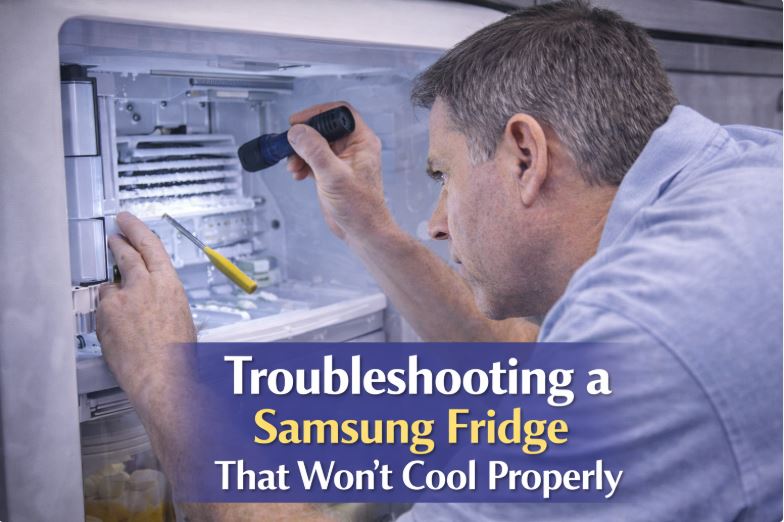
Work through these steps systematically. Don’t skip ahead even if you think you know the problem.
Step 1: Check the Obvious (5 minutes)
Start with the simplest possible causes before assuming major failure.
- [ ] Verify the refrigerator is plugged in securely
- [ ] Check that the circuit breaker hasn’t tripped
- [ ] Ensure temperature settings are correct (not accidentally changed)
- [ ] Verify you’re not in demo mode (display works but cooling disabled)
- [ ] Confirm the door closes completely and latches
- [ ] Check that door seals make contact all around
- [ ] Look inside to ensure vents aren’t blocked by food items
Step 2: Listen and Observe (10 minutes)
Your refrigerator makes specific sounds that indicate whether components are working.
- [ ] Listen for compressor running (humming from back or bottom of fridge)
- [ ] Open freezer and listen for evaporator fan (whooshing air sound)
- [ ] Note any unusual clicking, buzzing, or grinding sounds
- [ ] Verify refrigerator sits level (use a level on top)
- [ ] Open freezer and look for excessive frost buildup on back wall
- [ ] Check if condenser fan runs (underneath or in back, separate from evaporator fan)
Step 3: Temperature Tests (15 minutes)
Use an actual thermometer rather than trusting the display panel.
- [ ] Place refrigerator thermometer in glass of water on middle shelf
- [ ] Place freezer thermometer on top of frozen items
- [ ] Wait 4-6 hours for accurate readings
- [ ] Check multiple locations if readings seem off
- [ ] Document temperature readings and time
- [ ] If you adjusted settings, wait 24 hours before concluding they don’t work
Step 4: Physical Inspection (20 minutes)
Examine components for visible problems.
- [ ] Pull refrigerator out and clean condenser coils (see detailed instructions below)
- [ ] Run your hand around door gaskets feeling for air leaks
- [ ] Perform dollar bill test on door seals
- [ ] Look for frost or ice blocking air vents inside refrigerator and freezer
- [ ] Verify nothing obstructs fan operation
- [ ] Check for water pooling inside (indicates drain problems)
How to Clean Samsung Refrigerator Condenser Coils
This single maintenance task fixes a surprising number of cooling problems. If you haven’t cleaned your coils in over a year, start here.
Why This Matters
Dirty condenser coils are the #1 preventable cause of refrigerator cooling problems. The fix takes 15-20 minutes and costs nothing if you have a vacuum.
Samsung refrigerators with dirty coils work constantly but cool poorly. The compressor overheats and wears out faster.
Pet owners should clean coils every 6 months. Pet hair accumulates rapidly on coils and blocks airflow.
This simple maintenance task can save you hundreds of dollars in repair costs or thousands in premature replacement.
Tools Needed
You need minimal tools for this job. Most homeowners already have everything required.
A vacuum cleaner with a hose and brush attachment removes most debris. Use a soft brush attachment to avoid damaging coil fins.
A coil cleaning brush (View on Amazon) helps dislodge stubborn buildup. This specialized brush is optional but helpful.
A flashlight illuminates the coil area. Coils are usually in dark spaces behind or beneath the refrigerator.
Have a towel or drop cloth ready to protect floors when moving the refrigerator.
Step-by-Step Cleaning Process
Turn off and unplug your refrigerator for safety. Never work on an appliance that’s plugged in.
Locate the condenser coils. On most Samsung models, they’re on the back of the refrigerator behind a panel, or underneath behind the front grille.
Pull the refrigerator away from the wall if coils are on the back. You need access to work comfortably.
Remove any access panels or grilles covering the coils. These usually pull off or have a few screws.
Vacuum loose dust and debris from the coils using gentle pressure to avoid bending the coil fins.
Use the coil brush to dislodge stubborn buildup between coil fins. Work carefully to avoid damage.
Vacuum again after brushing to remove loosened debris. Clean the area around the coils including floor and wall.
Replace any panels or grilles you removed. Push the refrigerator back into position and plug it in.
Wait 24 hours to assess cooling improvement. The refrigerator needs time to stabilize after cleaning.
Testing the Evaporator Fan
If your freezer works but your fridge doesn’t cool, the evaporator fan is the prime suspect. Here’s how to test it.
What It Does
The evaporator fan is inside your freezer compartment. It circulates cold air from the evaporator coils to both the freezer and fresh food sections.
This fan runs whenever the compressor runs. You should hear it operating when you open the freezer door.
Without this fan, cold air stays in the freezer. The refrigerator section receives no cold air and stays warm.
How to Test
Open your freezer door and listen carefully. You should hear a distinct fan noise, like a small motor or whooshing air.
Many Samsung refrigerators have a door switch that turns off the fan when the door opens. Press and hold this switch while the door is open to keep the fan running.
Feel for airflow coming from the vents at the back of the freezer. Strong airflow indicates the fan is working.
If you hear nothing and feel no airflow, the evaporator fan has likely failed or is blocked by ice.
Accessing the Fan
The evaporator fan hides behind a panel inside the freezer. Accessing it requires removing this panel.
Remove all items from your freezer to get clear access.
Locate the screws holding the back panel inside the freezer. Remove these screws and carefully pull the panel forward.
Behind this panel, you’ll see the evaporator coils (the cold metal coils) and the evaporator fan.
Check for ice blocking the fan blades. Heavy frost buildup can prevent the fan from spinning even if the motor works.
If no ice is present but the fan doesn’t spin when you restore power, the fan motor has failed.
When to Replace
Replace the evaporator fan if it won’t run, makes grinding or squealing noises, or has visible damage to the blade or motor.
The part costs $50-$150 depending on your Samsung model. Installation takes 1-2 hours if you’re comfortable with the work.
This is a moderately difficult DIY repair. You’re working inside the freezer near refrigerant lines that you must not damage.
If you’re uncomfortable with this repair, professional installation costs $200-$350 total including the part.
Dealing with Frost Buildup and Defrost Problems

Excessive frost indicates your defrost system isn’t working correctly. This blocks airflow and prevents proper cooling.
Normal vs. Excessive Frost
A thin layer of frost on the evaporator coils is normal. This frost melts during regular defrost cycles.
Excessive frost means a layer of ice coating the entire evaporator coil area. Frost may extend to other freezer walls and block air vents.
If you see heavy frost buildup, your defrost system has failed or isn’t running enough cycles.
Manual Defrost Process
Sometimes manually defrosting your refrigerator is necessary to diagnose problems or restore operation temporarily.
Turn off your refrigerator or unplug it completely.
Remove all food from both refrigerator and freezer. Store perishables in coolers with ice.
Leave all doors open to allow warm room air to melt the ice.
Place towels on the floor to catch water. The defrost drain may not handle all the meltwater.
Use box fans pointed into the freezer to speed defrosting. This cuts time from 24 hours to 6-8 hours.
Never use sharp objects to chip away ice. You’ll damage components or puncture refrigerant lines.
Once all ice has melted, clean the interior thoroughly and dry all surfaces.
Plug the refrigerator back in and turn it on. Wait 24 hours for proper cooling to resume.
If frost returns within a week or two, your defrost system components need repair or replacement.
Testing Defrost Components
The defrost system has three main components that can fail. Testing them requires a multimeter.
The defrost heater is a heating element that melts frost from the evaporator coils. Test it for continuity with a multimeter.
The defrost thermostat monitors temperature and allows the heater to operate only when coils are cold enough. Test it by checking continuity when it’s cold.
The defrost timer or adaptive defrost control board determines when defrost cycles run. This is the most complex component.
When one defrost component fails, technicians often replace all three. This prevents returning for another repair soon after.
Door Seal and Gasket Problems
Worn or damaged door seals let warm air into your refrigerator, preventing proper cooling. This is an easy problem to fix.
How to Test Door Seals
The dollar bill test is the standard method. Close the refrigerator door on a dollar bill so half sticks out.
Try to pull the bill out. You should feel resistance.
If the bill slides out easily, the seal isn’t working properly.
Test all four sides of each door. Seals often fail in just one area, especially corners.
Visual inspection also helps. Look for cracks, tears, warping, or gaps in the gasket material.
Run your hand around the closed door while the refrigerator runs. You shouldn’t feel cold air leaking out.
Cleaning Door Seals
Sometimes dirty or sticky door seals don’t seat properly. Cleaning often fixes this.
Wash door gaskets with warm soapy water. Pay attention to the folds and grooves where dirt accumulates.
Remove any debris stuck in the seal grooves. Food particles or crumbs prevent proper sealing.
Apply a very thin layer of petroleum jelly to the gasket after cleaning. This keeps rubber flexible and improves sealing.
Clean door seals monthly to prevent buildup and maintain good sealing.
When to Replace
Replace door seals if they have visible cracks, tears, or permanent warping that cleaning doesn’t fix.
Failed dollar bill test in multiple locations indicates worn seals that need replacement.
If the gasket pulls away from the door or feels brittle, replacement is necessary.
A fridge door seal replacement (View on Amazon) costs $70-$100 per door for the part. Installation is straightforward for most DIYers.
Compressor Problems and What They Mean
The compressor is your refrigerator’s most expensive component. Understanding compressor problems helps you make smart repair decisions.
Signs of Compressor Failure
- A compressor that won’t start produces no sound at all. The refrigerator is completely silent, and nothing cools.
- A compressor that runs but doesn’t cool makes normal humming sounds but produces no cooling. Both sections stay warm.
- Clicking sounds indicate the compressor trying to start but failing. You’ll hear a click every few minutes as it attempts to start.
- A compressor that gets extremely hot to the touch is failing or overheating. It should be warm but not too hot to touch.
- If your compressor trips the circuit breaker repeatedly, it’s drawing too much power. This indicates serious problems.
Testing the Compressor
Listen for the compressor running. Place your hand on the back of the refrigerator near the bottom where the compressor sits.
You should hear a steady hum and feel slight vibration when the compressor runs. This is normal operation.
Check if the compressor feels warm. A normally operating compressor gets warm but not scalding hot.
If the compressor is silent, check the start relay. This small component sometimes fails before the compressor itself.
Testing compressor electrical components requires a multimeter and some technical knowledge. Many homeowners call professionals at this point.
Compressor Replacement Reality
Compressor replacement costs $400-$800 including parts and labor. This is expensive for a single repair.
Consider your refrigerator’s age before investing in compressor replacement. Refrigerators typically last 10-15 years.
On a 10+ year old Samsung refrigerator, compressor replacement rarely makes financial sense. The repair might cost more than a new refrigerator.
Check warranty coverage before paying for compressor replacement. Some Samsung models have extended compressor warranties.
Temperature Control and Thermostat Issues
Electronic temperature controls can fail, causing erratic cooling or no cooling at all.
Testing Temperature Controls
Adjust the temperature settings warmer and colder while listening for the compressor to respond.
The compressor should start running within a few minutes after you set temperature colder. If nothing happens, controls may have failed.
Verify the display shows your temperature changes. A non-responsive display indicates control board problems.
Wait 24 hours after adjusting settings before concluding they don’t work. Refrigerators change temperature slowly.
Thermistor Problems
The thermistor is a temperature sensor that monitors refrigerator temperature. It sends readings to the control board.
When the thermistor fails, the refrigerator doesn’t know when to cool. This causes erratic temperature control.
Thermistors can be tested with a multimeter for proper resistance at different temperatures. This requires technical knowledge.
The part costs $20-$50 but accessing it can be tricky. It’s often located near the evaporator coils behind panels.
Control Board Failure
The main control board manages all refrigerator functions. When it fails, symptoms vary widely.
Common signs include no response to button presses, error codes displaying, erratic cooling, or complete loss of cooling.
Control boards often fail due to power surges or moisture damage in humid climates.
Replacement costs $200-$400 including labor. Consider refrigerator age before making this investment.
When Refrigerant Is the Problem
Refrigerant leaks require professional repair. EPA regulations prohibit unlicensed individuals from handling refrigerant.
Signs of Refrigerant Leak
- A compressor that runs constantly but produces little or no cooling suggests low refrigerant.
- Hissing or bubbling sounds from the refrigerator indicate active refrigerant leaking.
- Oil residue on refrigerant lines or components appears when refrigerant leaks and carries oil out with it.
- Gradually decreasing cooling performance over weeks or months often indicates slow refrigerant leak.
Why You Can’t DIY This
Federal law requires EPA Section 608 certification to purchase and handle refrigerant. This protects the environment.
Repairing refrigerant leaks requires specialized equipment including recovery machines, vacuum pumps, and leak detectors.
The technician must find and repair the leak before recharging the system. Simply adding refrigerant doesn’t fix anything.
Refrigerant leaks often indicate sealed system failure. This can mean the refrigerator has reached end of life.
Cost Considerations
Professional diagnosis of refrigerant problems costs $100-$200 for the service call.
Leak repair and system recharge costs $300-$600 depending on leak location and refrigerant type.
On refrigerators over 8-10 years old, this repair often exceeds the refrigerator’s remaining value.
Sealed system failures may total more than replacement cost.
Demo Mode and Settings Issues
Sometimes your Samsung fridge isn’t actually broken. Settings problems can mimic serious failures.
Demo Mode (Common Problem)
Demo mode makes the display and lights work but disables actual cooling. Stores use this to display refrigerators without running them.
This mode is sometimes activated accidentally during cleaning or by curious children pressing buttons.
Symptoms include a working display, lights that turn on, but no cooling and no compressor running.
To exit demo mode on most Samsung models, press and hold the “Energy Saver” and “Fridge” buttons simultaneously for 3-5 seconds.
The exact button combination varies by model. Check your user manual or search online for your specific model number.
Other Settings Problems
Power saving modes on some Samsung models reduce cooling to save energy. This can make the refrigerator seem too warm.
Sabbath mode disables most functions including automatic cooling cycles. Check if this mode is active.
Vacation mode sets temperature warmer to save energy when you’re away. Disable this if you’ve returned home.
Child lock can prevent temperature adjustments. Unlock controls to change settings.
Food Loading and Organization Tips
How you load your refrigerator significantly affects cooling performance. Poor organization creates problems.
Common Loading Mistakes
Blocking air vents with food containers prevents cold air circulation. Vents are usually located at the back of the refrigerator and freezer.
Overpacking shelves restricts airflow between items. Cold air needs space to circulate.
Placing hot or warm food directly in the refrigerator forces the compressor to work harder and raises internal temperature.
Using solid containers that block air versus containers that allow air circulation affects cooling efficiency.
Optimal Organization
Keep air vents clear at all times. Don’t push food containers against the back wall where vents are located.
Leave space between items on shelves. Don’t pack things so tightly that no air flows between them.
Cool hot leftovers to room temperature before refrigerating. Or use the rapid cooling method of placing hot containers in ice water first.
Use containers that allow some airflow (View on Amazon). Solid plastic bins can block air circulation when packed tightly.
Organize food logically so you minimize door opening time. Less time with doors open means better temperature maintenance.
Samsung Model-Specific Cooling Issues
Different Samsung refrigerator types have particular vulnerabilities that affect troubleshooting approach.
French Door Models
Samsung French door refrigerators have more cooling problems than other styles. The dual door design lets more warm air in with each opening.
These models often use dual evaporator systems on some models. This means separate cooling systems for refrigerator and freezer.
Fan placement in French door models makes them more susceptible to airflow problems. The fans work harder to circulate air.
If you own a French door Samsung, pay extra attention to door seals and minimize how often you open doors.
Side-by-Side Models
Side-by-side Samsung refrigerators have different airflow patterns than French door models. Cold air distribution works differently.
These models more commonly develop damper control issues. The damper regulates how much cold air flows from freezer to refrigerator.
Ice buildup locations differ in side-by-side models. Frost tends to accumulate in different areas requiring different troubleshooting.
Single Door Models
Single door refrigerators with top or bottom freezers have simpler cooling systems. Fewer components mean fewer potential failures.
These models are generally more reliable and easier to diagnose. Standard troubleshooting procedures work well.
Parts are often less expensive and more readily available for single door models compared to French door units.
DIY vs. Professional Repair Decision Guide
Knowing when to tackle repairs yourself versus calling a professional saves time and money.
DIY-Friendly Fixes
Cleaning condenser coils requires only a vacuum and basic tools. Anyone can do this safely.
Replacing door seals involves removing old gaskets and installing new ones. This is straightforward with patience.
Basic defrosting just requires time and towels. No technical skills needed.
Checking settings, power connections, and performing basic troubleshooting carries no risk.
Temperature adjustments and monitoring are safe for anyone to perform.
Requires Professional Help
Compressor replacement involves refrigerant handling and requires EPA certification. Never attempt this DIY.
Any refrigerant work including leak detection, repair, and recharging must be done by certified technicians.
Control board replacement often requires extensive disassembly and technical diagnosis. Mistakes are expensive.
Sealed system repairs involve brazing refrigerant lines and handling high-pressure systems. These are dangerous DIY attempts.
Complex electrical diagnosis beyond simple continuity testing should be left to professionals.
Cost-Benefit Analysis
| Repair Type | DIY Cost | Professional Cost | DIY Time | Skill Level |
|---|---|---|---|---|
| Clean coils | $0-20 | $100-150 | 30 min | Easy |
| Replace door seal | $50-100 | $150-250 | 1 hour | Easy |
| Evaporator fan | $50-100 | $200-350 | 2 hours | Medium |
| Defrost system | $100-200 | $300-500 | 3 hours | Medium-Hard |
| Compressor | Not DIY | $600-1000 | N/A | Professional only |
| Refrigerant leak | Not DIY | $300-600 | N/A | Professional only |
| Thermistor | $20-50 | $150-250 | 1.5 hours | Medium |
| Control board | $150-300 | $300-500 | 2 hours | Medium-Hard |
Frequently Asked Questions
Why is my Samsung refrigerator not cooling but the freezer is fine?
This specific symptom indicates a problem with air circulation rather than the cooling system itself. The most common causes are a failed evaporator fan that can’t circulate cold air from the freezer to the fridge, blocked air vents preventing airflow, or a broken damper control that regulates cold air flow. Since the freezer works, you know the compressor and refrigerant system are functioning correctly.
How do I reset my Samsung refrigerator?
Unplug your Samsung refrigerator from the wall outlet for 5 minutes to perform a complete reset. This clears the control board and restarts all systems. After plugging back in, wait 24 hours for the refrigerator to stabilize and reach a proper temperature.
How long does it take for a Samsung fridge to get cold?
A new or newly reset Samsung refrigerator takes 24 hours to reach and stabilize at proper operating temperature. After minor repairs or adjustments, wait at least 6-8 hours before judging cooling performance. If you’ve just restocked with room temperature groceries, allow 4-6 hours for the refrigerator to cool everything down.
How do you know if your refrigerator compressor is bad?
Signs of a bad compressor include complete silence with no humming sound, clicking sounds as it tries but fails to start, or running constantly without producing any cooling. The compressor may feel extremely hot to the touch or trip the circuit breaker repeatedly. If both the freezer and fridge are warm while the compressor runs, it’s likely failed internally.
Why does my Samsung fridge cool intermittently?
Intermittent cooling usually indicates a failing component that works sometimes but not consistently. Common causes include a thermistor that sends incorrect temperature readings, a control board with failing circuits, a compressor that overheats and shuts down, or loose electrical connections. This requires systematic testing to identify which component is unreliable.
Can a refrigerator work without a fan?
No, a refrigerator cannot work properly without the evaporator fan. While the freezer might get somewhat cold from natural cold air settling, the refrigerator section will not receive adequate cooling. The fan is essential for circulating cold air throughout the appliance.
How much does it cost to fix a Samsung refrigerator not cooling?
Repair costs vary dramatically by problem. Simple fixes like cleaning coils cost nothing, replacing a door seal costs $50-150 DIY or $150-250 professionally, and evaporator fan replacement runs $200-350 professionally. Major repairs like compressor replacement cost $600-1000, while refrigerant leak repair costs $300-600.
Should I repair or replace my Samsung refrigerator?
Repair makes sense if the refrigerator is under 7-8 years old and repair costs less than 50% of replacement cost. For refrigerators over 10 years old, replacement is usually smarter unless the repair is very inexpensive. Compressor or sealed system failures on refrigerators over 8 years old almost never justify repair costs.
How do I force defrost my Samsung refrigerator?
To force defrost, unplug the refrigerator or turn it off, remove all food, and leave doors open for 6-24 hours until all frost melts. Speed the process by placing box fans pointed into the freezer compartment. Some Samsung models have a forced defrost mode accessible through the control panel, but this varies by model.
Preventive Maintenance to Avoid Samsung Fridge Cooling Problems
Regular maintenance prevents most Samsung refrigerator cooling problems. These simple tasks save money and extend appliance life.
Monthly Checks
Verify temperature settings haven’t accidentally changed. This takes 30 seconds but prevents problems.
Visually inspect door seals while opening and closing refrigerator. Look for visible gaps or damage.
Ensure air vents inside both compartments aren’t blocked by food. Move items as needed.
Listen for unusual sounds when the refrigerator runs. Catching problems early prevents bigger failures.
Every 6 Months
Clean condenser coils thoroughly. This is the single most important maintenance task.
Deep clean the refrigerator interior, removing shelves and drawers to clean underneath.
Perform the dollar bill test on all door seals. Replace any that fail the test.
Verify the refrigerator sits level. Use a level on top to check and adjust leveling feet if needed.
Annually
Schedule a full maintenance inspection. Check all components systematically.
Replace any door seals that show wear even if they still pass the dollar bill test.
Check behind and underneath the refrigerator for issues. Clean the area thoroughly.
Consider professional inspection on refrigerators over 5 years old. A technician can catch developing problems early.
Conclusion
Most Samsung refrigerator cooling problems have fixable causes. Start with the simplest solutions like cleaning condenser coils, checking settings, and testing door seals.
Many issues are completely DIY-friendly with basic tools and patience. Cleaning coils, replacing door seals, and basic troubleshooting save hundreds in service calls.
Know your limits. Compressor replacement and refrigerant work require professional expertise and certification.
Consider your refrigerator’s age when major repairs are needed. On units over 8-10 years old, expensive repairs often cost more than the remaining value.
Act quickly when cooling problems start. Food spoilage happens fast, and small problems become major failures if ignored.
Prevention through regular maintenance is always cheaper than emergency repairs. Clean those coils, check those seals, and your Samsung will reward you with reliable cooling.
Remember that proper maintenance extends refrigerator life significantly. A well-maintained Samsung refrigerator can last 12-15 years or more.

Hi, I’m Barlgan! I created Repair Me Yourself to empower homeowners to tackle appliance repairs with confidence. From decoding error codes to fixing cooling issues, I break down complex repairs into simple, actionable steps that save you time and money.