An LG ice maker not working is usually a setting, a temperature, or a water problem. Your fridge can tell you which of those it is in about ten minutes, and you don’t have to pull it out from the wall to start. Ten minutes is realistic if you own a thermometer. Work in this order: panel, freezer, water, then the test cycle.
Each step removes a suspect instead of adding a part.
I’ve opened a lot of LG ice maker assemblies over the years, and the genuinely failed ones were the minority. The rest were switched off, locked out, too warm, or thirsty. None of that needs a new module.
LG ice maker not working: read the panel before the toolbox
Start at the display.
Two switches can stop production without a single error code on your screen, and both of them live on the panel you’re already looking at. The ice maker has its own on and off command in the menu on most LG fridges. If your display reads ICE OFF, nothing else you do will matter. Turn it back on first.
Control lock is the second trap. A padlock icon on your panel means every key press gets ignored. Hold the lock key for about three seconds and the padlock clears. Check both.
Some models still use a mechanical switch on the ice maker body, usually above or beside the bucket. Slide it to ON and listen for the arm to drop.
Check that the bucket is pushed fully home. A half-seated bin can hold that switch open on some models. Then set Ice Plus if your model has it, because that mode runs your freezer colder and shortens the cycle. It’s useful while you’re testing whether the thing works at all.
You can also toggle the dispenser between cubed ice, crushed ice, and water on that same panel. That setting only changes what comes out of the chute, not whether the tray fills. Ignore it for now.
Freezer temperature decides whether ice forms
An ice maker needs the evaporator plate near 0°F (-18°C) before its thermostat will start a harvest. Warmer than that and the tray fills but never releases, which looks like a dead maker and isn’t.
Freeze first, and judge nothing for a full day.
Set your freezer to 0°F. Then check with a thermometer in the middle of the freezer, not against the door where the reading flatters you. A door reading proves nothing about the plate. What if the freezer reads 0°F and the tray still won’t dump?
Airflow matters as much as the setpoint you typed into the panel. A freezer packed against the vents, or a gasket letting room air in, will hold the box warm for hours while your display still claims everything is fine.
Checking the real temperature takes a thermometer and one night, and it costs less than any part you’d buy by guessing. If your freezer is warm overall, fix that first. An ice maker can’t outrun a compressor problem. A freezer that won’t freeze is a different job with a different price.
The cup test tells you about water
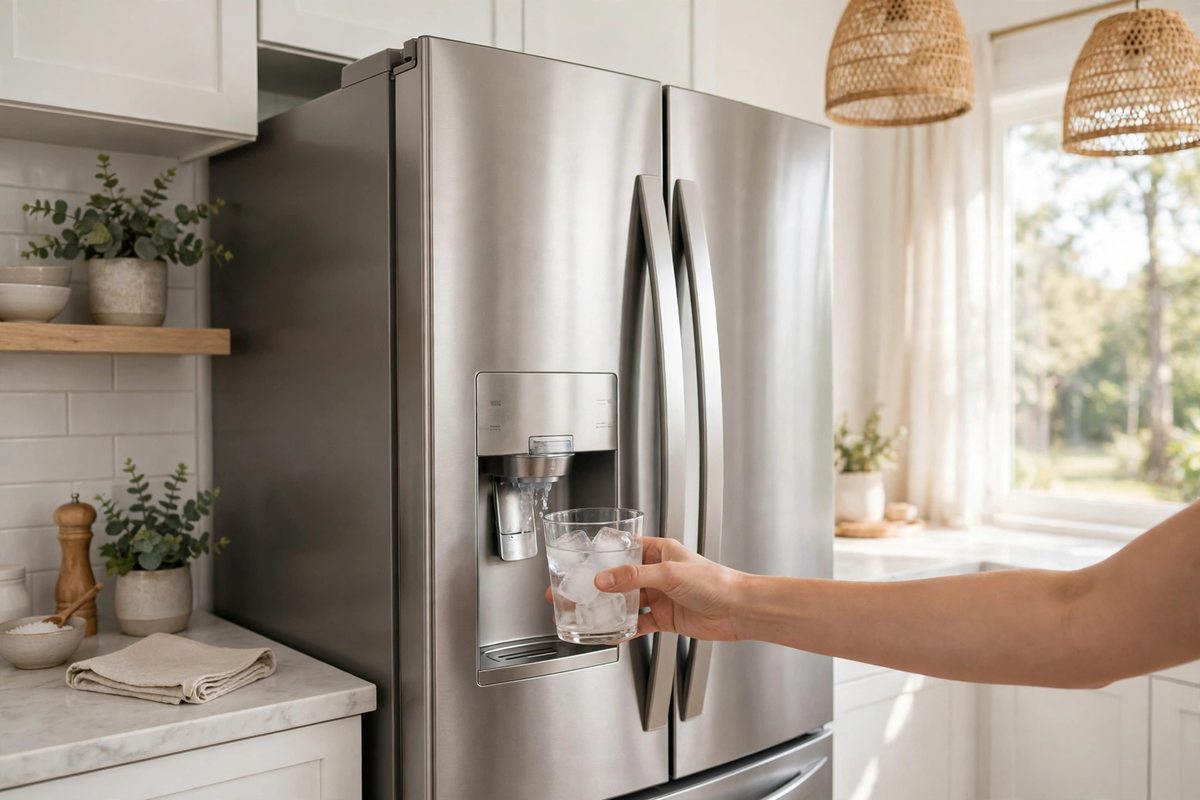
Fill a measuring cup from your door dispenser and time it.
LG’s own benchmark is one cup, eight ounces, in eight to ten seconds. That number beats any spec sheet. Slower than that and your ice maker is trying to fill its tray through a straw.
The tray gets a partial charge, the cubes come out small or hollow, and the harvest jams. A weak flow points at the saddle valve under your sink or a kinked line behind the fridge.
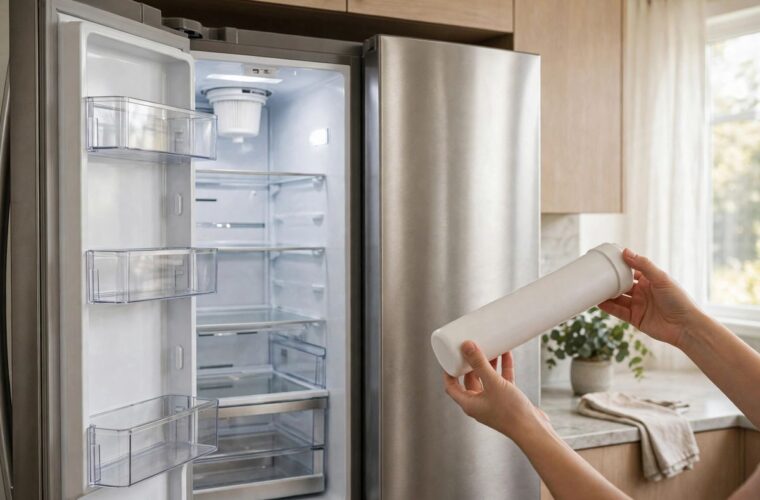
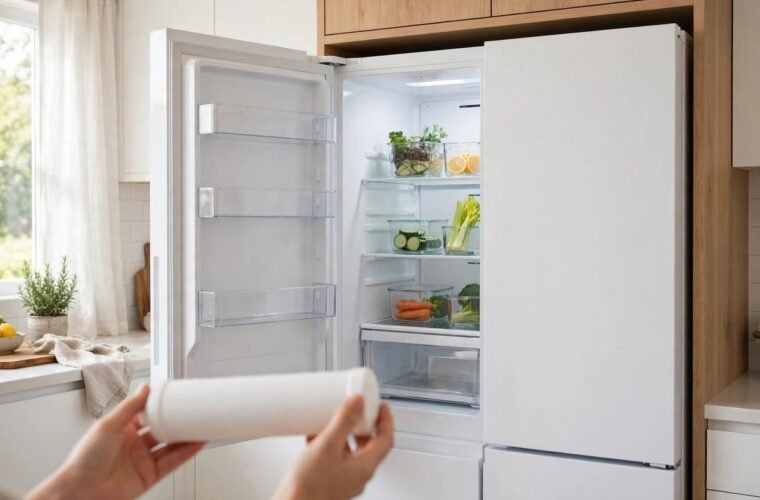
Change the water filter if it’s past six months, then run the dispenser for a minute or two so the line clears before you test anything else. Air in the line makes your valve chatter and the fill short.
Pull the unit out and look before you buy a part. If you have a bypass plug, fit it and retest. That isolates the filter housing from the rest of your supply in one move, and it’s free to try.
Trace the fill path when the cup test passes
Good flow at the dispenser doesn’t prove the ice maker is getting water. The two share a supply line, then split at the inlet valve behind the fridge.
Find that valve, a small dual coil block where the line enters the cabinet on the lower back. One coil feeds your water dispenser, the other feeds the ice maker. Only the second one matters here.
Pull the fill tube where it enters the freezer ceiling and look inside. Look for ice. A tube packed with clear ice means water reached it and froze there, so your valve works and defrost is your problem.
A dry tube points the other way, at the coil, the harness, or the module that commands it.
That’s the one case where you’re buying a part rather than clearing one. Do both checks above before you reach that point.
Run the ice maker’s own test cycle
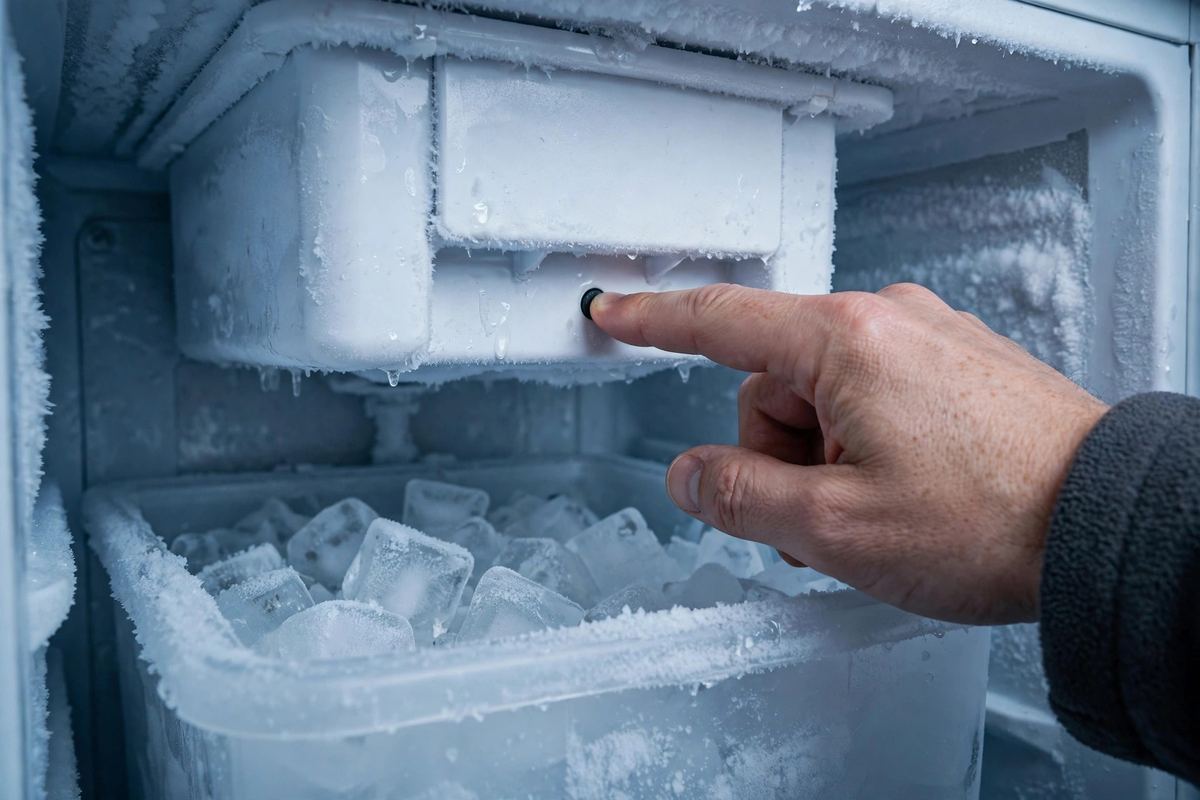
Twist-tray LG ice makers have a small test button on the head of the assembly, sometimes behind a plastic cap. It’s the fastest diagnostic in the whole fridge. No tools needed.
Press and hold it until the tray starts to move, then let go and watch. The cycle twists the tray to dump old cubes and opens the water valve to refill.
Watch two things: whether the tray moves, and whether water arrives. If the tray moves but nothing arrives within about a minute of the twist, the fill never started, and that points at water or a valve rather than the module.
Why does that matter? Those two answers split your fault list in half. One sends you to water, the other to hardware.
| What you see | What it means | Next move |
|---|---|---|
| Tray never moves | Module, thermostat, or no power to the head | Check the harness, then the module |
| Tray twists, no water | Valve, frozen fill tube, or low pressure | Cup test, then the fill tube |
| Water enters, no harvest | Freezer too warm or thermostat lazy | Temperature and airflow |
| Cycles twice, then stops | Board sees a fault it can’t clear | Power cycle, then service |
A fill tube packed with ice is common on models where the tube runs through the freezer ceiling. Defrost it with a hair dryer on low, then check your door seal, because it froze for a reason.
On Craft Ice and dual ice maker models there’s no button you can reach. Reset those at the breaker for a minute instead, then wait a full day before judging the result.
One more thing worth knowing: pressing the test button doesn’t reset a fault on the board. It runs one cycle. If your unit stops again after a single harvest, note how far it got before it quit.
While you have the bin out, press the dispenser paddle and listen for the auger. A silent auger is a separate fault from a tray that won’t fill, so test it once and rule it out.
A new LG that makes no ice yet
New fridges need 24 to 48 hours before the first harvest, and Craft Ice models take a day longer for round ice. Discard your first two or three batches, since they taste of the new line and the new filter.
The clarity settles after that. If nothing at all arrives after two days, run the cup test before you call anyone. A shut-off valve that was never opened is the first thing I check on a new install.
When the ice maker itself has failed
If your tray won’t cycle after a reset and the freezer sits at 0°F, the module is the suspect rather than your water supply, and that means a part swap. Prices vary by model, so price the module before you book a call. Which part do you price first?
An Er IF code on the panel points at the ice maker fan, which is a separate repair from the module itself. Write that code down before you call service, because it saves the tech a visit and you a diagnostic fee.
You can swap the module yourself on most LG fridges, but the harness clip is the part that breaks. Take your time on that clip, because a snapped one turns a cheap fix into a second order.
Before you order, put your model number into LG’s parts search and confirm the module is still sold. A module that’s still in stock ships within days, while a discontinued one sends you to used parts and auction listings, which is where this repair usually stalls.
Clumping points at warm air or a slow leak. Cleaning the bin and checking the door gasket solves more of those than any part will. Cleaning the ice maker covers the bin, the auger, and the chute in one pass.
If water works and ice never comes, the fill side is still the likely culprit. LG’s own ice maker troubleshooting page walks the settings path in order. The water-works pattern has its own checklist, and it keeps you from buying a module you didn’t need.
FAQ
How long should an LG ice maker take to make ice?
A twist-tray LG produces a batch every one to two hours once your freezer is at 0°F, so a full bucket takes most of a day. Craft Ice runs slower by design.
Why is my LG ice maker not working when the water dispenser is fine?
Your supply is proven, so the fault sits after the filter: the fill tube, the inlet valve, or the ice maker’s own fill cycle. Check the tube for ice first.
How do I reset an LG ice maker?
Switch the ice maker off at the panel for a minute, or cut power at the breaker. If your unit has a test button, pressing it runs a harvest and proves the motor turns.
Why are my LG ice cubes small or hollow?
Short fills. Your tray isn’t getting its full charge of water, which comes back to the filter, the inlet valve, or pressure at the saddle valve.
Should I replace the ice maker or call LG?
Replace it if the tray won’t cycle and your freezer is cold. Call service if the board shows a code that returns after a power cycle, since that fault lives outside the module.