
When your LG dishwasher flashes cryptic error codes, it’s trying to tell you exactly what’s wrong—if you know the language. These alphanumeric messages aren’t random technical jargon designed to frustrate you. They’re diagnostic shortcuts that pinpoint specific problems, from simple fixes you can handle in minutes to issues requiring professional attention.
Understanding these codes saves you time, money, and the hassle of unnecessary service calls. Many error codes resolve with straightforward troubleshooting steps you can perform yourself. This guide breaks down every common LG dishwasher error code, explains what triggered it, and provides clear action steps to get your appliance running again.
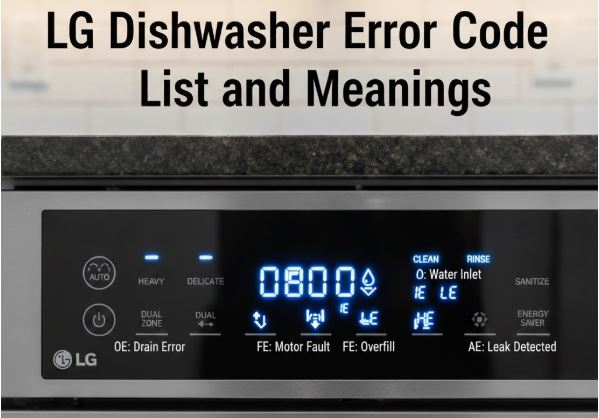
LG Dishwasher Error Codes Quick Reference & Solutions
| Error Code | Problem Type | What It Means | DIY Fix Difficulty |
|---|---|---|---|
| IE | Water inlet failure | Dishwasher not filling with water | Easy – Check supply valve and hoses |
| OE | Drain obstruction | Water not draining properly | Easy – Clean filter and check drain hose |
| FE / AE / E1 | Overfill / Flood detection | Too much water detected in tub or base | Medium – Check for leaks and leveling |
| LE / CE | Motor malfunction | Circulation motor or wiring issue | Medium – Power cycle; may need repair |
| HE | Heating failure | Water not reaching proper temperature | Hard – Likely needs heating element replacement |
| tE | Thermal error | Temperature exceeds safe limits | Hard – Thermistor or relay failure |
| nE | Vario motor issue | Spray arm motor malfunction | Medium – Power cycle; check for obstructions |
| bE | Bubble/suds error | Excessive foam detected | Easy – Using wrong detergent type |
| PF | Power failure | Electrical interruption during cycle | Easy – Simply restart the cycle |
| CL | Control lock | Child lock feature activated | Easy – Hold Dual Zone button 3 seconds |
LG Dishwasher Water Error Codes: IE, OE, and FE Explained
Water-related errors account for the majority of LG dishwasher problems. Understanding the distinction between inlet, outlet, and overfill issues helps you target the right solution.
IE Error: Inlet Water Failure
The IE code appears when your dishwasher fails to fill with sufficient water within 10 minutes of starting. The dishwasher monitors water level through sensors, and when expected thresholds aren’t met, it stops operation to prevent damage from attempting to wash without adequate water.
Common Causes: Water supply valve under your sink is partially or fully closed. Check that the valve handle is turned completely to the open position—it should be parallel with the pipe.
Kinked or bent inlet hose restricts water flow. Trace the supply hose from your water connection to the dishwasher, looking for sharp bends or furniture pressing against it.
Clogged inlet valve filter screen blocks water entry. Sediment and mineral deposits accumulate in the small mesh screen inside the water inlet valve connection.
Step-by-Step Solution: Turn off power to the dishwasher at the circuit breaker. Locate the water shut-off valve under your sink and verify it’s fully open. Inspect the inlet hose for visible kinks—straighten any bends you find.
For the filter screen, shut off the water supply, disconnect the inlet hose from the dishwasher, and examine the small mesh screen inside the valve. If you see debris, carefully clean it with an old toothbrush under running water. Reconnect everything and test.
Water Pressure Considerations: LG dishwashers require household water pressure between 20-120 PSI for proper operation. If your home’s water pressure falls below 20 PSI, the dishwasher cannot fill adequately regardless of valve condition. Low pressure throughout your house indicates a broader plumbing issue requiring professional assessment.
OE Error: Drainage Obstruction
When the OE code displays, your dishwasher detects water remaining in the tub after the drain cycle should have emptied it. The appliance protects itself by halting operation rather than attempting to wash in dirty water.
Primary Troubleshooting Steps: Check your kitchen sink drain and garbage disposal first. Dishwashers typically share the same drain line as your sink. A clogged disposal or sink drain prevents dishwasher drainage. Run your disposal for 30 seconds with water flowing to clear any blockages.
Clean the dishwasher’s internal filter by removing the lower rack and locating the cylindrical filter assembly at the tub bottom. Turn the filter counterclockwise, pull upward, separate the components, and rinse thoroughly under warm water. Food debris and grease accumulation here are the most common OE causes.
Inspect the drain hose under your sink for kinks or blockages. The hose should loop upward in a high position—LG specifies the drain hose end must be over 10 inches above the dishwasher floor to prevent water from siphoning back during fill cycles.
Air Gap Complications: Some installations include an air gap device on your countertop or sink. This small chrome cylinder can become clogged with debris. Remove the cover and clean inside if your system has one.
FE / AE / E1 Errors: Overfill Protection
These related codes indicate the dishwasher detects excessive water—either too much water entered the tub or water leaked into the base cabinet and triggered the flood protection switch.
Immediate Actions: The dishwasher automatically runs the drain pump when these errors appear to remove excess water. Allow this drainage to complete—it protects your kitchen floor from flooding.
Check whether detergent type caused oversudsing. Using regular dish soap instead of dishwasher detergent creates excessive foam that confuses water level sensors. The dishwasher interprets foam as water and triggers overfill protection.
Verify the dishwasher is properly level. An unlevel installation can cause water to pool incorrectly, triggering level sensors prematurely. Use a level tool across the front edge—the dishwasher should be perfectly horizontal.
When Professional Help Is Needed: If no visible water leaked onto your floor but the FE code persists, water may have leaked internally into the base cabinet where the flood switch resides. This requires unplugging the unit, inspecting for leak sources from the water inlet, drain connections, door seals, or internal hoses. These repairs typically exceed DIY comfort levels for most homeowners.
LG Dishwasher Motor and Mechanical Error Codes: LE, CE, and nE
These codes signal problems with the motors and mechanical components that circulate water and control spray patterns.
LE and CE Errors: Circulation Motor Issues
LE and CE are essentially identical—both indicate the circulation motor that powers wash water through the spray arms has malfunctioned or the control board lost communication with the motor.
Quick Reset Procedure: Turn off the dishwasher completely. Flip the circuit breaker powering the dishwasher to OFF and wait 10 full seconds. Return the breaker to ON, power up the dishwasher, and start a new cycle.
This power cycle clears temporary electronic glitches and resets communication between the control board and motor. If the error code disappears and the cycle runs normally, the issue was likely a momentary malfunction.
When Codes Return: Persistent LE or CE errors after power cycling indicate genuine motor failure or wiring harness problems between the motor and main control board. The motor may have failed mechanically, wiring connections may have corroded, or the control board itself malfunctioned.
These scenarios require professional diagnosis with multimeter testing to determine which component failed. Motor replacement is complex, involving partial dishwasher disassembly and electrical work beyond typical homeowner comfort zones.
nE Error: Spray Arm Motor Malfunction
The nE code specifically relates to the vario motor controlling the spray arms rather than the main circulation pump. Some LG models feature variable spray patterns that redirect water pressure between upper and lower racks—the vario motor controls this distribution.
Troubleshooting Approach: Attempt the same power cycle procedure as LE/CE errors. Many nE codes clear after a full reset.
Physically inspect spray arms for obstructions. Remove both upper and lower spray arms by twisting counterclockwise and lifting out. Check that small food particles or mineral deposits aren’t blocking the spray holes or preventing the arms from spinning freely.
Look for foreign objects that may have fallen into the spray arm mechanism—small items like broken glass, toothpicks, or twist-ties can jam the motor. Remove the bottom rack and carefully examine the area around the lower spray arm mount.
LG Dishwasher Temperature-Related Error Codes: HE and tE
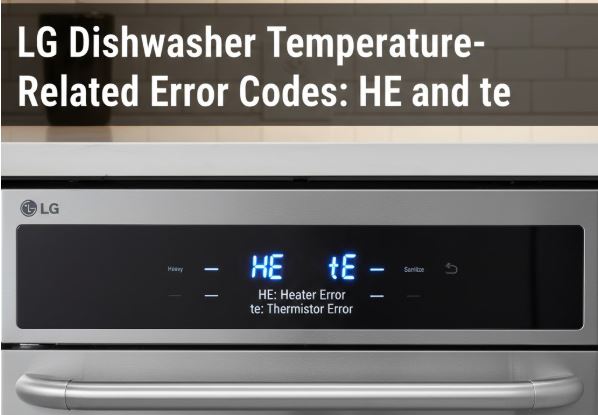
Temperature regulation keeps dishes sanitized and ensures detergent dissolves properly. When heating systems malfunction, these codes alert you to the problem.
HE Error: Heating Element Failure
The HE code means your dishwasher cannot heat water to the programmed temperature, or water temperature failed to rise as expected during the wash cycle. Proper water temperature is crucial—most cycles require temperatures above 120°F, with sanitization cycles exceeding 150°F.
What Causes HE Errors: Failed heating element is the primary culprit. The heating element at the tub bottom physically burns out over time, especially in hard water areas where mineral deposits accumulate on the element surface.
Faulty thermistor prevents accurate temperature readings. Even if the heating element works, a malfunctioning temperature sensor cannot verify when target temperature is reached, triggering the error code.
Wiring issues between the heating element and control board interrupt power delivery. Corroded connections or damaged wires prevent electricity from reaching the element.
DIY Limitations: HE errors typically require professional repair. Accessing the heating element involves removing the dishwasher from its cabinet position, flipping it upside down or on its back, and opening the sealed base. Testing requires a multimeter to check element resistance and thermistor operation.
Heating element replacement itself is straightforward if you can access it, but getting to the component safely challenges most homeowners. Professional technicians have the tools and experience to complete this repair efficiently.
tE Error: Thermal Overheating
The tE code indicates water temperature exceeded 194°F or the thermistor itself failed. This represents a dangerous condition—water shouldn’t reach near-boiling temperatures during normal operation.
Potential Causes: Stuck relay on the control board keeps the heating element continuously powered even after target temperature is reached. The relay should switch off power to the element, but mechanical failure causes it to remain closed.
Defective thermistor sends incorrect temperature readings to the control board. If the sensor reports cold water when it’s actually hot, the board continues heating until safety limits trigger the error.
Safety Implications: The tE error protects both the dishwasher and your dishes from heat damage. Excessive temperatures can warp plastic components, damage electronics, and melt plastic dishes or containers.
This error almost always requires professional service. Control board relay replacement or thermistor replacement involves electrical expertise and specialized testing equipment.
LG Dishwasher Detergent and Sudsing Errors: bE Code
The bE code specifically identifies excessive foam and suds inside the dishwasher tub. Modern dishwashers use minimal water compared to older models, making them extremely sensitive to detergent type and quantity.
Why Sudsing Causes Problems
Excessive foam interferes with water level sensors. The sensors cannot distinguish between actual water and foam, leading to inaccurate level readings that disrupt the wash cycle.
Suds reduce cleaning effectiveness by cushioning the mechanical action and preventing water from directly contacting dish surfaces.
Common Mistakes: Using regular liquid dish soap instead of dishwasher detergent is the most frequent cause. Just a few drops of hand dishwashing liquid (View on Amazon) creates mountains of suds in a dishwasher environment.
Adding too much dishwasher detergent, especially powder formulas in soft water areas, also generates excess foam.
Clearing the Error: Place a bowl containing 4-7 ounces of milk on the upper rack and run an Auto cycle. The milk proteins break down suds naturally, clearing the foam without manual intervention.
For immediate relief, open the dishwasher and use a cup to scoop out visible suds. Add a tablespoon of cooking oil to the water—oil breaks down soap suds chemically.
LG Dishwasher Non-Error Status Codes: Understanding Normal Displays
Not every code indicates a problem. LG dishwashers display informational messages that confuse users who mistake them for errors.
| Display Code | What It Actually Means | Action Needed |
|---|---|---|
| 01-24 (numbers) | Delay start hours remaining | None – informational only |
| 2H, H-01, etc. | Time remaining over 99 minutes | None – cycle in progress |
| dr | Drain mode currently active | None – wait for completion |
| END | Cycle finished successfully | Remove clean dishes |
| CR | Test mode activated | Exit by powering off 1-2 minutes |
| P1, P2, P3, P4 | Custom cycle from ThinQ app | None – running downloaded program |
Delay Start Confusion: Two-digit numbers from 01 to 24 simply count down hours until a delayed cycle begins. This isn’t an error but rather confirmation that you successfully activated the delay start feature. To cancel and start immediately, open the door and press the cancel button combination for your model.
Time Display Format: When cycle time remaining exceeds 99 minutes, LG dishwashers display it differently. The “2H” means more than two hours remaining. Once time drops below 99 minutes, the display switches to actual minute countdown.
How to Properly Reset Your LG Dishwasher
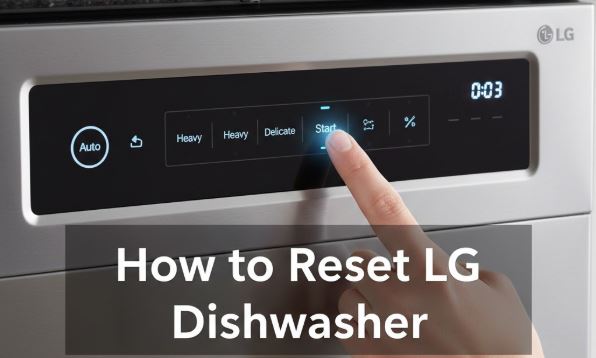
Before calling for service, a complete reset clears many error codes caused by temporary glitches rather than mechanical failures.
Full Reset Procedure: Press the power button to turn the dishwasher completely off. Locate your home’s electrical panel and flip the circuit breaker controlling the dishwasher to the OFF position.
Wait a minimum of 10-15 minutes. This duration allows internal capacitors to fully discharge and the control board to completely reset its memory.
Return the circuit breaker to ON. Power up the dishwasher and select a new cycle. If the error code was caused by a temporary electronic malfunction, it should not reappear.
When Resets Don’t Work: If the same error code returns immediately or within one to two cycles, you’re dealing with a genuine component failure rather than a software glitch. Further troubleshooting or professional service becomes necessary.
Also Read:
Frequently Asked Questions
How do I fix the IE error code on my LG dishwasher when the water supply is fine?
If your water supply valve is fully open and you’re still getting the IE error, the problem likely involves the inlet valve filter screen or improper drain hose installation. Start by disconnecting power and water to the dishwasher, then remove the inlet hose from the water valve connection and inspect the small mesh filter screen inside the valve for sediment or debris buildup—even minor blockages significantly restrict water flow.
Additionally, verify your drain hose installation height meets LG specifications. The drain hose endpoint must be positioned at least 10 inches above the dishwasher floor to prevent water from siphoning out during the fill cycle. If the drain connects lower than this, water drains as fast as it enters, triggering the IE code because the tub never reaches proper fill level. Relocating the drain hose to proper height often resolves mysterious IE errors when all other factors check out correctly.
What’s the difference between FE, AE, and E1 error codes on LG dishwashers?
These three codes are essentially interchangeable and indicate the same fundamental problem—the dishwasher detected excessive water either in the main tub or in the base cabinet where the flood protection switch resides. Different LG model series use different code designations for the same condition, with newer models typically displaying FE while older models show AE or E1.
When any of these codes appear, the dishwasher automatically activates the drain pump to remove excess water and protect your floor from flooding. The causes range from simple issues like using regular dish soap that creates excessive suds confusing the water level sensors, to serious problems like failed water inlet valves that don’t shut off properly, to internal leaks that drip into the base cabinet and trip the flood switch. If you haven’t used wrong detergent and the dishwasher is properly level, persistent FE/AE/E1 codes warrant professional inspection for internal leaks.
Can I fix the LE or CE motor error myself or do I need a technician?
The LE and CE motor errors have two possible outcomes—they’re either temporary electronic glitches that clear with a simple reset, or they indicate genuine motor or wiring failures requiring professional repair. Start with the DIY approach by turning off the dishwasher, flipping its circuit breaker off for at least 10 seconds, then restoring power and starting a new cycle.
If the error disappears and doesn’t return for multiple cycles afterward, you successfully cleared a temporary malfunction and no further action is needed. However, if the LE or CE code reappears immediately or within the next few uses, you’re facing actual motor failure, damaged wiring harness, or control board communication problems.
These repairs require multimeter testing to diagnose which component failed, partial dishwasher disassembly to access the circulation pump motor, and electrical expertise to safely replace components—all of which typically exceed DIY comfort levels and warrant professional service.
Why does my LG dishwasher keep showing the OE error even after cleaning the filter?
Persistent OE errors after filter cleaning usually indicate the problem exists in your home’s drain system rather than the dishwasher itself. The dishwasher drain hose connects to your kitchen plumbing, most commonly to the garbage disposal or sink drain, and blockages in these shared drain lines prevent proper dishwasher drainage.
Run your garbage disposal for 30-60 seconds with cold water flowing to clear any accumulation. If you recently installed a new disposal, verify the knockout plug was removed from the dishwasher inlet port—forgetting this step completely blocks drainage. Check whether your sink drains slowly, which indicates a clog in the main drain line affecting both sink and dishwasher.
Additionally, inspect the drain hose itself for sagging sections that collect water or kinks that restrict flow. Some installations include an air gap device on your countertop that can clog—remove the chrome cover and clean inside. If all these check out fine, the dishwasher’s internal drain pump may have failed or become obstructed, requiring professional service.
What does the HE error mean and how urgent is the repair?
The HE error indicates your dishwasher cannot heat water to the programmed temperature for the selected cycle. This happens when the heating element burns out, the thermistor fails to accurately measure temperature, or wiring problems interrupt power delivery to the heating system. While the dishwasher may continue running cycles, the cleaning results will be significantly compromised without proper heat.
The urgency depends on your usage needs. Cold water washing with modern detergents can handle lightly soiled dishes reasonably well, so if the HE error appears during a busy period, you can temporarily continue using the dishwasher on quick cycles with pre-rinsed dishes until you can schedule professional repair.
However, heavily soiled items, greasy cookware, and proper sanitization all require heated water, so prolonged use with HE errors means inferior cleaning and potential health concerns from inadequate sanitization. The heating element replacement itself is straightforward but requires accessing the sealed dishwasher base, making it a repair most homeowners prefer to leave to professionals who can complete it in 30-45 minutes.
Take Control of Your LG Dishwasher: Error Codes Are Your Ally
LG dishwasher error codes eliminate the guesswork from appliance troubleshooting. Instead of wondering what’s wrong, you receive specific diagnostic information pointing directly to the problem area. Many codes resolve with simple fixes you can handle yourself in under 10 minutes—checking valves, cleaning filters, or power cycling the unit.
Even when codes indicate issues requiring professional service, understanding what they mean helps you make informed decisions. You’ll know whether it’s urgent or can wait, what parts might need replacement, and whether you’re dealing with a minor issue or major repair.
Keep this guide bookmarked for quick reference when codes appear. The difference between a five-minute DIY fix and an unnecessary service call often comes down to simply understanding what your dishwasher is trying to tell you. Your LG dishwasher is communicating clearly—now you speak its language.

Hi, I’m Barlgan! I created Repair Me Yourself to empower homeowners to tackle appliance repairs with confidence. From decoding error codes to fixing cooling issues, I break down complex repairs into simple, actionable steps that save you time and money.