
Gas leaks don’t announce themselves dramatically. There’s no alarm, no visible sign, no sudden change that makes the danger obvious. A slow leak from a corroded fitting behind a gas range, a hairline crack in a flexible connector running to a dryer, a degraded seal on a water heater connection — these develop gradually, silently, and invisibly. The only clue is sometimes a faint sulphur smell that comes and goes, that you notice one day and dismiss the next, wondering if you imagined it.
That uncertainty is the most dangerous part. Gas leaks are detectable long before they become dangerous — but only if you have the right tool and use it systematically. The human nose, despite what people assume, is an unreliable gas detector. It fatigues within minutes of exposure, desensitizes to low concentrations, and can be fooled by other household odours. The mercaptan that utility companies add to natural gas to give it its distinctive smell is detectable by the nose at around 1 part per million — but by the time you can smell it clearly, the concentration in an enclosed space may already be significant.
A dedicated combustible gas detector picks up methane and propane at concentrations an order of magnitude below what the nose can reliably detect. It doesn’t fatigue. It doesn’t get distracted. And it gives you a consistent, objective reading every time. This guide covers everything a homeowner needs to know about gas leak detection tools — how they work, what the specifications mean, which models are worth owning, and how to use them correctly on every gas appliance in the home.
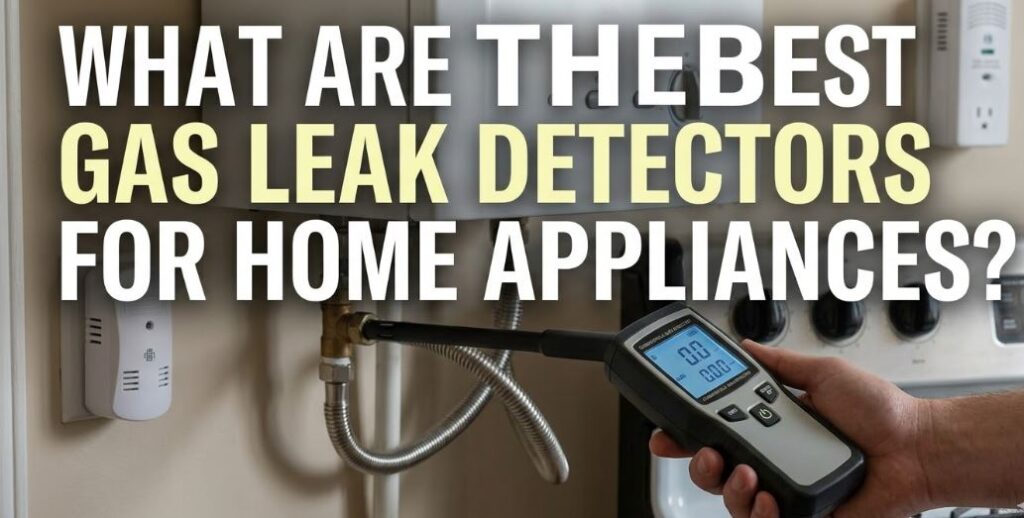
Quick Reference: Best Gas Leak Detectors for Home Appliances
| Gas Detector (View on Amazon) | Gas Types Detected | Sensitivity | Display Type | Response Time |
|---|---|---|---|---|
| UEi Test Instruments CD100A | Methane, propane, natural gas | 50 ppm | LED + audible | <1 second |
| Klein Tools ET120 | Methane, propane, CO | 50 ppm | LED + audible | <1 second |
| Amprobe GSD600 | Methane, propane | 50 ppm | LED + audible | <1 second |
| First Alert CO606 | Gas + CO combo | Alarm threshold | LED alarm | 10–30 seconds |
Why a Dedicated Gas Leak Detector Is Not Optional
There is a tendency among homeowners to treat gas leak detection as something that happens automatically — the smell will alert them, the utility company will investigate, the carbon monoxide detector will catch any problem. Each of these assumptions has a specific and important flaw.
The smell assumption fails because olfactory fatigue is real and rapid. Within three to five minutes of continuous exposure to a low-level gas odour, the human nose loses sensitivity to it. A leak that was faintly detectable when you entered the kitchen becomes imperceptible within minutes — not because the gas has dispersed, but because your detection system has desensitized. Worse, during sleep, smell sensitivity drops dramatically. Low-level overnight gas accumulation from a slow leak may reach dangerous concentrations before any occupant perceives it.
The utility company assumption fails for two reasons. Gas utility companies respond to reported leaks — they don’t proactively inspect individual appliance connections. And a slow leak that doesn’t trigger a neighbour complaint or a gas company alert system can persist for months without anyone outside the household knowing it exists. The homeowner has to initiate the investigation.
The carbon monoxide detector assumption fails on chemistry. Carbon monoxide detectors detect CO — a combustion byproduct — not uncombusted natural gas or propane. A gas leak that hasn’t ignited produces no carbon monoxide. A CO detector is silent in the presence of raw leaked gas. The two tools detect entirely different hazards and neither substitutes for the other.
A combustible gas detector is the only tool that directly detects the gas itself at concentrations below the lower explosive limit — the concentration at which ignition becomes possible. Owning one and knowing how to use it correctly is the most important safety investment a homeowner with any gas appliance can make.
How Gas Leak Detectors Work
Understanding the detection mechanism helps you use the tool correctly and interpret its behaviour accurately — particularly when you get an unexpected reading or no reading in a place where you expected one.
Catalytic Bead Sensors
The most common sensor type in consumer gas detectors is the catalytic bead — also called a pellistor. It contains a small bead of catalytic material that promotes combustion of any flammable gas at temperatures far below the gas’s actual ignition point. When combustible gas contacts the bead, a tiny, controlled oxidation reaction occurs that raises the bead’s temperature. This temperature change alters the electrical resistance of the bead, which the detector’s circuitry measures and converts to an alert.
Catalytic bead sensors are robust, reliable, and responsive — they’re the technology used in industrial gas detection equipment and have a long track record of performance in real-world conditions. Their limitation is that they require oxygen to function — in very oxygen-depleted environments, sensitivity decreases. For home appliance use, this is almost never a relevant constraint.
Semiconductor Sensors
Semiconductor sensors use a metal oxide material — typically tin dioxide — that changes electrical resistance when it absorbs gas molecules. They’re less expensive than catalytic sensors, which is why they appear in lower-cost consumer detectors, but they’re also more prone to false positives from non-gas substances including alcohol, solvent fumes, cooking odours, and aerosol sprays.
For appliance-specific leak detection where you’re working in a kitchen or utility room with various chemical products present, semiconductor sensor false positives are a practical limitation worth knowing about. A detector that alarms when you spray cooking oil nearby, or when you clean with a solvent-based product, loses credibility through false alerts and can cause real leaks to be dismissed as another false positive.
Photoionization Detectors (PID)
Photoionization detectors use ultraviolet light to ionize gas molecules and measure the resulting electrical current. They’re extremely sensitive — capable of detecting gases at parts per billion concentrations — and are used primarily in industrial and environmental monitoring applications. At the consumer level they’re rare and expensive, and their sensitivity is genuinely excessive for home appliance leak detection work. This type isn’t a practical consideration for residential use.
What Specifications Actually Matter for Home Use
Gas detector specifications look similar across products but vary in ways that significantly affect usefulness in residential appliance inspection scenarios.
Sensitivity Threshold
Sensitivity is expressed in parts per million (ppm) — the minimum gas concentration the detector reliably alerts to. The lower explosive limit (LEL) of methane is approximately 50,000 ppm (5% of air volume). A detector that alerts at 50 ppm is detecting gas at 0.1% of the LEL — a tiny fraction of a dangerous concentration, which gives you an enormous safety margin between detection and danger.
Consumer detectors typically alert at 50–300 ppm. Professional detectors reach 10–25 ppm. For home appliance leak detection, 50 ppm sensitivity is appropriate and sufficient — it detects leaks early enough to address them well before any risk of ignition. Detectors alerting only at 300 ppm or above are less useful for finding slow connection leaks where concentration at the source may be low and dissipates quickly in a ventilated space.
Response Time
Response time — the time between gas contact and detector alert — matters for the scanning technique used in appliance inspection. A detector with a one-second response allows you to move the probe slowly around fittings and connections while the alert keeps pace with your movement. A detector with a 10–30 second response requires you to hold the probe stationary at each point for a full count before moving on — which makes a systematic scan of multiple appliance connections tediously slow.
Professional-grade detectors typically respond in under one second. Consumer semiconductor detectors may take 5–30 seconds. For appliance inspection specifically — where you’re scanning multiple fittings on a range, flexible connector, and regulator in sequence — response time is a practical working condition rather than a marginal spec difference.
Probe Design
The probe — the tip of the detector that contacts the air being sampled — determines how precisely you can locate a leak source. A slim, pointed probe can reach the back of a fitting, navigate around a flexible connector coil, and probe into the gap between an appliance and a wall. A wide, blunt probe samples a larger area simultaneously, which reduces localization precision.
For appliance work where you need to determine not just that a leak is present but exactly which fitting among several is the source, a slim probe design is meaningfully better. Some detectors include both a standard probe tip and an extension for reaching behind appliances without moving them — this is a genuine practical feature for checking connections on installed ranges and dryers.
Audible and Visual Alert
Both matter in different ways. An audible alert allows you to keep your eyes on the probe position and the fitting being tested rather than on the detector display — critical for precise localization when you’re moving the probe slowly around a connection. A visual alert — LED lights or a bar graph display — gives you a sense of relative gas concentration rather than just a binary present/absent reading, which helps you locate the highest-concentration point (the actual leak source) within a broader area of gas presence.
Detectors that combine a variable-rate audible alert (faster beeping as concentration increases) with a visual bar graph or LED progression give you both the hands-free convenience of audio and the concentration gradient information of a visual display — the ideal combination for appliance inspection.
Alarm Reset and Sensitivity Modes
Some detectors include selectable sensitivity modes — a high-sensitivity mode for trace leak detection and a lower-sensitivity mode for working in environments with background gas presence (such as a kitchen where small amounts of gas may be present from a burner that wasn’t fully ignited). This mode switching is genuinely useful in practice and distinguishes detectors designed for real-world appliance inspection from those designed for a single alarm-and-evacuate use case.
The Best Gas Leak Detectors for Home Appliance Use
1. UEi Test Instruments CD100A — Best Overall for Home Use
The UEi Test Instruments CD100A (View on Amazon) is the most consistently recommended combustible gas detector for homeowners and DIY appliance repair for a specific combination of reasons that goes beyond its headline specifications. It uses a catalytic bead sensor rather than a semiconductor sensor, which gives it significantly better resistance to false positives from cooking odors, alcohol, and cleaning products — a real-world advantage in kitchen environments where most gas appliance connections are located.
Its sensitivity threshold of 50 ppm and sub-second response time make it practical for slow-scan appliance inspection work. The alert escalates from slow beeping at low concentrations to rapid continuous alarm at higher ones — the variable rate gives you directional information as you move the probe, with faster beeping indicating proximity to the leak source. The slim probe tip accesses tight fitting locations cleanly.
At $35–$50, it sits at the right price point for a tool that should be in every home with gas appliances — expensive enough to be built to a genuine performance standard, accessible enough that cost is not a barrier to ownership. UEi is a test instrument brand with professional trade credentials, which means the CD100A’s performance claims reflect real-world use rather than optimistic laboratory specifications.
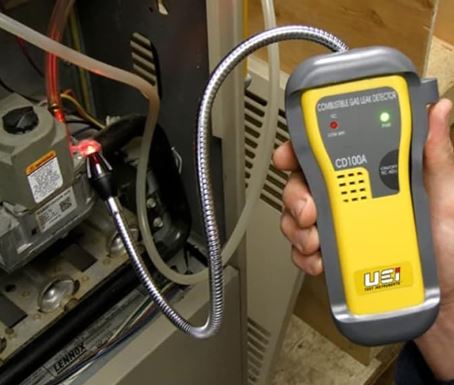
2. Klein Tools ET120 — Best for Dual Gas and CO Detection
The Klein Tools ET120 (View on Amazon) detects both combustible gases (methane and propane) and carbon monoxide in a single instrument. This is its primary differentiator from the UEi CD100A — while neither tool substitutes for a dedicated CO alarm, the ability to check for CO presence during an appliance inspection that’s already motivated by a suspected gas issue adds meaningful diagnostic value in a single pass.
Klein’s build quality is consistent with its broader tool range — the ET120 is more robustly constructed than most consumer gas detectors and the probe design is well suited to appliance inspection work. The LED alert system provides both concentration indication and a clear binary alarm state. For someone who wants a single gas-related tool that covers both combustible gas detection and basic CO presence indication during appliance inspection, the ET120 is the right choice.
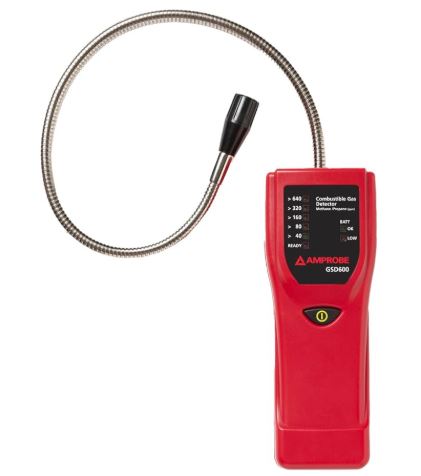
3. Amprobe GSD600 — Best for Sensitivity and Precision
The Amprobe GSD600 (View on Amazon) uses a catalytic sensor with a flexible gooseneck probe — the gooseneck is the key differentiating feature. It can be bent to reach connection points directly behind an installed range, under a dryer, or behind a water heater without moving the appliance away from the wall. For homeowners who work in tight spaces where a rigid probe simply can’t reach the connection being tested, the flexible probe transforms the investigation from impossible to straightforward.
Sensitivity and response time are comparable to the UEi CD100A, and the variable-rate audible alert provides the same concentration-gradient feedback during scanning. The higher price — $55–$75 — is justified if flexible probe access is relevant to your specific appliance installation. If your appliances are easily accessible from the front and sides, the CD100A provides equivalent detection performance at a lower cost.
How to Use a Gas Detector on Home Appliances
The technique used during a gas leak inspection is as important as the tool itself. A detector used incorrectly produces inconclusive results even when a real leak is present.
Pre-Inspection Preparation
Ventilate the inspection area moderately before starting — open a window in an adjacent room, not the room being inspected. Full ventilation disperses any gas that’s present and prevents detection. But zero ventilation in a sealed kitchen or utility room can accumulate background gas concentration from minor normal sources — like a briefly unlit pilot or a burner that wasn’t fully seated — that causes false readings across the entire inspection area.
Turn off all gas appliances before inspecting. An operating burner or pilot flame introduces combustion products that can affect sensor readings and prevents accurate detection at the connection points of that appliance.
Allow the detector to warm up fully before beginning. Most catalytic sensor detectors require 30–60 seconds of warm-up before sensitivity is fully established. Starting the scan before warm-up produces unreliable initial readings.
The Scanning Technique
Hold the probe tip as close to the surface being tested as possible without touching — within 3–5mm of fittings, connections, flexible connector coils, and regulator bodies. Gas leaks at connections are concentrated immediately adjacent to the leak point and disperse rapidly in any air movement. Probing at 20–30mm from the surface in a room with any air movement may miss a real leak entirely.
Move the probe slowly — at around 25mm per second — along the full circumference of each threaded connection, the full length of flexible connector, and across each valve body. A one-second response detector alerts within one probe-diameter of movement past a leak point at this scanning speed. Faster movement risks passing the leak point between detection cycles.
Work from low to high on vertical connections. Natural gas (methane) is lighter than air and rises. Propane is heavier than air and sinks. Scanning upward from ground level to connection height for propane appliances ensures you detect any pooled gas below connection level before reaching the connection itself.
After a Positive Alert
When the detector alerts, stop moving the probe. Slowly retract it 50mm and approach the alert point again from a slightly different angle. The point at which the alert reoccurs with each approach confirms the leak location. Once confirmed, do not operate any electrical switches, do not use a phone, and do not attempt to repair the leak yourself — evacuate, leave doors open as you exit, and call your gas utility’s emergency line from outside the building.
For low-level detections — the detector beeps intermittently rather than continuously alarming — the approach is different. Mark the location with masking tape, ventilate the space fully, wait 10 minutes, and rescan with no air movement. If the detection recurs in the same location, the leak is real. Apply a gas-rated leak detection solution — a soapy bubble solution specifically formulated for gas connections — to the suspected fitting. Bubbling confirms a leak at that specific point and indicates a fitting that needs professional tightening or replacement.
Gas Appliance Inspection Checklist
A systematic inspection covers every gas connection point on every gas appliance in the home — not just the appliance that prompted the investigation. A leak at one appliance often reflects the same age-related degradation affecting all connections installed at the same time.
| Appliance | Connection Points to Check | Specific Areas |
|---|---|---|
| Gas range / cooktop | Supply shutoff, flexible connector, regulator, burner valve bodies | Both ends of flexible connector, full valve body circumference |
| Gas dryer | Supply shutoff, flexible connector | Both threaded ends, connector coil full length |
| Gas water heater | Supply shutoff, flexible connector, draft hood | All threaded connections, relief valve |
| Gas furnace / boiler | Supply shutoff, flexible connector, gas valve body | Valve body, pilot assembly, all threaded joints |
| Gas fireplace | Supply shutoff, flexible connector, valve, pilot | Log lighter connections, valve body |
| Outdoor gas line | All exterior shutoffs, meter connections | Meter inlet, regulator, service connections |
Companion Safety Tools: Building a Complete Gas Safety Kit
A gas leak detector is the primary tool but not the only one relevant to gas appliance safety. A complete home safety kit includes several additional items that address different aspects of the same overall risk.
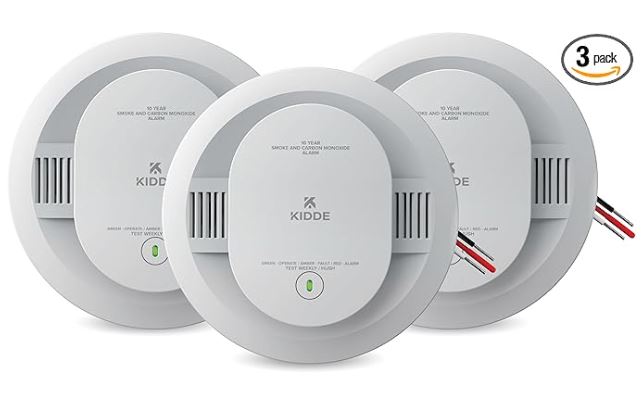
A carbon monoxide detector is a separate and essential safety device that detects CO from incomplete combustion — a different but related gas appliance hazard. The Kidde Smoke and Carbon Monoxide Detector or the First Alert CO606 (View on Amazon) model are both well-regarded options. Every home with gas appliances should have CO detectors on every level.
Gas-rated leak detection solution — a non-corrosive soapy solution in a squeeze bottle, designed specifically for gas fitting inspection — provides visual confirmation of leaks identified by the electronic detector. Rectorseal BIG BLU is a purpose-formulated option available at most hardware stores. Never use standard dish soap, which can corrode brass fittings over time.
A digital manometer — a pressure gauge that connects to a gas line via an appliance connection — allows measurement of gas supply pressure at the appliance, which is useful for diagnosing burner performance problems that may relate to low supply pressure rather than an appliance fault. This is a more specialized tool that’s relevant primarily if you’re investigating burner output issues rather than leak detection.
Frequently Asked Questions
How do I know if I have a gas leak without a detector?
The mercaptan added to natural gas and propane gives them a distinctive rotten egg or sulphur smell that’s detectable by most people at concentrations around 1 ppm. If you smell this odour — even faintly, even intermittently — treat it as a real leak until proven otherwise. Evacuate, ventilate, and call your gas utility from outside. Do not use a gas detector to investigate an odour strong enough to smell clearly — at that concentration, evacuation is the correct response, not investigation.
Can I use soapy water instead of a gas detector?
Soapy water applied to a specific fitting confirms a leak at that point if bubbles form — but only if you already know which fitting to test. It provides no capability for scanning an area to locate an unknown leak. A gas detector is the tool for finding the leak location. Soapy water is the tool for confirming it once found. They serve complementary rather than equivalent functions.
How often should I check my gas appliances for leaks?
An annual inspection of all gas appliance connections using a combustible gas detector is a reasonable minimum maintenance schedule. Additionally, inspect after any appliance move or installation, after any plumbing or utility work that may have disturbed gas lines, after any seismic activity in earthquake-prone regions, and any time you notice even a faint gas odour that wasn’t present previously.
What is the difference between a gas leak detector and a carbon monoxide detector?
A gas leak detector detects uncombusted fuel gas — methane, propane, or LPG — before it ignites. A carbon monoxide detector detects CO, which is a byproduct of incomplete combustion and is produced when fuel gas burns without adequate oxygen. Both are real and distinct hazards from gas appliances, and neither detector substitutes for the other. Every home with gas appliances needs both types of device — a dedicated CO alarm for continuous monitoring and a handheld gas leak detector for periodic appliance inspection.
Are gas leak detectors accurate enough for home use?
Quality catalytic-sensor gas detectors at the 50 ppm sensitivity level are accurate and reliable for home appliance inspection work. Semiconductor-sensor detectors at the budget price point are adequate for obvious leaks but less reliable for trace-level detection and more prone to false positives in kitchen environments. The key is choosing a catalytic-sensor model from a reputable test instrument brand — UEi, Klein, Amprobe, Fluke — rather than an unbranded semiconductor detector where sensitivity and reliability claims may not reflect real-world performance.
What should I do if my gas detector goes off during an inspection?
Stop the inspection immediately. Do not operate any electrical switches including lights — a spark from a light switch in a gas-rich environment can cause ignition. Do not use your phone inside the building. Leave all doors open as you exit to ventilate the space. Call your gas utility’s emergency line from outside and report a suspected gas leak. Let the utility company make the safety determination before re-entering. If the concentration detected was low and intermittent — suggesting a slow connection seep rather than a major leak — the utility company will investigate and advise on whether professional repair of a specific fitting is the appropriate response.
Can a gas leak detector expire or lose accuracy over time?
Yes. Catalytic bead sensors have a service life of approximately 3 to 5 years under normal use conditions. Sensor degradation is gradual and may not produce obvious false readings — an aged sensor may simply become less sensitive, giving you false confidence that no leak is present when trace levels exist. Check manufacturer recommendations for sensor replacement intervals and replace the detector or sensor at the recommended interval regardless of whether it appears to be functioning normally. Some professional-grade detectors support sensor replacement without replacing the entire instrument.
Also Read: What’s the Best Inspection Camera for Home Repairs?
Conclusion
A gas leak is not a dramatic event until it suddenly is. The slow seep from a fitting that was slightly undertightened five years ago, the hairline crack in a flexible connector that developed from repeated vibration, the valve seat that’s degraded enough to allow trace leakage — these are the real-world gas appliance hazards that a combustible gas detector finds before they become emergencies.
The UEi Test Instruments CD100A is the right starting point for most homeowners — catalytic sensor technology, 50 ppm sensitivity, sub-second response, and a slim probe design that covers every gas appliance connection in a systematic annual inspection. Step up to the Klein Tools ET120 if dual gas and CO detection in a single instrument matters to you. Choose the Amprobe GSD600 if a flexible probe is needed to reach behind installed appliances without moving them. Invest in the Fluke 721 if quantitative ppm readings and professional-grade sensitivity are priorities.
Whichever model you choose, the most important thing is to own one and use it. Annual appliance connection inspections with a quality gas detector take less than 30 minutes and provide something that no other tool, no other habit, and no other safety measure can substitute for: objective, reliable confirmation that your gas appliances are not leaking.
That confirmation — or the early warning that lets you act before a situation becomes dangerous — is worth considerably more than the cost of any detector on this list.
Browse gas leak detectors on Amazon and make this the safety investment you don’t delay.

Hi, I’m Barlgan! I created Repair Me Yourself to empower homeowners to tackle appliance repairs with confidence. From decoding error codes to fixing cooling issues, I break down complex repairs into simple, actionable steps that save you time and money.