The average appliance service call in 2026 starts at $125–$175 before a single part is even unboxed. For most homeowners, this “entry fee” is the most frustrating part of a broken dishwasher or dryer. However, modern appliances are designed with modularity in mind. Whether it’s a $15 thermal fuse in a dryer or a $30 drain pump in a washer, the actual fix is often remarkably simple—provided you have the data to identify it.
The barrier to DIY success isn’t usually a lack of mechanical ability; it’s a lack of the right diagnostic and disassembly tools. By investing in five core categories of tools, you can move from “guessing and swapping parts” to “testing and knowing.”
This guide breaks down the five essential appliance repair tools every homeowner should own, how to use them across different appliances, and the specific types of products that offer the best “budget-to-performance” ratio.
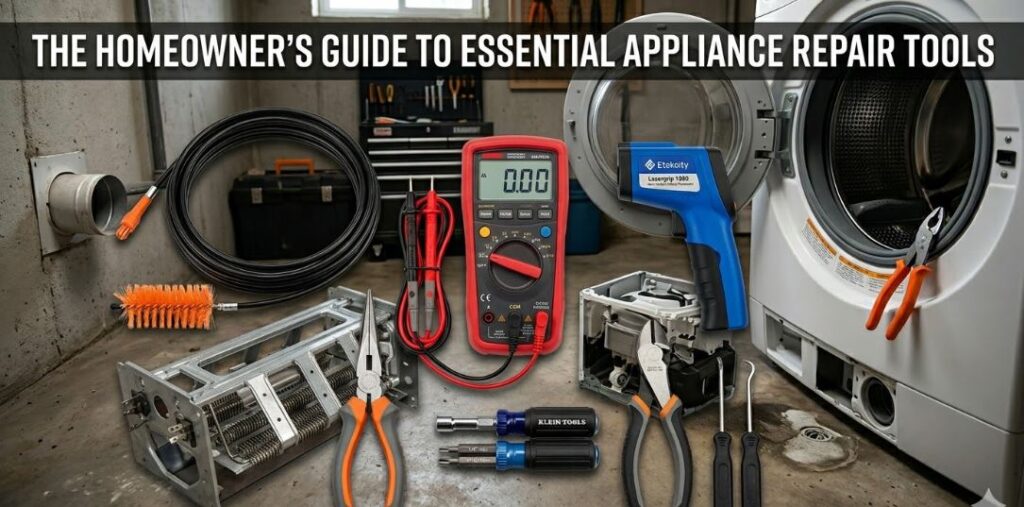
Essential Appliance Repair Tools: At-a-Glance Summary
Before diving into the technical details, use this table to see which tool category solves your specific appliance headache.
| Tool Category | Best For… | Key Appliance Fixes | Approx. Price |
| Digital Multimeter | Electrical “Vitals” | Testing fuses, heating elements, and door switches | $30–$45 |
| Nut Driver Set | Fast Disassembly | Removing rear panels and internal mounting brackets | $15–$25 |
| IR Thermometer | Heat/Cold Accuracy | Checking oven calibration and fridge cooling zones | $16–$25 |
| Flexible Vent Kit | Airflow & Blockages | Clearing dryer vents and washer drain hoses | $10–$18 |
| Pliers & Hook Set | Tight Spaces | Pulling wire terminals and fishing out lost screws | $12–$20 |
1. The Digital Multimeter: The “Brain” of Your Toolkit
If an appliance has a plug, you need a multimeter. This is the only tool that can tell you if a component is “dead” (open circuit) or “alive” (continuous circuit). In appliance repair, we primarily use two settings: Continuity (to see if a fuse or heater is broken) and AC Voltage (to see if the wall outlet or control board is sending power).
Why it’s essential: Without a multimeter, you are “parts cannoning”—buying parts and hoping one fixes the problem. A multimeter allows you to test a $10 lid switch on a washing machine or a heating element in an oven in under 60 seconds.
What to look for:
- Auto-Ranging: The meter chooses the scale for you (essential for beginners).
- NCV (Non-Contact Voltage): Detects electricity through insulation so you can check for “live” wires safely.
- Large Backlit Display: For working in dark corners behind a refrigerator.
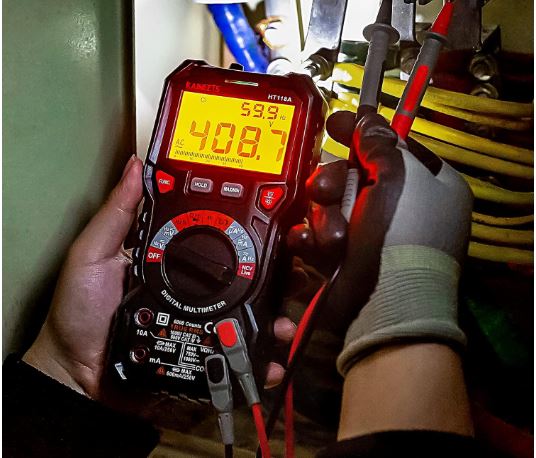
Top Recommendation: KAIWEETS HT118A Digital Multimeter (View on Amazon). This is a standout for DIYers. It features LED-guided ports that light up to show you exactly where to plug in your test leads, virtually eliminating the risk of a “rookie” short circuit.
2. Nut Drivers and Magnetic Bit Sets: The Disassembly Workhorse
Most American-made appliances (Whirlpool, Maytag, GE, Kenmore) are held together by 1/4-inch and 5/16-inch hex-head screws. While you can use a standard wrench, it is slow and frustrating. A dedicated nut driver set allows you to remove back panels and internal brackets in seconds.
Why it’s essential: Appliance screws are often recessed in deep plastic or metal channels where standard pliers or adjustable wrenches cannot reach. A magnetic nut driver prevents you from dropping screws into the “abyss” at the bottom of a washing machine cabinet.
What to look for:
- Hollow Shaft: Allows you to turn a nut even if the bolt it’s attached to is long and sticking out.
- Magnetic Tips: A must-have for one-handed disassembly.
Top Recommendation: Klein Tools 7-in-1 Magnetic Nut Driver (View on Amazon). Instead of carrying seven separate tools, this heavy-duty driver stores all common appliance sizes in one handle. It is a staple for professional technicians.
3. Infrared (IR) Thermometers: No-Contact Temperature Intelligence
A refrigerator that isn’t cooling or an oven that is “burning everything” is often a victim of a faulty sensor or blocked airflow. An IR thermometer allows you to scan surface temperatures instantly without touching potentially dangerous heating elements.
Why it’s essential: You can use an IR gun to “see” where the cold air is entering a fridge. If the back wall is -10°F but the main compartment is 50°F, you know you have an airflow/damper issue, not a coolant leak. In an oven, it helps you identify “hot spots” that indicate a failing bake element.
What to look for:
- 12:1 Distance-to-Spot Ratio: This allows you to get an accurate reading on a small fuse from a foot away.
- Backlit LCD: Essential for reading temperatures inside a dark freezer.
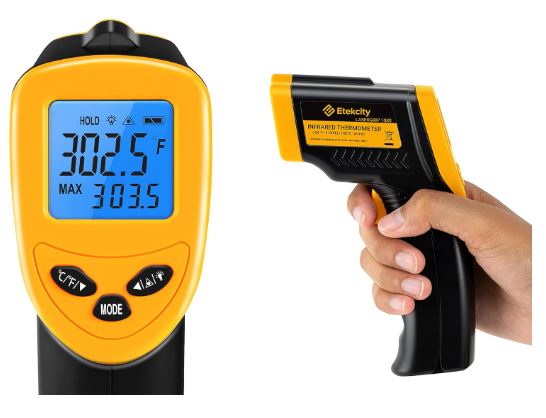
Top Recommendation: Etekcity Lasergrip 1080 Infrared Thermometer (View on Amazon). Accurate, incredibly fast, and rugged enough for a garage environment. It is arguably the highest “value-per-dollar” tool in the home diagnostic category.
4. Flexible Cleaning and Retrieval Tools: The “Zero-Part” Fix
Not every appliance failure requires a new part. In fact, roughly 30% of dryer and washer failures are caused by physical blockages—lint in the vent, a coin in the pump filter, or a “slug” of detergent in a hose.
Why it’s essential: A dryer that takes two cycles to dry is a fire hazard. A washing machine that won’t drain often just has a baby sock caught in the pump. Flexible cleaning rods allow you to clear these blockages yourself, saving a $150 “cleaning fee” from a technician.
What to look for:
- Interlocking Rods: So you can extend the reach up to 30 feet for deep wall vents.
- Power Drill Attachment: Spinning the brush makes it 10x more effective at dislodging compacted lint.
Top Recommendation: Holikme 30 Feet Dryer Vent Cleaner Kit (View on Amazon). This kit includes the drill adapter and high-density brushes needed to clear out the most stubborn obstructions in your dryer or washer drain lines.
5. Specialized Pliers and Hook Sets: The “Small Space” Specialists
Appliances are packed tightly. To replace a water valve or a door spring, you often have to work in a space smaller than your hand. Standard pliers are usually too bulky; you need “reach” and “finesse.”
Why it’s essential: Needle-nose pliers are required to pull stubborn wire terminals off of switches. Hook and pick sets are the “secret weapon” for removing O-rings, aligning screw holes in metal panels, or fishing a lost screw out of a tight corner.
What to look for:
- Long Reach: For grabbing items behind a drum or motor.
- Comfortable Rubber Grips: To prevent hand fatigue when pulling on high-tension springs.
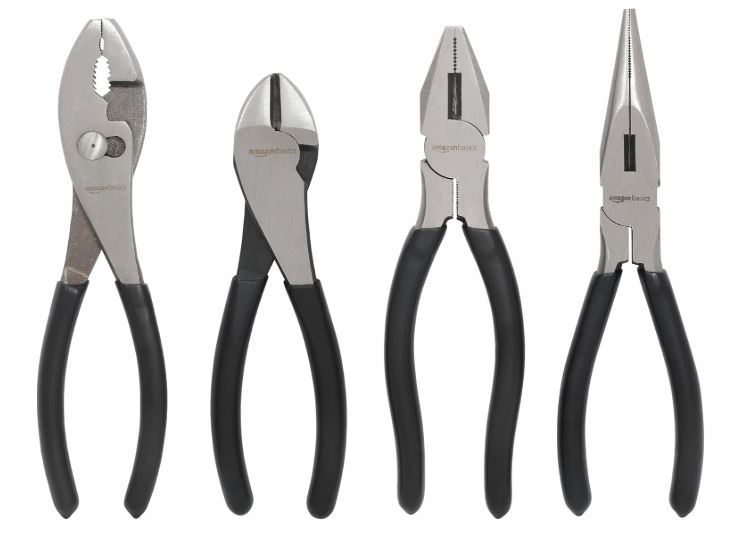
Top Recommendation: Amazon Basics 4-Piece Pliers Set (View on Amazon). This set includes long-nose and diagonal cutters, providing the basic leverage needed for 90% of appliance wire and spring tasks.
Frequently Asked Questions
Which tool should I buy first if I’m on a tight budget?
If you can only afford one tool today, buy the Digital Multimeter. Electrical failures (fuses, switches, elements) account for the vast majority of “sudden” appliance deaths. Without a meter, you are just guessing. The multimeter provides the definitive “Yes/No” answer required to move forward with a repair.
Is it safe to use these tools if I have no electrical experience?
Yes, provided you follow one rule: Unplug the appliance before testing. Most DIY diagnostic tests (Continuity and Resistance) are performed on “dead” circuits using the multimeter’s internal battery. As long as the machine is unplugged, there is no risk of shock during these tests. For voltage testing (live power), we recommend using the Non-Contact Voltage (NCV) feature to stay safe.
Can I use a standard screwdriver instead of a nut driver?
While some appliance screws have a “slot” for a flat-head screwdriver, they are notoriously easy to strip. Nut drivers grip all six sides of the hex head, providing the torque necessary to break loose screws that have been rusted or vibrated tight over years of use. It’s a small investment that prevents a “rounded-off screw” headache.
Do infrared thermometers work on all surfaces?
IR thermometers can struggle with highly reflective surfaces like shiny chrome or stainless steel. To get an accurate reading on a shiny appliance panel, place a small piece of black electrical tape on the surface and aim the laser at the tape. This provides a consistent “emissivity” for a perfect reading.
Also Read:
- Can W-Fi Sensors Really Diagnose Broken Home Appliance?
- What Smart Tools Can Monitor Fridge and Freezer Performance?
Conclusion
Building a home appliance toolkit isn’t about becoming a master electrician; it’s about having the right “keys” to unlock the information hidden inside your machines. By starting with these five categories, you move from being a frustrated bystander to an empowered homeowner who can fix 80% of common failures for the price of a single service call.

Hi, I’m Barlgan! I created Repair Me Yourself to empower homeowners to tackle appliance repairs with confidence. From decoding error codes to fixing cooling issues, I break down complex repairs into simple, actionable steps that save you time and money.