
A squeaking dryer starts as a minor annoyance and quickly becomes the loudest thing in the house. It is hard to ignore, and the problem with ignoring it is that the friction causing the squeak is actively wearing down whatever component is rubbing. What starts as a $15 fix can become a $200 one if left alone long enough.
The location and pattern of the squeak tell you a lot about the source. A squeak from the back of the dryer points to different components than one coming from the front. A squeak that appears only at the start of the cycle points somewhere different than one that runs continuously. Let’s use those clues to find the cause of the dryer squeaking noise and fix it.
Dryer Squeaking Noise Quick Reference
| Where and When It Squeaks | Most Likely Cause |
|---|---|
| Continuous squeak from the back of the dryer | Worn drum rollers or dry roller shafts |
| Squeak from the front during rotation | Worn drum glides or dry idler pulley |
| High-pitched squeal throughout the cycle | Glazed or worn drive belt |
| Squeaking that rises in pitch as drum speeds up | Failing drum bearing |
| Intermittent squeak matching drum rotation | Dry idler pulley or stiff belt section |
| Squeak only from the bottom of the machine | Unlevel feet or loose leveling legs |
What Causes a Dryer to Squeak While Running?
Discussed below are eight issues that could be blamed when your dryer won’t stop producing squeaking noise while running and how to fix them:
1. The Drum Rollers or Roller Shafts Are Dry or Worn
This is the most common source of dryer squeaking, and it almost always originates from the back of the machine.
Drum rollers support the rear of the drum and allow it to spin smoothly. Each roller sits on a small metal shaft. When the rubber on the roller wears down or the shaft loses its lubrication, metal contacts metal and produces a persistent, high-pitched squeak with every rotation of the drum.
A roller squeak tends to be continuous throughout the cycle and gets louder as the dryer heats up and the rubber hardens further from the warmth.
How to Lubricate or Replace Drum Rollers
Unplug the dryer and remove the rear access panel to reach the rollers. Spin each roller by hand and listen for the squeak. A dry shaft often quiets immediately when you apply a small amount of lubrication.
Apply WD-40 Specialist White Lithium Grease (View on Amazon) to the roller shaft rather than the rubber surface. This grease is formulated to handle the heat and load of appliance components without attracting lint or breaking down quickly under temperature cycling. If the rubber rollers themselves are cracked, flattened, or worn smooth, lubrication alone will not fix the squeak and full roller replacement is the correct fix.
2. The Idler Pulley Is Worn or Dry
The idler pulley is a spring-loaded wheel that keeps constant tension on the drive belt. It sits on a small bearing or bushing that allows it to spin freely as the belt moves around it. When that bearing dries out or wears down, the pulley produces a sharp, chirping squeak that is often rhythmic and matches the belt speed rather than the drum speed.
An idler pulley squeak tends to come from the front lower area of the dryer cabinet and is one of the more distinctive squeak sounds because of its rapid, repetitive chirp pattern.
How to Fix a Squeaking Idler Pulley
Unplug the dryer and access the idler pulley from the front or rear panel depending on your model. Spin the pulley by hand and listen for the squeak. A dry pulley often squeaks clearly during this test.
Apply a small amount of WD-40 Specialist White Lithium Grease to the pulley bearing. If the pulley wobbles on its shaft or grinds when spun by hand rather than just squeaking, the pulley bearing has failed and the full assembly needs replacement (View on Amazon).
3. The Drive Belt Is Glazed or Worn
A drive belt that is wearing out does not always snap cleanly. Instead, it often develops a glazed, hardened surface from heat and friction that causes it to squeal or squeak as it slips slightly against the pulleys rather than gripping them cleanly.
A belt squeak tends to be a continuous, high-pitched squeal rather than a rhythmic chirp. It sometimes comes with a faint burning rubber smell when the belt is slipping badly enough to generate heat against the pulley surface.
How to Inspect and Replace a Glazed Belt
Unplug the dryer and access the belt through the front or rear panel. Run your fingers along the entire length of the belt and look for glazed sections that appear shiny and hardened rather than matte and flexible. Also check for cracking, fraying, or stiff spots anywhere along the belt.
A belt showing any of these signs is approaching failure and should be replaced before it snaps entirely, which leads directly to the drum-not-turning problem covered in our post on dryer drum not turning but motor runs.
Check out replacement dryer belts on Amazon!
4. The Drum Glides Are Worn Down
Drum glides are the plastic or nylon pads lining the front of the drum opening where the drum edge rests against the front bulkhead. They allow the drum to slide smoothly during rotation. When they wear thin, the drum edge starts dragging directly against the cabinet, producing a scraping squeak that runs continuously throughout the cycle.
A drum glide squeak tends to come from the front of the machine rather than the rear. It often sounds slightly lower-pitched than a roller or pulley squeak and may have a faint scraping quality to it rather than a clean high-pitched tone.
How to Inspect and Replace Drum Glides
Unplug the dryer and open the front panel to inspect the glide pads. Worn glides look flat, shiny, and compressed in sections rather than uniformly thick. In severe cases, bare metal contact marks are visible on the front bulkhead.
Since the front panel is already open during this repair, it makes excellent sense to inspect and replace the belt and idler pulley at the same time.
5. The Drum Bearing Is Failing
The drum bearing sits at the very center of the rear drum wall and supports the back of the drum on its central shaft. When it wears out, the drum wobbles slightly on its axis and the bearing produces a deep, grinding squeak that intensifies noticeably as spin speed increases.
A bearing squeak is one of the more serious causes on this list because it indicates the drum is no longer properly supported. Continued use accelerates wear on every other drum support component simultaneously.
How to Diagnose a Failing Drum Bearing
Open the dryer door and spin the drum slowly by hand with the machine unplugged. A failing bearing produces a grinding or squeaking sensation even at slow, hand-powered rotation speed. The noise gets clearly worse as you increase the rotational speed.
Also push and pull on the back wall of the drum. A small amount of play is normal, but excessive movement that makes a grinding sound points directly to the bearing. Bearing replacement is more involved than roller or glide repair and on older machines it is worth comparing the cost against the machine’s remaining lifespan.
6. The Dryer Is Not Level
An unlevel dryer vibrates unevenly during operation, causing the cabinet to rub against nearby surfaces and the internal drum support components to carry uneven loads. This friction produces a squeaking that can sound like it is coming from inside the machine when it is actually the cabinet or the stressed feet.
Unlevel feet also accelerate wear on rollers, glides, and bearings by loading one side of the drum more heavily than the other during every cycle.
How to Level the Dryer
Place a spirit level on top of the machine and check it both front-to-back and side-to-side. Adjust the four leveling feet by hand or with a wrench until the bubble sits perfectly centered in both directions. Tighten the locking nut above each foot firmly to hold the position against vibration.
Add Anti-Vibration Dryer Pads (View on Amazon) under all four feet after leveling. They grip smooth floors far better than bare rubber feet, prevent the machine from shifting back out of level over time, and eliminate cabinet-to-floor friction squeaks entirely on tile and hardwood surfaces.
7. A Foreign Object Is Caught Between the Drum and the Door Seal
Small items that survive the wash cycle, coins, buttons, bra underwires, and zip ties, sometimes get trapped in the gap between the drum edge and the front door seal. As the drum rotates, the trapped object produces a rhythmic squeaking or scraping sound that changes pitch as the drum speed changes.
This cause is easy to rule in or out quickly and costs nothing to fix if that is the problem.
How to Find and Remove a Trapped Object
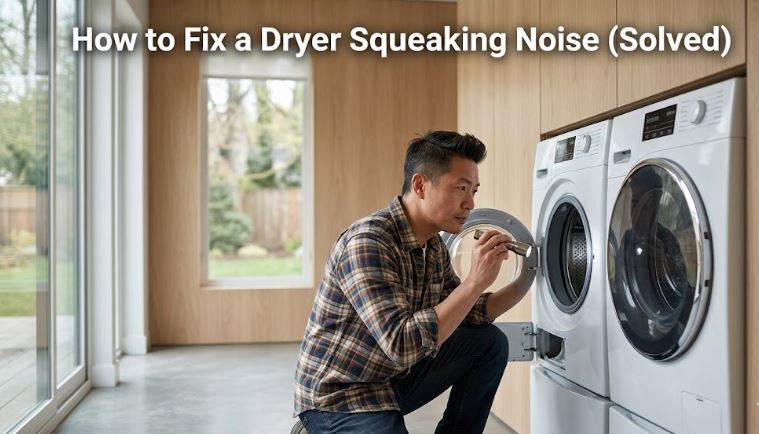
Unplug the dryer and open the door. Shine a flashlight into the gap between the drum edge and the rubber door seal, working your way all the way around the circumference. Use needle-nose pliers to extract anything you find.
Also, press firmly on the door seal all the way around its circumference while the dryer is unplugged and rotate the drum by hand. Any object trapped behind the seal will make itself known as you push the seal inward. Check pockets before every wash cycle and the problem simply does not happen.
8. The Motor Bearings Are Wearing Out
Motor bearing squeak is the least common cause on this list but the most serious. The motor bearings allow the motor shaft to spin smoothly, and when they wear out the motor produces a low rumbling or grinding squeak that does not match the drum rotation speed because the motor spins faster than the drum.
Lint buildup around the motor from a neglected vent system accelerates bearing wear significantly by trapping heat around the motor housing during every cycle.
How to Identify and Address Motor Bearing Squeak
Listen carefully to determine whether the squeaking matches the drum rotation speed or runs at a faster, independent rhythm. A squeak faster than the drum rotation points to the motor. A squeak that matches the drum speed points to the rollers, glides, or bearing.
If the motor is the source, replacement is the correct fix since motor bearings are not serviceable on most residential dryer motors. Cleaning the exhaust vent thoroughly beforehand removes the heat trap that caused the premature wear.
Dryer Squeaking Noise Fix Cost and Difficulty Overview
| Cause | DIY Difficulty | Part Cost | Pro Repair Cost |
|---|---|---|---|
| Remove foreign object | Very easy | Free | $80 – $130 |
| Level the dryer and add pads | Easy | Free – $20 | N/A |
| Lubricate roller shafts or pulley | Easy | $8 – $15 | $80 – $150 |
| Drive belt replacement | Moderate | $10 – $20 | $100 – $200 |
| Drum glide kit | Moderate | $10 – $25 | $100 – $180 |
| Idler pulley replacement | Moderate | $10 – $25 | $100 – $180 |
| Drum roller kit | Moderate | $15 – $35 | $120 – $220 |
| Drum bearing replacement | Advanced | $15 – $40 | $150 – $300 |
| Motor replacement | Advanced | $80 – $200 | $200 – $400 |
Frequently Asked Questions
Is it safe to keep running a squeaking dryer?
It depends on the cause. A minor squeak from a dry pulley shaft or unlevel feet is not immediately dangerous but will worsen over time. A squeak from worn drum bearings or a glazed belt that is close to snapping should be addressed promptly since continued use accelerates damage to surrounding components and could leave you with a non-functional dryer.
Can I lubricate the drum rollers without replacing them?
Sometimes. If the roller rubber is still in good shape and the squeak comes from a dry shaft, lubrication with white lithium grease often resolves the squeak without needing a replacement. However, if the rubber is cracked, hardened, or flat-spotted, lubrication does not fix the underlying wear and roller replacement is the correct solution.
Why does my dryer squeak only when it is warm but not at the start of the cycle?
Heat causes rubber components to harden and metal components to expand slightly. A squeak that only appears once the dryer warms up points to a belt or roller that has enough flexibility when cold to function quietly but loses that flexibility under heat. This is a reliable sign that replacement is approaching.
How do I tell whether the squeak is from the front or back of the dryer?
Stand beside the dryer during a cycle and listen carefully from the front and then the rear. A squeak from the front typically comes from the drum glides or idler pulley. A squeak from the rear almost always points to the drum rollers, roller shafts, or drum bearing. This location test narrows the diagnosis significantly before you open the machine.
Does a squeaking dryer use more electricity?
Indirectly, yes. Worn rollers, glides, and bearings create friction that the motor must overcome to keep the drum spinning. That extra mechanical resistance draws slightly more current from the motor. More significantly, worn components often reduce drum spin efficiency enough to extend drying times, which adds meaningful energy cost over many cycles.
Find the Squeak Before It Finds a Bigger Problem
A squeaking dryer is the machine flagging friction somewhere it should not exist. The squeak is small right now, but every cycle it runs that way is grinding down the component further and stressing the parts around it.
Start with the free checks: level the machine, check for trapped objects, and listen to identify front versus rear squeak. Then move to lubrication before committing to parts replacement.
Don’t forget to check out our ultimate dryer troubleshooting guide for other common dryer problems that you can troubleshoot yourself from home, and get to save both on time and cost.

Hi, I’m Barlgan! I created Repair Me Yourself to empower homeowners to tackle appliance repairs with confidence. From decoding error codes to fixing cooling issues, I break down complex repairs into simple, actionable steps that save you time and money.