
Most DIY appliance repairers start with a multimeter. It tests continuity, measures voltage, checks resistance — and for a long time, that feels like enough. Then you run into a situation where an appliance is clearly drawing too much power, a motor is running hot for no obvious reason, or a circuit breaker keeps tripping even though every component tests fine individually. Suddenly, you need to measure current — and that’s where a clamp meter earns its place.
But is a clamp meter actually necessary for home appliance troubleshooting, or is it an expensive luxury that only professionals need? The honest answer sits somewhere in the middle, and it depends heavily on what appliances you work on and how deep your diagnostics go. This guide lays it out clearly — what a clamp meter does, where it genuinely adds value, where it doesn’t, and which models make sense for home use.
Quick Reference: Best Clamp Meter for Home Appliance Troubleshooting on Amazon
| Clamp Meter | Best For | AC Current Range | True RMS |
|---|---|---|---|
| Klein Tools CL390 | General home appliance use | 0–400A | Yes |
| Fluke 323 | Frequent DIY / semi-pro use | 0–400A | Yes |
| AstroAI TRMS Clamp Meter | Budget-conscious beginners | 0–600A | Yes |
| Uni-T UT210E | Low-current appliance work | 0–100A | Yes |
What a Clamp Meter Actually Does
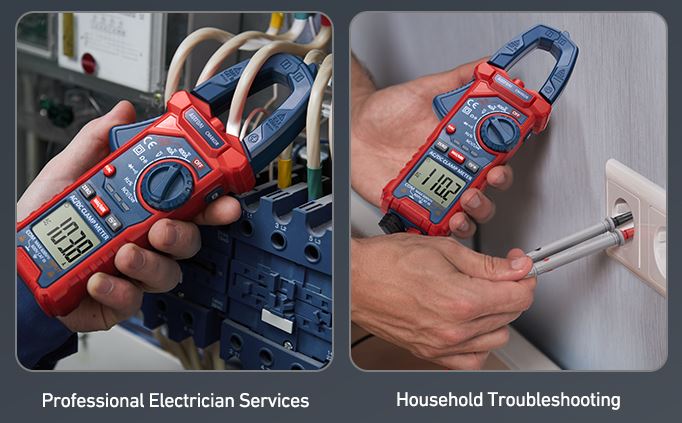
A clamp meter measures electrical current — amperage — flowing through a conductor without breaking the circuit or making any direct contact with the wire itself. The hinged jaw clamps around a single wire and detects the magnetic field generated by current flowing through it. That’s it. No cutting wires, no inserting probes into live terminals, no circuit interruption.
Most clamp meters also measure AC and DC voltage, resistance, and continuity — which means they can do everything a basic multimeter does, plus current measurement. The clamp jaw is what sets them apart.
This matters enormously in appliance diagnosis because current draw is one of the most revealing indicators of how a motor, compressor, or heating element is actually performing under load. A component can pass a continuity test and still be failing — drawing excessive current due to worn windings, mechanical friction, or a developing short. A clamp meter catches what a multimeter misses.
Where a Clamp Meter Genuinely Helps with Appliance Troubleshooting
Motor Diagnosis
Electric motors are at the heart of washing machines, dryers, dishwashers, refrigerator compressors, and HVAC fans. When a motor is struggling — due to worn bearings, a seized component, or degrading windings — its current draw increases before it fails completely. Measuring running amperage against the motor’s nameplate rating tells you whether it’s operating within spec or heading toward failure.
A motor drawing 15–20% above its rated amperage is a motor under stress. This is invisible to a multimeter doing static continuity tests but immediately obvious with a clamp meter on a running circuit.
Compressor Health
Refrigerator and air conditioning compressors are expensive to replace and often show signs of decline through elevated current draw long before they fail outright. Clamping around the compressor supply wire and comparing the reading to the compressor’s rated locked rotor amperage (LRA) and run load amperage (RLA) — usually on the appliance data plate — tells you a great deal about remaining compressor health.
Nuisance Tripping Circuit Breakers
If a circuit breaker trips regularly but no individual component tests faulty, the issue may be cumulative load — too many appliances on one circuit — or a single appliance intermittently pulling excessive current under load. A clamp meter left on the circuit while the appliance runs through a cycle can capture the peak current event that’s causing the trip.
Dryer and Oven Heating Elements Under Load
A continuity test confirms a heating element isn’t open. But a clamp meter tells you whether it’s drawing its correct wattage under actual operating conditions. A heating element that reads fine on continuity but pulls low amperage may have a developing partial break that causes intermittent underheating — a fault that’s genuinely difficult to catch any other way.
Validating Repairs After Completion
After replacing a motor, pump, or compressor, measuring current draw confirms the new component is running within spec. It’s a professional-quality validation step that adds confidence to any repair.
Where a Clamp Meter Adds Less Value
It’s worth being direct about the situations where a clamp meter doesn’t add much over a standard multimeter, so you can make an informed decision about whether to buy one.
For straightforward component testing — checking whether a thermal fuse has continuity, measuring resistance across a temperature sensor, verifying voltage at a terminal — a multimeter handles everything and a clamp meter adds nothing. The majority of basic appliance repairs fall into this category.
If you primarily work on smaller appliances — toasters, coffee makers, window air conditioners, or small kitchen appliances — the current draws involved are low and consistent enough that abnormal readings are rarely the diagnostic path. Faults in these appliances are almost always component failures that a multimeter identifies directly.
And if you’re early in your DIY journey, the added complexity of interpreting current readings — nameplate amperage, LRA, RLA, power factor — can create more confusion than insight before you’ve built a solid foundation with basic electrical testing.
Clamp Meter vs. Multimeter: Which Should You Get First?
This is the most practical question for anyone building a home repair toolkit, and the answer is clear: get the multimeter first.
A multimeter covers continuity, voltage, and resistance — the three diagnostics that solve the majority of home appliance problems. A clamp meter adds current measurement, which is valuable but situational. If your budget allows only one tool, the multimeter is the right call every time.
Once you’re comfortable with multimeter-based diagnosis and you’re finding that current measurement would have helped you on a specific job — that’s the right time to add a clamp meter. At that point you’ll use it purposefully rather than occasionally picking it up and wondering what to do with it.
| Diagnostic Need | Multimeter | Clamp Meter |
|---|---|---|
| Continuity testing (fuses, switches, elements) | ✓ | ✓ |
| Voltage measurement at terminals | ✓ | ✓ |
| Resistance testing (sensors, windings) | ✓ | ✓ |
| Current draw under load | ✗ | ✓ |
| Motor health assessment | Limited | ✓ |
| Nuisance breaker diagnosis | Limited | ✓ |
| Component-level fault finding | ✓ | ✓ |
| Safe to use without breaking circuits | ✓ | ✓ (jaw clamp) |
What to Look for in a Clamp Meter for Home Appliance Troubleshooting
Jaw Size
The jaw needs to fit around the wire you’re testing. Most residential appliance wiring is relatively slim — 12 AWG to 6 AWG — so standard jaw sizes (around 1 inch / 25mm opening) are more than sufficient. You only need a large-jaw meter if you’re working on heavy commercial equipment.
Minimum Current Sensitivity
Standard clamp meters are optimized for industrial current ranges — they’re accurate at 50A, 100A, 200A. But many home appliances draw only 5A to 15A in normal operation. A meter that’s inaccurate below 10A isn’t much use for diagnosing a refrigerator compressor drawing 8A. Look for a clamp meter with good low-current sensitivity — ideally accurate down to 1A or below. The Uni-T UT210E is notable for this, with accurate readings down to fractions of an amp.
True RMS
Just as with multimeters, True RMS matters when measuring current in appliances with inverter motors or variable-speed drives. Modern washing machines, high-efficiency refrigerators, and variable-speed HVAC systems all produce non-sinusoidal current waveforms. A non-True RMS clamp meter will give you inaccurate readings on these appliances. Given that True RMS is now standard on most mid-range meters, it’s worth insisting on.
Inrush Current Capture
When a motor starts, it draws a brief surge of current — the inrush current — that can be 6 to 10 times higher than the running current. Some clamp meters include an inrush capture mode that holds the peak reading long enough for you to see it. This is useful for diagnosing start capacitor problems, which cause motors to struggle on startup. It’s not essential, but it’s a genuinely useful feature.
Data Hold and MAX Mode
Data hold freezes the current reading on the display so you can read it after removing the clamp from a tight space. MAX mode continuously captures and holds the highest reading seen during a measurement period — useful for catching peak current events during an appliance startup cycle.
The Best Clamp Meters for Home Appliance Troubleshooting
Klein Tools CL390 — Best for Most Home DIYers
The Klein Tools CL390 (View on Amazon) hits the ideal balance for home appliance work. It’s True RMS, measures AC to 400A (with good sensitivity at low-current appliance ranges), and includes all the standard multimeter functions alongside the clamp. The jaw opens to 1.5 inches — enough for any residential wiring. It has a clearly backlit display, data hold, and a CAT III 600V safety rating.
Klein Tools is a brand with deep roots in the electrical trade, and the CL390 reflects that. It’s accurate, robust, and designed for real-world use rather than occasional box ticking. For someone who wants a clamp meter that also replaces their basic multimeter, this is the one to get.
Fluke 323 — Best for Frequent and Serious Use
If you work on appliances regularly or want a meter built to last a decade of heavy use, the Fluke 323 (View on Amazon) is the benchmark. It measures AC current to 400A with True RMS accuracy, includes voltage and resistance measurement, and is built to Fluke’s characteristically exacting standards. The jaw mechanism is smoother, the display is cleaner, and the overall build quality is noticeably better than anything in the same feature tier from other brands.
It doesn’t have inrush capture or advanced features — Fluke’s higher models cover those — but for clean, reliable current and voltage measurement on home appliances, the 323 is more than capable. If you’re investing in a clamp meter you won’t need to replace, this is the one.
Uni-T UT210E — Best for Low-Current Appliance Work
The Uni-T UT210E (View on Amazon) is a standout choice for anyone whose appliance work skews toward smaller draws. It measures AC and DC current down to 100A but — critically — maintains accuracy at very low current levels, sometimes down to 0.1A. This makes it genuinely useful for testing refrigerator compressors, small pump motors, dishwasher circulation pumps, and other components that draw well under 10A in normal operation.
It’s compact, True RMS, and includes a capacitance testing function that most clamp meters lack — useful for testing motor run capacitors, which are a common failure point in HVAC systems and appliance motors. At $35–$50 it represents exceptional value for the feature set.
AstroAI TRMS Clamp Meter — Best Budget Option
If you want clamp meter capability at the lowest responsible price, the AstroAI TRMS (View on Amazon) is a credible option. It’s True RMS, covers AC current to 600A, and includes standard multimeter functions. Build quality is a step below Klein or Fluke, and low-current accuracy isn’t its strongest suit — but for occasional use on larger appliances like dryers, washing machines, and HVAC units, it gets the job done without a significant investment.
Think of it as a capable entry point rather than a long-term tool. If you find yourself using it frequently, upgrading to the Klein CL390 or Fluke 323 will be a noticeable improvement.
How to Use a Clamp Meter on Home Appliances
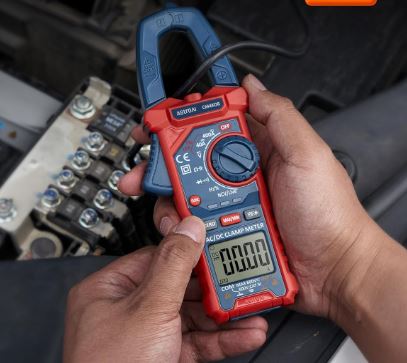
The process is straightforward but requires one important preparation step: you must clamp around a single conductor only, not around a cable containing multiple wires. When you clamp around both the hot and neutral wires together, the magnetic fields cancel out and the meter reads zero. This is the most common mistake beginners make.
For most appliance testing, access the power cord or the individual supply wire feeding the component you’re testing. Open the clamp jaw, position it around the single wire, close it, and read the display. Make sure the wire runs through the center of the jaw for the most accurate reading.
Check the reading against the appliance’s nameplate data or the component’s rated current. A significantly higher reading indicates overload or component degradation. A significantly lower reading may indicate a partial open or a developing fault in a heating element.
Frequently Asked Questions
Do I really need a clamp meter for basic appliance repair?
For most basic appliance repairs — replacing a thermal fuse, a door switch, a heating element, or a pump — you don’t need a clamp meter. A good multimeter handles these diagnostics. A clamp meter becomes valuable when you need to assess how a motor or compressor is performing under actual load, or when a circuit breaker keeps tripping and you can’t isolate the cause with static tests alone.
Can a clamp meter replace a multimeter for appliance work?
Most clamp meters include voltage, resistance, and continuity functions, so technically yes — a quality clamp meter can replace a basic multimeter. In practice though, clamp meters are bulkier and less convenient for the fine probe work involved in component-level testing. Many experienced technicians carry both because each excels at different tasks.
What amperage rating do I need for home appliance work?
Most home appliances draw between 5A and 30A during normal operation, with startup surges up to 60–80A for large motor-driven appliances. A clamp meter rated to 400A is more than sufficient. More important than the upper limit is low-current accuracy — make sure your meter reads reliably below 10A, which is where most refrigerator and small motor diagnostics sit.
Why does my clamp meter read zero when clamped around an appliance cord?
You’re almost certainly clamping around both conductors in the cord simultaneously. The magnetic fields of the current flowing in opposite directions cancel each other out, giving a zero reading. You need to clamp around a single conductor only. For standard two or three-wire appliance cords, you may need to separate the wires or access the individual conductors inside the appliance at a terminal block.
What is inrush current and why does it matter for appliance diagnosis?
Inrush current is the brief surge of current a motor draws the moment it starts — typically 6 to 10 times the normal running current. It lasts only a fraction of a second. A healthy motor starts quickly and the current drops to its normal running level within seconds. A motor with a failing start capacitor or worn windings may draw high inrush current for longer than normal or fail to start at all. Clamp meters with inrush capture mode hold this peak reading so you can evaluate it.
Can I use a clamp meter safely on a 240V appliance?
Yes, provided your clamp meter is rated for it — most quality models are rated to 600V CAT III or higher, which comfortably covers 240V dryer and oven circuits. The clamp jaw itself never touches the wire, so the voltage rating refers to the overall meter’s ability to withstand the electromagnetic environment and any incidental contact. Always check your specific meter’s rating before use on 240V circuits.
Is a True RMS clamp meter worth the extra cost?
For modern appliances, yes. Inverter-driven washing machines, variable-speed refrigerator compressors, and modern HVAC systems all produce non-sinusoidal waveforms that non-True RMS meters misread — sometimes by 10–40%. Since True RMS is now standard on most mid-range clamp meters without significant price premium, there’s little reason to settle for a non-True RMS model.
Conclusion on ‘Clamp Meter for Home Appliance Troubleshooting’
A clamp meter is not an essential first purchase for home appliance troubleshooting — but it’s a genuinely powerful addition once your diagnostics start going deeper than component-level testing. It sees things a multimeter simply cannot: a motor drawing excessive current under load, a compressor degrading before it fails, a circuit pulled beyond its limits by a struggling appliance.
If you’re just starting out, put your budget into a quality multimeter and a voltage tester. Come back to the clamp meter when you’ve hit a diagnostic wall that current measurement would have solved — and at that point, the Klein Tools CL390 or Fluke 323 will serve you well for years.
The best toolkit isn’t the most complete one. It’s the one where every tool earns its place because you understand exactly what it’s for.
Browse clamp meters on Amazon and find the right fit for where your repairs are taking you.

Hi, I’m Barlgan! I created Repair Me Yourself to empower homeowners to tackle appliance repairs with confidence. From decoding error codes to fixing cooling issues, I break down complex repairs into simple, actionable steps that save you time and money.