
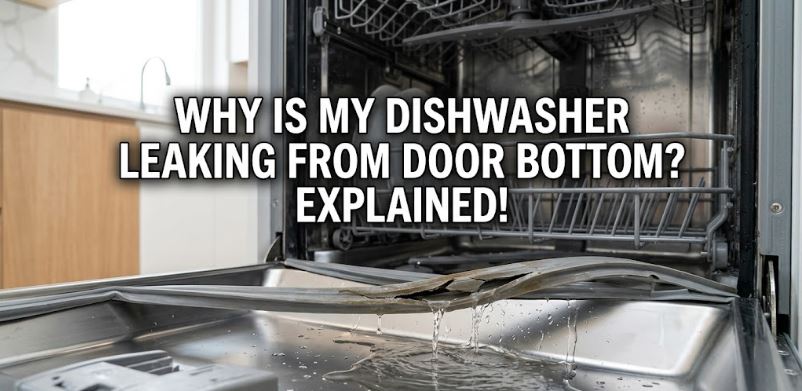
A puddle on your kitchen floor in front of the dishwasher is one of those problems that demands immediate attention. Water damage to kitchen flooring, cabinets, and subflooring happens faster than most people expect, and a leak that gets ignored for even a few weeks can cause warping and mold that costs far more to fix than the dishwasher itself.
The good news is that a door bottom leak almost always has a specific, identifiable cause. And identifying it correctly the first time means you are not chasing the wrong component while water keeps dripping.
Here is a quick first step before diving into causes. Run a short cycle and watch closely where the water first appears. Water appearing at the front bottom edge of the door during the wash phase points to different causes than water appearing after the cycle ends or water that pools even when the machine is off. That timing narrows your diagnosis significantly before you open anything.
Important Safety Step First
Stop running the dishwasher until you have identified and fixed the leak. Even a slow drip reaching the subfloor or electrical components beneath the machine creates genuine safety and structural risks. Unplug the machine or turn off the circuit breaker while you diagnose the cause.
Quick Reference for a Dishwasher Leaking From Door Bottom
| When the Leak Appears | Most Likely Cause |
|---|---|
| During wash cycle at door bottom corners | Worn or dirty door gasket |
| During wash, water deflecting off dishes | Dish blocking spray arm or large item deflecting water |
| After cycle ends, water on floor | Drain hose connection or check valve issue |
| Machine off or unplugged, water still entering | Stuck water inlet valve |
| Leak started gradually, worsening over weeks | Deteriorating door gasket or unlevel machine |
| Water appears at front but traces to bottom | Internal hose or pump seal leak tracking forward |
Why Is Water Coming Out of My Dishwasher Door Bottom?
Several issues are worth checking when your dishwasher starts leaking from the bottom, and they include:
1. The Door Gasket Is Dirty, Misaligned, or Worn
This is the most common cause of a dishwasher leaking from the bottom of the door, and it is also one of the quickest fixes on this list.
The door gasket is a rubber seal that runs around the full perimeter of the door opening. It compresses when the door closes and creates a watertight seal against the tub frame. Over time, food debris, grease, and soap scum accumulate on the gasket surface and prevent it from sealing evenly against the tub. Hard water deposits make this worse by building up ridges that lift sections of the gasket away from the frame.
When the gasket is dirty enough, water finds its way through the imperfect seal during the high-pressure wash phase and drips from the bottom corners of the door onto the floor below.
A gasket that has shifted out of its retaining groove or cracked from age produces the same leak even when it looks visually intact from the outside.
How to Clean, Reseat, or Replace the Door Gasket
Open the door fully and inspect the gasket along its entire perimeter. Look for visible food debris, grease buildup, cracks, stiffening, or sections that have pulled away from the retaining groove.
Clean the gasket thoroughly with warm water and a soft cloth. Pay extra attention to the lower corners where the gasket bends and debris concentrates most heavily. Also clean the tub frame surface that the gasket presses against. Run a short cycle and watch the door bottom to see if the leak has stopped.
If sections of the gasket have pulled out of the groove, press them firmly back into position. If the gasket is cracked, permanently deformed, or brittle, it needs a complete replacement (View on Amazon).
2. Dishes Are Deflecting Water Past the Door Seal
This is a cause that experienced appliance technicians see constantly, and it is entirely free to fix.
A large item loaded vertically against the front of the bottom rack, a cookie sheet, a cutting board, a large pot lid, can intercept water from the spray arm and redirect it in unexpected directions. That redirected water hits the inside of the door at an angle, overcomes the door seal’s surface tension, and drips from the bottom edge of the door during the wash phase.
A spray arm that is partially blocked from rotating creates the same effect because it shoots water in a fixed direction rather than rotating evenly, creating concentrated streams that hit the door at high pressure.
How to Fix a Deflection Leak
Remove any large flat items from the front of the bottom rack and reload them along the outer sides or back of the rack. Then check that both spray arms spin freely by hand with the racks fully loaded.
Run a cycle and watch whether the leak disappears. If it does, loading was the entire problem. If the spray arm was blocked, our post on dishwasher spray arm not spinning covers every spray arm cause and fix in detail.
3. The Dishwasher Is Not Level
An unlevel dishwasher is one of the most underdiagnosed causes of door bottom leaks, and it is worth checking early because it costs nothing and takes under five minutes.
When the machine tilts forward even slightly, the water inside the tub during the wash phase shifts toward the front. The water level at the front of the tub rises higher than it should, and during the vigorous wash phase that water sloshes against and over the front lip of the tub, finding its way past the door gasket and dripping from the door bottom.
This cause often develops gradually as the leveling feet shift from vibration over months of use, so a machine that was perfectly level at installation can drift out of level without anyone noticing.
How to Level the Dishwasher
Place a spirit level on the top edge of the open door and check it both side to side and front to back. The machine should be level side to side and slope very slightly backward, one to two degrees, to keep water toward the drain rather than toward the door.
Adjust the front leveling legs by turning them clockwise to raise that corner or counterclockwise to lower it. Most dishwasher legs adjust by hand or with a wrench at the base of the machine. Tighten the locking nut above each leg after adjustment. Run a cycle and confirm the door leak has stopped before pushing the machine back into its cabinet space.
4. Too Much Detergent or the Wrong Detergent Is Being Used
Excess suds inside a dishwasher produce a foam that the machine cannot contain during the wash cycle. As suds volume increases, the foam works its way past the door gasket at the lowest point of the seal, which is the bottom of the door, and drips continuously during the suds-heavy portion of the cycle.
Using regular hand dish soap in a dishwasher is the most dramatic version of this cause. Even a small squirt of hand soap creates enough foam to overflow the tub within minutes. Using too much automatic dishwasher detergent produces a less dramatic but equally problematic suds buildup over a longer cycle.
How to Fix a Suds Leak
Open the dishwasher mid-cycle if the leak is active and you can see excessive suds filling the tub beyond a moderate amount. Cancel the cycle and let the suds dissipate. Sprinkle a tablespoon of table salt directly onto the suds inside the tub to break them down rapidly, then run a rinse-only cycle with no detergent to flush the remaining foam out.
Going forward, always use automatic dishwasher detergent specifically formulated for dishwashers (View on Amazon). Never use hand soap or laundry detergent. Measure powder or gel detergent carefully and use the recommended amount for your water hardness level rather than filling the dispenser to maximum every cycle.
5. The Door Latch or Hinge Is Loose or Damaged
The door latch keeps the door pulled firmly against the tub frame during the wash cycle. When the latch is loose, bent, or worn, the door does not press the gasket against the tub with enough consistent force to maintain a watertight seal throughout the entire cycle.
Similarly, worn or bent door hinges allow the door to sag slightly when closed. A sagging door creates an uneven gap at the bottom of the seal where the door no longer presses firmly against the tub frame, and water exploits that gap during the wash phase.
How to Inspect and Fix the Latch and Hinges
Close the door and try gently pulling the bottom of the door outward while a cycle runs. Any noticeable flex or give at the bottom of the door confirms the latch or hinges are not holding the door firmly enough.
Check the latch assembly screws and tighten any that have loosened. If the latch itself is visibly bent or the catch mechanism is worn, the latch needs replacement (View on Amazon). For hinge issues, inspect the hinge springs on both sides of the door for stretching or breakage and then replace any hinge that allows the door to sag when open.
6. The Water Inlet Valve Is Stuck Open
This is a less common but unmistakable cause because it produces a very specific symptom: water enters the dishwasher even when the machine is turned off or unplugged.
The water inlet valve controls the flow of water into the dishwasher during the fill phase. When its solenoid fails in the open position, water continuously trickles into the tub. Eventually the tub overfills, water reaches the front lip, and it drips from the door bottom onto the floor. This can happen while the machine is running, between cycles, and even overnight when nobody has used the kitchen.
How to Confirm and Replace a Stuck Inlet Valve
Open the dishwasher when it is not running and check whether water is trickling into the tub or whether the tub floor is wet when it should be dry. Also turn off the hot water supply valve under the sink and check whether the water entering the tub stops. If stopping the supply valve stops the water, the inlet valve is confirmed as stuck open.
Turn off the water supply and unplug the dishwasher before replacing the valve. Access it from the kick panel at the base of the machine. Consider replacing the water inlet valve (View on Amazon) if it appears faulty. Confirm compatibility with your dishwasher model number before ordering.
7. The Tub or Internal Hose Has a Crack or Loose Connection
When the leak cannot be linked to the door gasket, loading, leveling, detergent, or the inlet valve, the source is likely inside the machine rather than at the door itself. Internal hose connections, pump seals, and even the tub itself can develop leaks that track along the bottom of the machine and appear at the front door area, creating the impression of a door leak when the actual source is further inside.
A corroded or cracked tub is the most serious version of this cause and is most common on older machines or those exposed to excessively harsh detergents over many years.
How to Find an Internal Leak Source
Remove the kick panel at the base of the door and run a short cycle while watching the interior components with a flashlight. Look for water dripping from hose connections, pump seals, or the tub base rather than from the door area. Water that originates from an internal point and then tracks forward along the bottom of the machine will appear to come from the door but actually emerges from a connection point further back.
Tighten any loose hose clamps you find. Replace any hose with visible cracking or deterioration. A cracked tub is a more serious finding and on machines over ten years old it is worth comparing the cost of tub replacement against a new dishwasher entirely.
Dishwasher Leaking From Door Bottom: Fix Cost and Difficulty Overview
| Cause | DIY Difficulty | Part Cost | Pro Repair Cost |
|---|---|---|---|
| Clean door gasket | Very easy | Free | $80 – $130 |
| Reload dishes to stop deflection | Very easy | Free | N/A |
| Level the dishwasher | Easy | Free | $80 – $130 |
| Switch to correct detergent | Very easy | Free | N/A |
| Reseat misaligned gasket | Easy | Free | $80 – $130 |
| Replace door gasket | Easy | $15 – $35 | $100 – $180 |
| Tighten door latch screws | Easy | Free | $80 – $130 |
| Replace door latch assembly | Moderate | $15 – $40 | $100 – $200 |
| Replace water inlet valve | Moderate | $20 – $50 | $100 – $200 |
| Internal hose or pump seal repair | Advanced | $10 – $50 | $150 – $300 |
Frequently Asked Questions
Why does my dishwasher only leak from the door bottom during the wash cycle and not the rinse cycle?
The wash cycle uses higher water pressure and more vigorous spray arm action than the rinse cycle. If the leak only appears during the wash phase, the door gasket is almost certainly the cause. The seal handles the lower-pressure rinse cycle adequately but cannot maintain a watertight seal against the stronger wash phase pressure. Cleaning or replacing the gasket resolves this specific pattern in the majority of cases.
Can a dirty dishwasher door gasket really cause a leak?
Yes, and it is more common than most people expect. Food debris, grease, and mineral deposits create ridges on the gasket surface that prevent it from sealing evenly against the tub frame. The gap that results, sometimes only a fraction of a millimeter, is enough for water under wash cycle pressure to find its way through. Cleaning the gasket thoroughly with warm water and a cloth takes ten minutes and frequently resolves the leak entirely.
My dishwasher leaks only at the lower corners of the door. What causes that?
The lower corners are the most vulnerable point of the door seal because the gasket has to bend around a sharp corner at each point. This bend concentrates stress on the rubber and is where gasket deterioration appears first. Lower corner leaks almost always point to a worn or partially detached gasket at those corners. Press the gasket firmly back into its groove at both corners and run a test cycle. If the leak returns, full gasket replacement is the correct fix.
How do I stop my dishwasher from leaking when I am not home?
Turn off the hot water supply valve under the sink before leaving for any extended period. This prevents the inlet valve from supplying water to the machine and eliminates the risk of an unattended leak causing floor or cabinet damage while you are away. If the machine leaks even with the supply valve closed, an internal component rather than the inlet valve is the source and needs professional assessment.
Is a dishwasher door bottom leak dangerous?
Water reaching the subfloor beneath kitchen tiles or hardwood creates conditions for mold growth, wood rot, and structural damage within weeks. Water reaching electrical components beneath the machine creates a shock and fire risk. Stop using the dishwasher until the leak is fixed, turn off the circuit breaker for the appliance, and dry the affected floor area thoroughly before assessing for damage.
Find the Source of the Dishwasher Leak Before the Floor Pays the Price
A dishwasher leaking from the door bottom is one of those problems where acting quickly saves significantly more than the cost of the repair. Water damage compounds fast, and the fix is almost always simpler than the damage it prevents.
Start with the gasket since it is responsible for the overwhelming majority of door bottom leaks and takes ten minutes to clean and test. Then check the loading, the leveling, and the detergent before considering any component replacement.
And in case of other dishwasher malfunctions, you may need to check out our ultimate dishwasher troubleshooting guide for effective diagnostic and repair tips.

Hi, I’m Barlgan! I created Repair Me Yourself to empower homeowners to tackle appliance repairs with confidence. From decoding error codes to fixing cooling issues, I break down complex repairs into simple, actionable steps that save you time and money.