
Your Whirlpool dishwasher just stopped mid-cycle, or maybe it won’t start at all. You’ve got dirty dishes piling up, and you need answers now. Whether you’re dealing with flashing lights, error codes, or a machine that’s simply refusing to cooperate, this guide walks you through every major Whirlpool dishwasher problem with real solutions.
If your Whirlpool dishwasher isn’t working properly, the most common culprits are control board failures, clogged spray arms, faulty door latches, or incorrect cycle settings. Most issues can be resolved through systematic troubleshooting, proper cleaning, or a simple reset without requiring professional repair.
These solutions have been tested on multiple Whirlpool models including the WDF520PADM, WDT730PAHZ, and WDP370PAHB series. This isn’t generic advice copied from a manual. These are field-tested fixes that address the root causes, not just symptoms.
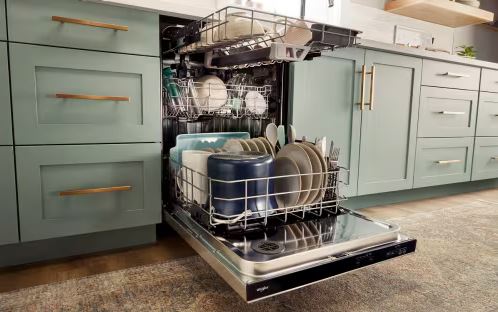
Quick Whirlpool Dishwasher Troubleshooting Reference
| Problem | Most Likely Cause | Quick Fix Time |
|---|---|---|
| Won’t turn on | Door latch failure or power issue | 5-15 minutes |
| Flashing lights | Control board error or stuck button | 10-20 minutes |
| Not washing dishes | Clogged spray arms or low water pressure | 15-30 minutes |
| Error codes displayed | Sensor malfunction or heating element issue | 20-45 minutes |
| Won’t drain | Blocked filter or kinked drain hose | 10-25 minutes |
How Whirlpool Dishwashers Fail
Whirlpool dishwashers are built with solid engineering, but they’re not immune to wear and tear. The average dishwasher runs 200+ cycles per year, which means moving parts fail, sensors drift, and electronics degrade.
Most failures happen in predictable patterns. Control boards fail after 5-8 years of use, especially in humid environments. Door latches wear out from daily use. Spray arms clog from hard water minerals and food particles.
The key to effective troubleshooting is understanding your dishwasher’s feedback system. Flashing lights aren’t random—they’re diagnostic codes. Strange noises tell you which component is struggling. A dishwasher that runs but doesn’t clean is screaming about water flow issues.
Here’s what separates minor fixes from major repairs: accessibility and cost. If you can reach it with basic tools and it costs under $50, you can probably handle it. Anything involving the motor, pump assembly, or complex wiring should go to a technician.
How Do You Troubleshoot a Whirlpool Dishwasher?
The key to fixing Whirlpool dishwashers is working systematically through each potential problem area. Start with the most common issues first, then move to more complex diagnostics only when needed.
Pay attention to any error codes or flashing light patterns your dishwasher displays. These provide specific clues about what’s failing. Write them down before attempting any fixes.
Don’t immediately assume expensive repairs. Most Whirlpool problems resolve with basic maintenance like filter cleaning or simple resets. Only progress to component replacement after eliminating these simple causes.
Here’s how to troubleshoot the most common Whirlpool dishwasher problems:
Whirlpool Dishwasher Not Turning On
Power issues are frustrating because they seem catastrophic, but are often simple fixes. So, before you assume the worst, methodically check these areas when your Whirlpool dishwasher won’t turn on:
Check the Power Supply
Start at the circuit breaker panel. A tripped breaker looks “centered” between ON and OFF positions. Flip it completely off, then back on. Don’t just push it toward ON.
Next, verify the outlet itself. Plug in a phone charger or lamp to confirm power flow. If the outlet is dead, you’ve found your problem.
Many Whirlpool models have a delay start feature that can appear like a power failure. Check your control panel for a timer display showing hours until start.
Test the Door Latch Assembly
The door latch is your dishwasher’s primary safety mechanism. If it doesn’t engage fully, the control board won’t allow the cycle to start.
Open and close the door firmly while listening for a distinct “click.” No click means the latch isn’t catching. Inspect the door strike plate for damage or debris.
Remove the inner door panel to access the latch assembly. Check for broken plastic tabs or loose wiring. The latch switch should show continuity when pressed and none when released.
Inspect the Thermal Fuse
Located on the control board, the thermal fuse acts as a fail-safe against overheating. When it blows, your dishwasher becomes completely unresponsive.
Access the control panel by removing the front screws. The thermal fuse is a small white or black component with two wires. Test it with a multimeter (View on Amazon) set to continuity mode.
A blown fuse indicates an underlying problem—usually a shorted heating element or failing control board. Replace the fuse, but also investigate what caused it to blow.
Examine Control Panel Buttons
Stuck buttons are more common than you’d think. Food residue and moisture seep behind the membrane, causing shorts or false inputs.
Press each button individually and feel for unusual resistance. Clean around button edges with isopropyl alcohol on a cotton swab.
If multiple buttons feel mushy or unresponsive, the control panel membrane needs replacement. This is a $40-80 part that requires careful installation.
What else?
Remember to also check the start switch as a non-working start button could stop your dishwasher from turning on.
Whirlpool Dishwasher Control Board Problems
The control board is your dishwasher’s brain, managing every function from water fill to drying. When it fails, you see erratic behavior that defies logic.
Signs of Control Board Failure
Control board failures show distinct patterns. You might see all lights flashing simultaneously, buttons that don’t respond, or cycles that start then immediately stop.
Random beeping indicates corrupted programming or failing capacitors on the board. Temperature errors when the heating element tests fine point to control board sensor circuits.
One telltale sign: the dishwasher works perfectly for one cycle, then fails the next with no pattern. Consistent failures usually mean a specific component, but intermittent issues scream “control board.”
Control Board Problem Guide:
| Symptom | Likely Issue | Repair Difficulty |
|---|---|---|
| All lights flash | Complete board failure | Hard – Replace board |
| No response to buttons | Membrane or board trace damage | Medium – Test connections |
| Starts then stops | Faulty relay on board | Hard – Board replacement |
| Wrong cycle runs | Memory corruption | Easy – Reset may work |
| Display shows random codes | Processor malfunction | Hard – Replace board |
Test the Control Board
Disconnect power before touching any electrical components. Remove the control panel cover (usually 4-6 screws along the top edge).
Visually inspect for burn marks, bulging capacitors, or corrosion. These are dead giveaways of board failure. Check all wire connections for looseness or corrosion.
Use a multimeter to test voltage at the board’s input terminals. You should see 120V AC at the power input. No voltage means a wiring issue, not board failure.
Testing output signals requires specific voltage ranges for each function. Without a schematic, this becomes guesswork. If visual inspection and basic voltage tests don’t reveal issues, replacement is usually more economical than deep diagnostics.
Replace or Repair?
Control boards for Whirlpool dishwashers cost $150-300 depending on model. Labor adds another $150-250 if you hire out.
If your dishwasher is over 10 years old and needs a board, seriously consider replacement. A new dishwasher starts around $400-500 and includes warranty coverage.
For dishwashers under 5 years old, board replacement makes economic sense. The rest of the machine still has years of life remaining.
Some failures are repairable. Loose solder joints can be reflowed. Blown fuses on the board can be replaced if you have soldering skills. But most home users should swap the entire board.
Whirlpool Dishwasher Flashing Lights
Flashing lights are diagnostic indicators, not random errors. Each pattern corresponds to specific failure modes programmed by Whirlpool engineers.
Decode Flash Patterns
Count the flashes carefully. Some patterns repeat, others flash continuously. Write down what you see before resetting anything.
Single repeating flash: Typically indicates a heating circuit problem. Check your heating element resistance and high-limit thermostat.
Two flashes: Usually points to filling issues. Your water inlet valve may be stuck, or you have low water pressure feeding the dishwasher.
Three flashes: Drainage problems are calling. Check for blocked filters, kinked drain hoses, or failing drain pumps.
Four or more flashes: These often indicate sensor failures or control board issues. Temperature sensors, flow meters, and turbidity sensors all generate these codes.
Fix Common Flash Codes
Most flash codes clear after addressing the underlying issue. But some require manual reset procedures to clear error memory.
For heating-related flashes, test your heating element. It should show 15-30 ohms resistance. Infinite resistance means it’s broken. Zero resistance indicates a short.
Fill-related flashes need water supply investigation. Turn off the water supply, disconnect the inlet hose, and check the inlet valve screen for debris. Hard water areas see severe mineral buildup here.
Drainage flashes require thorough cleaning. Remove the lower spray arm, filter assembly, and check the sump area for bone fragments, toothpicks, or other debris.
Reset Flash Codes
Many Whirlpool models respond to a specific reset sequence. This clears temporary errors and resets the control board memory.
First method: Press “Heated Dry” then “Normal” four times in sequence. Wait 5 seconds between each press. The lights should cycle through patterns, then reset.
Second method: Turn off the breaker for 5 minutes. This forces a complete power cycle. Turn it back on and try starting a cycle.
Third method: Press and hold “Start/Cancel” for 3 seconds to abort the current cycle. Wait 1 minute. Try starting a new cycle from scratch.
If flashing persists after all resets, you’re dealing with a hard failure that needs component replacement.
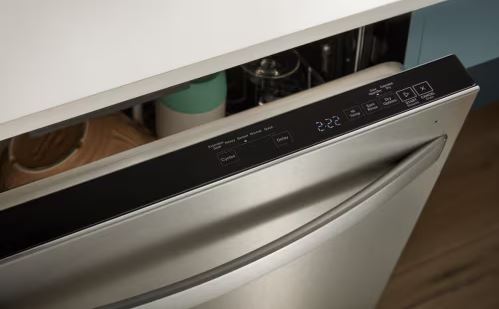
Whirlpool Dishwasher Error Codes
Error codes provide precision diagnostics that flashing lights can’t match. Models with digital displays show alphanumeric codes that pinpoint exact failures.
Critical Error Codes
F1E1 or F2E2: Control board can’t communicate with the user interface. Check the ribbon cable connecting these two boards. Reseat it firmly on both ends.
F3E2: Water temperature too high. Your thermistor is reading incorrectly or your heating element is stuck on. Disconnect power immediately to prevent damage.
F4E1: Drain issue detected. Water isn’t evacuating properly. This triggers after the pump runs for 2+ minutes without clearing water.
F6E4 or F7E1: Water inlet problems. Either no water is entering (valve failure) or water is entering when it shouldn’t (valve stuck open).
F8E4: Slow drain condition. Water drains but too slowly, indicating partial blockage or weak drain pump.
Error Code Quick Reference:
| Code | What It Means | First Step |
|---|---|---|
| F1E1 | Interface connection failure | Reseat ribbon cable |
| F2E2 | User interface failure | Replace UI board |
| F3E2 | Temperature sensor issue | Test thermistor resistance |
| F4E1 | Won’t drain | Clean filter and sump |
| F6E4 | Fill problem | Check inlet valve |
| F7E1 | Heating element short | Replace heating element |
| F8E4 | Slow drain | Clear drain path |
| F9E1 | Diverter motor stuck | Check diverter disc |
Clear Error Codes
Unlike flashing lights, error codes often require more than a simple reset. The control board stores them in non-volatile memory.
Try the cancel/reset sequence first. Press and hold “Start/Cancel” for 3 seconds. If the code returns immediately, the fault is still active.
Power cycle the unit completely. Flip the breaker off for 5 full minutes. This dumps the control board’s temporary memory. Power back on and test.
Some codes clear only after the underlying problem is fixed and a successful cycle completes. Fix the issue, clear the code, then run a rinse-only cycle to confirm resolution.
Model-Specific Codes
Whirlpool has used different code systems across model years. Pre-2015 models often lack digital displays, relying solely on light patterns.
Gold Series and newer models show more detailed codes on LCD displays. These include additional sensors and diagnostic capabilities.
Older mechanical dial models don’t generate codes at all. You troubleshoot these based on symptoms and mechanical inspection only.
Check your model number (usually inside the door frame) and search “[model number] error codes” for specific code charts. Whirlpool’s website maintains documentation for most models.
How to Reset a Whirlpool Dishwasher
Resetting isn’t just about clearing errors. It’s about returning the control system to a known good state, clearing corrupted memory, and forcing fresh sensor readings.
Standard Reset
The most reliable reset method works across most Whirlpool models manufactured after 2010.
Open the dishwasher door fully. Locate the “Start/Cancel” button (it might be labeled differently but serves the same function).
Press and hold for exactly 3 seconds until all lights go dark or you hear a drain pump activate. This aborts the current cycle and clears active commands.
Close the door and wait 60 seconds. This pause allows capacitors to discharge fully. Open the door, select a new cycle, press Start, and close within 3 seconds.
Factory Reset
Factory resets wipe all custom settings and return the dishwasher to out-of-box configuration. Use this when normal resets fail.
Method one works for models with keypads: Press “Heated Dry” followed by “Normal” four times rapidly. The control panel should flash all lights, then reset.
Method two requires power cycling: Turn off the circuit breaker. Wait exactly 5 minutes. Turn breaker back on. This forces the control board to reinitialize completely.
Method three involves entering diagnostic mode, then selecting the reset option. This varies by model and requires specific button combinations found in your service manual.
Check After Resetting
After any reset, run a test cycle before loading dishes. Select a short rinse cycle to verify all functions work correctly.
Listen for normal operation sounds: water filling, spray arms spinning, drain pump activating. Unusual sounds indicate problems that survived the reset.
Check for error codes or flashing lights during the test cycle. If they return immediately, your reset didn’t address the underlying hardware failure.
Verify the door latch clicks firmly and the cycle doesn’t pause unexpectedly. These indicate mechanical issues unrelated to electrical resets.
Run Diagnostic Mode
Diagnostic mode accesses hidden testing functions that cycle through every component independently. This pinpoints failures with precision that normal operation can’t match.
Enter Diagnostic Mode
The button sequence varies by model year, but follows similar patterns. Have a pen and paper ready to record results.
Here’s how to enter the Whirlpool dishwasher into diagnostic mode:
For most touchpad models: Press “Heated Dry,” then “Normal,” then “Heated Dry,” then “Normal” in quick succession. All lights should illuminate, indicating diagnostic mode is active.
For models with rotating dial controls: Turn the dial to “OFF,” then to “Normal Wash,” then off again, then Normal Wash again, all within 5 seconds.
Some newer models require: “Cancel” button held for 3 seconds, followed by pressing “Start” five times rapidly. Success shows all display segments lighting up.
Test Individual Components
Once in diagnostic mode, the dishwasher cycles through each component with manual control. You initiate each test, observe operation, then move to the next.
Water inlet test: Listen for the inlet valve opening. Water should flow steadily. Weak flow indicates valve problems or supply line issues.
Drain pump test: Should activate immediately and run for 30 seconds. Quiet running or no activation means pump failure.
Heating element test: Takes 60+ seconds to show results. Check water temperature increase during the test cycle. No heat means element failure.
Spray arm test: Each arm should receive pressure independently. Weak spray indicates clogged distribution manifolds or failing circulation pump.
Motor tests: The wash motor runs at various speeds. Listen for smooth operation without grinding, squealing, or hesitation.
Interpret the Results
Each component passes or fails clearly during testing. Failures show as non-operation, error codes, or component error lights.
Document every failure point. Multiple failures often stem from one root cause. A failed control board can cascade into seeming sensor failures.
Temperature and resistance readings give precise data. Compare your readings against factory specifications in the service manual.
Exit diagnostic mode by pressing Cancel/Start or turning off power. The dishwasher returns to normal operation mode.
Whirlpool Dishwasher Not Washing Dishes
Dishes coming out dirty is the most frustrating failure because the machine appears to work normally. It runs through cycles, makes appropriate sounds, but doesn’t clean.
This problem has layered causes. Water quality, loading technique, detergent chemistry, and mechanical wear all contribute.
Check Water Pressure and Flow
Your dishwasher needs 20+ PSI water pressure to operate effectively. Low pressure means weak spray patterns that can’t dislodge food.
Test pressure at the kitchen sink with a pressure gauge. Anything below 20 PSI needs investigation. Check if your home’s pressure regulator is failing.
Remove the lower spray arm and look through the holes. Mineral deposits and food particles block these openings, reducing spray effectiveness drastically.
Inspect the spray arm bearing. It should spin freely when you flick it with your finger. Sticky rotation means the bearing is clogged or worn.
Fix Detergent Problems
Modern low-phosphate detergents require specific water conditions to work properly. Hard water above 7 grains needs extra help.
Check your detergent dispenser operation. The door should pop open during the wash cycle, not prewash. Stuck doors mean your detergent never enters the wash.
Run a test cycle with powdered Cascade and white vinegar in the rinse dispenser. If this cleans perfectly but your regular detergent doesn’t, you’ve found the issue.
Rinse aid is essential for modern dishwashers. The surfactants help water sheet off dishes rather than forming droplets. Without it, you see spotting and streaking.
Clean the Filter
The filter assembly catches food particles before they recirculate. When clogged, it restricts water flow and reduces cleaning power dramatically.
Remove the lower spray arm, then twist and lift the filter assembly. Most Whirlpool models use a two-part system: coarse filter and fine mesh.
Clean both components under running water with a soft brush. Baked-on debris needs soaking in hot soapy water for 30 minutes.
Establish a cleaning schedule based on use. Daily dishwasher use needs weekly filter cleaning. Less frequent use can extend to monthly cleaning.
Test Spray Arms
Spray arms develop wear patterns over time. The distribution disc inside the pump assembly directs water to different arms during the cycle.
Run a cycle with the door slightly ajar (just enough to see inside). Watch whether both upper and lower spray arms receive water pressure.
No water to one arm indicates a stuck diverter or clogged distribution port. These components sit in the sump area beneath the filter.
Remove the spray arms and run water through them with a garden hose. Clogs become immediately obvious. Use a straightened paperclip to clear blocked holes.
Cleaning Problem Guide:
| Symptom | Root Cause | Fix Complexity |
|---|---|---|
| Dishes dirty on top rack | Upper spray arm clogged | Easy – Clean arm |
| Bottom dishes still dirty | Lower spray arm blocked | Easy – Clean arm |
| Nothing getting clean | Filter completely clogged | Easy – Clean filter |
| Clean but covered in film | Hard water or old detergent | Easy – Change detergent |
| Food stuck in one corner | Poor loading technique | Easy – Adjust placement |
| Intermittent cleaning | Diverter valve stuck | Medium – Clean/replace valve |
Advanced Whirlpool Dishwasher Troubleshooting
When basic fixes don’t resolve your issue, advanced diagnostics narrow down complex problems. These techniques require more time but provide definitive answers.
Electrical Testing
Always disconnect power before testing electrical components. A multimeter is essential. Digital meters (View on Amazon) provide clearer readings.
Test heating elements with resistance measurements. Disconnect the element wires and measure across the terminals. Proper resistance runs 15-30 ohms depending on model.
Check thermistors (temperature sensors) similarly. At room temperature, they should read 50,000-60,000 ohms. Resistance decreases as temperature rises.
Test the circulation pump motor for continuity. You should see 5-15 ohms across the motor windings. Open circuits mean failed motor windings.
Door latch switches should show zero ohms when pressed (closed circuit) and infinite ohms when released (open circuit).
Water System Inspection
Check the air gap if you have one installed. This vent prevents drain water from siphoning back into the dishwasher. Clogs here cause drainage issues.
Examine your drain hose routing. It should rise at least 20 inches before connecting to the disposal or drain pipe. Low loops allow backflow.
The inlet valve contains a screen filter that catches sediment. Turn off water, disconnect the inlet line, and inspect this screen. Heavy buildup restricts flow.
Verify the float switch operates freely. This safety device prevents overfilling. If stuck, your dishwasher won’t fill properly or fills continuously.
Mechanical Checks
Motors, pumps, and valves all have mechanical wear points. These fail gradually, causing intermittent problems before complete failure.
Circulation pump impellers can crack or wear down. Remove the pump assembly and inspect the impeller for damage. Even small chips reduce pumping efficiency.
Check door springs and hinges for proper tension. Weak springs let doors slam, stressing the latch assembly and potentially damaging the inner door.
Inspect all rubber seals and gaskets. Splits or compression damage allow water leaks. The door gasket is especially critical for proper operation.
Examine racks and tines for damage. Broken or rusted tines don’t hold dishes properly, leading to poor spray coverage.
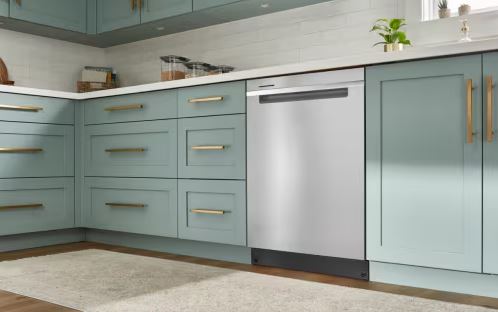
Maintenance Schedule for the Whirlpool Dishwasher
Regular maintenance prevents 70% of dishwasher failures. These simple tasks take minutes but extend machine life by years.
Monthly Tasks
Clean the filter assembly thoroughly. This single task prevents most washing and draining problems. Mark it on your calendar.
Wipe down door gaskets with a damp cloth. Food particles and soap residue degrade the rubber over time.
Check spray arm holes and clear any visible blockages. Spin both arms to verify free rotation.
Run an empty cycle with dishwasher cleaner or two cups of white vinegar. This dissolves mineral buildup in hidden areas.
Quarterly Tasks
Inspect the drain hose connection under the sink. Look for kinks, splits, or loose clamps that could cause future leaks.
Clean the door gasket groove where debris accumulates. Use an old toothbrush and mild cleaner to reach into the folds.
Check water inlet line connections for leaks or corrosion. Tighten if needed, but don’t over-tighten and crack the fitting.
Test the door latch by opening and closing firmly. Any change in feel indicates developing wear.
Annual Tasks
Deep clean the interior including all corners, edges, and the door interior. Remove both racks to access hidden areas.
Inspect the heating element for damage or heavy buildup. Scale on the element reduces heating efficiency.
Check all visible hoses for aging, cracks, or bulges. Replace any questionable hoses before they fail catastrophically.
Run a diagnostic cycle to verify all components operate correctly. This catches developing problems before they cause failures.
When to Call a Professional
Knowing when to call a technician saves money and prevents worsening damage. Some repairs require specialized tools or expertise that aren’t cost-effective to develop.
Repairs for Professionals
Motor replacement involves complete disassembly of the tub and pump housing. The part costs $150-250, and the labor is extensive. Mistakes can damage the tub seal permanently.
Control board failures on models under warranty should always go through authorized service. DIY replacement voids warranty coverage.
Door latch assemblies with internal wiring require careful routing. Incorrect assembly can pinch wires and create short circuits.
Leak diagnosis can be tricky when water appears in unexpected places. Technicians have pressure testing equipment that finds hidden cracks.
Cost-Benefit Analysis
Consider the dishwasher’s age first. Units over 10 years old rarely justify repairs over $200. Parts availability becomes limited, and other components are near end-of-life.
Compare repair cost to replacement cost. If repairs exceed 50% of new dishwasher cost, replacement makes financial sense.
Factor in energy efficiency improvements. New dishwasher models (View on Amazon) use 3-4 gallons per cycle versus 6-10 gallons for older units. Energy savings offset replacement cost over time.
Multiple simultaneous failures indicate systemic issues. One repair leads to another, creating mounting costs.
Choose the Right Technician
Verify certification through Whirlpool’s service network. Authorized technicians have model-specific training and genuine parts access.
Ask about diagnostic fees and whether they apply to repair costs. Reasonable fees are $75-125 and should credit toward approved repairs.
Request detailed estimates before authorizing work. Breakdown of parts and labor prevents surprise bills.
Check online reviews for reliability and honesty. Good technicians explain problems clearly and offer options, not just expensive repairs.
Common Whirlpool Dishwasher Myths Debunked
Dishwasher advice spreads through word-of-mouth, accumulating myths that waste time and money.
Myth: Running the dishwasher half-full wastes water.
False.
Modern dishwashers use the same water volume regardless of load size. Wait for full loads to save energy, not water.
Myth: Hand-washing is more water-efficient.
Wrong.
Dishwashers use 3-4 gallons per cycle. Hand-washing dishes for a family dinner uses 8-20 gallons depending on technique.
Myth: Pre-rinsing dishes is necessary.
Outdated advice.
Modern detergents need food soil to activate properly. Scrape large debris but skip the rinse.
Myth: Dishwasher-safe means indestructible.
Not quite.
Plastics warp on the heating element, wood deteriorates from moisture, and some glazes fade from detergent chemistry.
Myth: More detergent equals cleaner dishes.
Actually causes the opposite.
Excess detergent creates excessive suds that block spray patterns and leave residue.
Common Questions Answered
Why does my Whirlpool dishwasher start then stop immediately?
This indicates a door latch problem or control board failure. The cycle begins, but the latch doesn’t maintain secure contact or the board detects a fault. Check that the door closes firmly with an audible click. If latching seems normal, test the door switch for continuity.
How long should a Whirlpool dishwasher last?
Expect 9-12 years with proper maintenance. High-quality models with minimal electronic features often reach 15 years. Heavy use shortens this to 7-9 years. Annual maintenance extends lifespan significantly compared to neglected units.
Can I use regular dish soap in my dishwasher?
Never use regular dish soap. It creates massive suds that overflow the tub and damage the circulation pump. Only use detergent specifically formulated for automatic dishwashers. The chemistry is completely different.
What causes rust spots in my Whirlpool dishwasher?
Rust comes from three sources: chipped rack coating exposing metal, rusty water supply, or corroded screws/hardware inside the tub. Touch up rack chips with vinyl repair paint. Test your water for rust content. Replace severely rusted racks before rust spreads.
Why does my dishwasher leave white film on dishes?
Hard water mineral deposits cause cloudy film. Install a water softener or use detergent with built-in softener additives. Increase rinse aid amount in the dispenser. Run a cycle with citric acid cleaner to remove existing buildup. Check your water hardness—above 7 grains needs intervention.
Should I run hot water before starting the dishwasher?
This helps older models that don’t have built-in heaters boost cold inlet water. Modern Whirlpool dishwashers heat water internally, making this unnecessary. However, starting with 120°F water from your tap reduces cycle time slightly.
How do I know if my dishwasher drain pump is failing?
Listen for unusual sounds during the drain cycle—grinding, humming without water movement, or complete silence. Water remaining in the tub after the cycle indicates drainage failure. Test the pump by entering diagnostic mode and running the drain test independently.
Troubleshoot Your Whirlpool Dishwasher Today
You now have the knowledge to diagnose and fix most Whirlpool dishwasher problems without a service call. Most issues trace back to simple causes: clogged components, minor electrical faults, or maintenance neglect.
Start with the easiest solutions first. Clean the filter, check the door latch, and reset the control board. These three steps solve 60% of dishwasher complaints and take under 30 minutes combined.
Document your troubleshooting steps. Write down error codes, symptoms, and solutions you’ve tried. This information helps technicians if professional service becomes necessary.
Preventive maintenance beats reactive repairs every time. Monthly filter cleaning and quarterly inspections catch problems while they’re still minor and inexpensive to address.
Your dishwasher is a workhorse appliance that handles one of your home’s most repetitive tasks. Treat it right, understand its quirks, and it’ll serve you reliably for over a decade.