
You’re staring at a tower of laundry with a stackable unit that refuses to cooperate. The washer won’t drain, the dryer won’t heat, or worse, neither appliance responds when you press start. Stackable units save space but create unique troubleshooting challenges since problems in one unit can affect the other.
Water leaks from above damage the dryer below, vibration issues multiply when stacked vertically, and accessing components requires awkward maneuvering in tight spaces. This guide addresses the specific failure patterns in Maytag stackable combinations, from electrical issues that shut down both machines to mechanical problems isolated to individual units.
Maytag stackable washer and dryer troubleshooting typically involves shared electrical circuits, vibration transfer between units, drainage complications from elevated positioning, and thermal issues caused by restricted airflow in compact installations. Most problems are solvable without professional help.
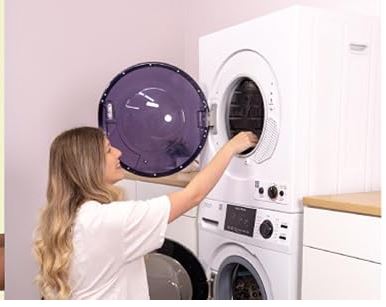
Quick Maytag Stackable Washer and Dryer Troubleshooting Guide
| Symptom | Affected Unit | Primary Cause | Immediate Check |
|---|---|---|---|
| Both units dead | Washer & Dryer | Circuit breaker tripped | Check breaker panel, verify outlet voltage |
| Washer won’t start | Washer only | Door lock failure or lid switch | Test door mechanism, check for error codes |
| Excessive vibration | Washer (affects dryer) | Unbalanced load or failed shock absorbers | Level unit, redistribute clothes, inspect suspension |
| Dryer won’t heat | Dryer only | Thermal fuse or vent restriction | Clean dryer vent, test thermal fuse continuity |
| Water leaking down | Washer only | Drain hose connection or door seal | Inspect hose routing, check door gasket |
| Grinding noise | Either unit | Foreign object or bearing failure | Remove items, check drum rotation manually |
Understanding Maytag Stackable Washer and Dryer Configuration Challenges
Stackable units introduce complications that standalone appliances don’t face. The vertical arrangement creates a cascading failure risk where water leaking from the washer ruins the dryer’s electronic components below. Vibration from an unbalanced washer shakes the entire stack, potentially damaging both control panels. Heat from the dryer rises into the washer’s base, affecting its electronic timer and controls over time.
Maytag stackables typically use a stacking kit with brackets that secure the dryer on top. These brackets must remain tight or the dryer shifts during operation, and a loose stack magnifies vibration problems exponentially compared to side-by-side units. Check bracket security every six months by hand-tightening the mounting bolts to prevent loosening.
Electrical configurations vary by installation. Some stackables share a single 240V outlet through a splitter cord, while others use separate circuits for each appliance. Shared circuits mean one unit’s electrical fault can trip the breaker for both machines. Independent circuits isolate problems but require more complex troubleshooting to identify which unit caused a breaker trip.
Ventilation poses unique challenges too. The dryer vent must route around or behind the washer, often creating longer vent runs with multiple turns. These extended paths accumulate lint faster and restrict airflow more than direct venting, making routine vent cleaning even more critical for stackable installations.
Diagnosing Shared Electrical Problems on Maytag Stackable Units
When both units stop working simultaneously, start with the power supply.
Verify Circuit Breaker Status
Stackable units draw substantial current during operation. The washer pulls 15-20 amps during the spin cycle, while the dryer needs 20-30 amps for heating. If they run simultaneously on a shared circuit, combined load can trip breakers rated for 30 amps or less.
Check your electrical panel for tripped breakers. A tripped breaker sits between the “on” and “off” positions, and you reset it by pushing fully to “off” then back to “on.” If it trips immediately upon reset, you have a short circuit requiring professional diagnosis.
Some installations use two separate breakers, one for the washer (typically 120V) and one for the dryer (240V). Identify which breaker controls which appliance by testing with a voltage meter at the outlet.
Test Outlet Voltage and Connections
Stackable units often use special outlet configurations. The dryer needs 240V with three or four prongs depending on local codes, while the washer uses standard 120V. If installed with a splitter setup, verify both appliances receive correct voltage.
Use a digital multimeter (View on Amazon) to test the dryer outlet. You should measure approximately 240V between the two hot terminals and 120V between each hot terminal and neutral. Lower readings indicate wiring problems or loose connections at the breaker panel.
Inspect the outlet itself for burn marks or loose receptacles. High current draw causes outlet deterioration over time, and damaged outlets create fire hazards while preventing proper appliance operation. Replace them immediately.
Check Power Cords and Terminal Blocks
The dryer power cord connects to a terminal block inside the rear panel. These screw terminals can loosen from vibration, especially in stackable setups. Unplug the dryer and remove the rear access panel, then tighten all terminal block screws firmly since loose connections create arcing that damages terminals and prevents proper current flow.
Examine the power cord for damage along its entire length. Cords pinched between the wall and unit develop internal breaks, so replace any cord showing fraying, melted insulation, or exposed wires.
Electrical Component Testing:
| Component | Testing Method | Normal Reading | Problem Indicator |
|---|---|---|---|
| 240V dryer outlet | Multimeter AC voltage | 220-250V between hot terminals | Below 200V or no reading |
| 120V washer outlet | Multimeter AC voltage | 110-125V hot to neutral | Below 100V or fluctuating |
| Power cord continuity | Multimeter resistance | Near 0 ohms through each wire | Infinite resistance or intermittent |
| Terminal block | Visual + voltage test | Tight screws, no discoloration | Loose, burned, or corroded |
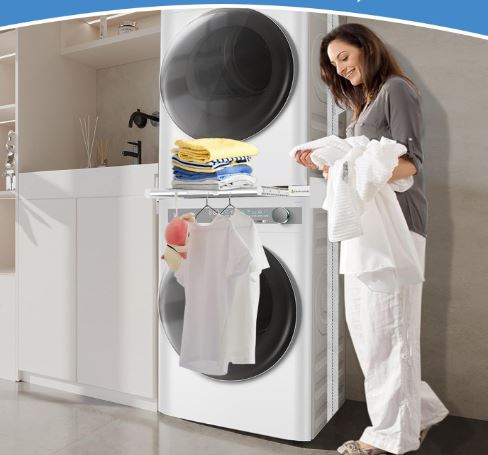
Maytag Stackable Washer Will Not Start
A non-starting washer requires systematic elimination of possible causes, and here’s how to go about it:
Investigate Door Lock Mechanism
Modern Maytag stackable washers use electronic door locks that must engage before the cycle starts. The door lock assembly includes a solenoid that secures the door and a switch that signals the control board, and either component can fail independently.
Close the door and listen for the distinctive click of the lock engaging. No click suggests the lock solenoid isn’t receiving power or has failed mechanically. Check for error codes on the display since most Maytag models show specific codes for door lock failures.
Test the door lock switch with a multimeter by accessing the lock through the front panel or top depending on your model. With the door closed, the switch should show continuity, while an open door should break continuity. If readings don’t change with door position, replace the lock assembly.
Test the Lid Switch (Top-Load Models)
Top-load stackable washers use a magnetic lid switch rather than a door lock. This switch mounts under the lid and detects when the lid closes properly, and failed lid switches are extremely common on washers 5+ years old.
Manually activate the switch by pressing it with a screwdriver while watching for a response. The washer should attempt to start if the switch is the only problem. Test switch continuity with the lid open (should be open circuit) and closed (should show continuity).
Examine the Control Panel and User Interface
Stackable units take more abuse to their control panels due to difficulty reaching controls at the top of the stack. Repeated hard pressing wears out buttons and damages the electronic interface board behind them.
Look for physical damage like cracked displays, unresponsive buttons, or moisture inside the control panel. Water splashing up from loading can seep into control electronics. Remove the control panel (usually secured by clips or screws at each end) and inspect the circuit board for corrosion or burned components.
Press each button and verify you see the corresponding indicator light. If buttons work intermittently, clean the membrane switch contacts with electronic contact cleaner. If the entire panel is dead, verify it’s receiving power from the main control board.
Check the Main Control Board
The control board acts as the washer’s brain, coordinating all functions. Board failures cause erratic behavior where some cycles work while others don’t, or the washer runs but ignores timer settings. Complete board failure leaves the washer totally unresponsive.
Inspect the main control board behind the control panel or inside the top cabinet. Look for obvious damage like burned resistors, capacitors with bulging tops, or disconnected wires. Many board failures show no external signs and require professional diagnosis or replacement.
How to Reset Maytag Stackable Washer
Resetting a Maytag washer clears error codes and restarts the control sequence, and here are your options:
Standard Power Reset Procedure
The most effective reset is a complete power cycle. Unplug the washer from the wall outlet and wait exactly 60 seconds. This duration allows all capacitors to fully discharge and the control board memory to clear. For hardwired installations, turn off the dedicated circuit breaker instead.
After one minute, restore power and wait another 30 seconds before attempting to start a cycle. The washer should go through an initialization sequence where you might hear relays clicking or see lights flash briefly. This indicates the control board reset successfully.
Perform this reset after any error code appears or when the washer behaves unpredictably. It won’t fix mechanical problems but often resolves software glitches.
Control Panel Reset Sequence
Some Maytag stackable models have a hidden reset combination. With the washer plugged in but not running, press and hold specific buttons simultaneously. The combination varies by model but commonly involves pressing “Extra Rinse” and “Delay Start” together for 3 seconds.
Consult your model’s service manual for the exact button sequence. Successfully entering reset mode usually makes all panel lights blink or displays a special code, and this reset erases custom settings and returns the washer to factory defaults.
Clearing Specific Error Codes
Error codes indicate what the control board detected as a problem. Common Maytag washer codes include “LF” (long fill indicating water inlet problem), “dr” (door not locking), and “HC” (hot and cold hoses reversed). Simply resetting without addressing the underlying issue brings the code right back.
After fixing the actual problem, use the power reset to clear the code from memory. Some persistent codes require multiple reset cycles or holding the “cancel” button for 5-10 seconds to fully clear.

Fixing Washer-Specific Mechanical Problems
Beyond electrical issues, stackable washers suffer mechanical failures unique to their design.
Addressing Excessive Vibration and Movement
Stackable washers vibrate more noticeably than freestanding models because the dryer on top amplifies every movement. Excessive vibration damages both appliances, loosens plumbing connections, and creates floor damage.
First, verify the washer sits level on all four corners using a spirit level across the top and from front to back. Adjust the leveling feet by turning them clockwise to raise or counterclockwise to lower. The unit should be perfectly level side-to-side and tilted slightly forward (1-2 degrees) to aid draining.
Check that the shipping bolts were removed during installation. These large bolts secure the suspension during transport but must be removed before operation. Forgetting this step causes violent shaking and rapid suspension damage, and the bolt locations are clearly marked in your installation manual.
Inspect Suspension and Shock Absorbers
The washer drum floats on suspension rods or springs with shock absorbers dampening movement. These components wear out after years of use, especially with frequent overloading, and failed suspension creates excessive shaking during the spin cycle.
Access the suspension by removing the front or rear panel depending on your model. Look for broken springs, damaged shock absorbers, or suspension rods that have disconnected. Shock absorbers should compress and extend smoothly without binding, so replace them if they feel stiff, loose, or make noise when compressed.
Suspension springs should show no signs of elongation or breakage. Replace all suspension components together since mixing old and new creates unbalanced suspension that defeats the purpose.
Diagnose Drain and Spin Issues
Stackable washers struggle more with drainage because the drain hose must route up and over before descending to the drain pipe. This creates a high point that can trap water if the pump lacks sufficient power or the hose has restrictions.
Check that the drain hose isn’t pushed too far into the standpipe. It should insert only 4-6 inches since deeper insertion creates a siphoning effect that drains water during the fill cycle, causing long fill times and overflow errors.
Clean the drain pump filter located behind the lower front panel. This filter catches coins, lint, and small objects, and a clogged filter restricts drainage and can burn out the pump motor. Clean it every 2-3 months for optimal performance.
Test the drain pump by running a drain/spin cycle and listening for the pump motor running. It should hum steadily for 1-2 minutes. If you hear grinding or no sound at all, the pump has failed and needs replacement.
Solving Dryer Problems in Maytag Stackable Configurations
The dryer on top faces unique challenges from its elevated position.
Combat Reduced Airflow and Vent Issues
Stackable dryer vents typically make multiple 90-degree turns to reach the exterior wall. Each turn reduces airflow efficiency by approximately 25%, so a vent with three turns operates at less than half the efficiency of a straight run.
Measure your total vent length including equivalent length for turns (add 5 feet for each 90-degree elbow). If the total exceeds 25 feet, consider rerouting for a shorter path or upgrading to a larger diameter vent. Many installations use 4-inch ducting, and upgrading to 6-inch ducts significantly improves airflow in long runs.
Inspect the vent path for crushing or kinking, especially behind the unit where space is tight. Even partial compression reduces airflow enough to cause overheating and blown thermal fuses. Use rigid metal duct wherever possible and never use flexible plastic or foil ducts that compress easily.
Clean the entire vent system every 3 months in stackable installations versus the standard 6-month interval for standalone dryers. The additional turns trap more lint more quickly.
Troubleshoot Heating Element Failures
Stackable dryer heating elements fail more frequently due to increased lint exposure and airflow restrictions. A non-heating dryer that still tumbles indicates a broken heating element, blown thermal fuse, or failed gas valve (on gas models).
Test the heating element for continuity after disconnecting power. Access it by removing the rear panel of the dryer, and a functional element shows 10-50 ohms resistance. Infinite resistance means the element wire broke internally and requires replacement.
Also test the thermal fuse mounted on or near the heating element housing. This fuse has no reset, and once blown it needs replacement. Thermal fuses blow when exhaust temperatures exceed safe limits, always indicating an airflow problem that must be corrected to prevent repeat failures.
Address Control Panel Accessibility Issues
Reaching the dryer control panel at the top of a stack proves awkward for shorter users. This often leads to forceful button pressing that damages the control interface over time.
If certain buttons become unresponsive, remove the control panel and clean the membrane switch contacts. Look for worn spots on the rubber button pads, and replace the entire control panel assembly if pads show significant wear.
Consider installing a step stool near the unit to make the controls more accessible. This reduces the tendency to press buttons harder than necessary.
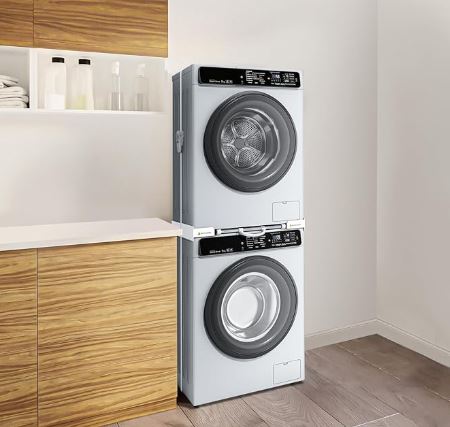
Water Management in Maytag Stackable Installations
Water-related problems in stackables create cascading damage risks.
Prevent Washer Leaks from Damaging the Dryer
Any leak from the washer potentially drips onto the dryer below, damaging its electronic components. Water and lint combine to create conductive sludge that shorts out control boards and motor windings.
Inspect washer hose connections monthly. The fill hoses attach at the back with rubber gaskets that deteriorate over time. Look for mineral buildup around connections since this indicates slow leaking. Replace fill hoses every 5 years regardless of condition, and braided stainless steel hoses last longer and fail more safely than rubber.
Check the door boot (front-load) or tub seal (top-load) for tears or degradation. Front-load boots develop mold and eventually crack, allowing water to escape during the wash cycle. Clean the boot monthly with diluted bleach to prevent mold growth that accelerates deterioration.
Place a water-absorbent mat under the entire stackable unit as an early warning system. Check it weekly for moisture since any dampness indicates a leak that needs immediate attention before it damages the dryer.
Optimize Drain Hose Routing
The elevated washer position creates challenging drain hose routing. The hose must rise from the pump outlet, travel up the washer’s back, then route to the wall drain at the appropriate height.
Secure the drain hose to the washer’s back panel with the provided clips. Loose hoses can shift during operation, creating kinks that prevent proper drainage. The hose should have a gentle upward slope with no low points where water can pool.
Verify the standpipe or drain sink sits at the correct height of 30-48 inches from the floor, which is ideal for most Maytag models. Too low causes siphoning, while too high prevents proper draining. The hose must form a goose-neck at the connection point, with the highest point at least 35-40 inches above the floor.
Vibration Isolation and Structural Concerns in Maytag Stackable Units
Stackable units transfer vibration into floor structures more aggressively than standalone appliances.
Install Vibration Dampening Solutions
Anti-vibration pads (View on Amazon) under the washer’s feet significantly reduce transmitted vibration. These rubber or polymer pads absorb shaking before it reaches the floor, and they’re especially important for installations on upper floors where vibration disturbs rooms below.
Some installations benefit from a vibration-dampening platform that supports the entire stack. These platforms use rubber isolation mounts to decouple the appliances from the floor. They’re more expensive but nearly eliminate vibration transmission.
Verify the floor itself can support the combined weight of both appliances plus water and laundry. A fully loaded stackable unit weighs 500-700 pounds, and weak floors flex during the spin cycle, amplifying vibration. Reinforce floor joists if necessary, especially in older construction.
Secure the Stacking Kit Properly
The stacking kit brackets bolt to the washer’s top and grip the dryer’s feet. These connections must remain tight to prevent the dryer from shifting, and vibration gradually loosens bolts over time.
Check bracket tightness every 3-6 months. Remove items from the dryer’s top, lift the dryer slightly (you may need help), and tighten all mounting bolts. Don’t overtighten since you’re securing plastic or sheet metal that can crack under excessive torque.
Replace the stacking kit if you notice cracking or stress marks. Generic kits may not fit as precisely as Maytag’s OEM kit designed for your specific model combination.
Temperature and Humidity Complications in Maytag Stackable Units
The tight spacing between stacked units affects both appliances’ operating conditions.
Manage Heat Transfer Between Units
Heat from the dryer rises into the washer’s base. Over time, this elevated temperature degrades plastic components, dries out rubber seals, and stresses electronic controls. The washer’s control board especially suffers from constant heat exposure.
Ensure adequate clearance around the entire stack. Maytag typically recommends at least 1 inch on each side and 6 inches behind. These gaps allow heat dissipation and provide access for service. Installations in closets need ventilation through a louvered door or vent fan to prevent heat buildup that shortens appliance life.
Some installations benefit from a heat shield between units. A reflective metal sheet on the washer’s top deflects dryer heat away, and this simple addition can extend the washer’s control board life significantly.
Control Moisture and Condensation
Front-load washers in stackable configurations sometimes develop moisture problems. The door seal traps water that creates mold and mildew, and this moisture can affect the dryer above if the stacking bracket has openings.
Leave the washer door open between uses to promote drying. Run a monthly cleaning cycle with washer cleaner or diluted bleach to prevent mold growth, and wipe the door seal dry after each use if mold becomes a persistent problem.
Check for condensation on the dryer’s underside, especially in humid climates. Moisture here indicates poor ventilation or air leaking from the washer below. Improve general room ventilation and seal gaps in the stacking bracket.
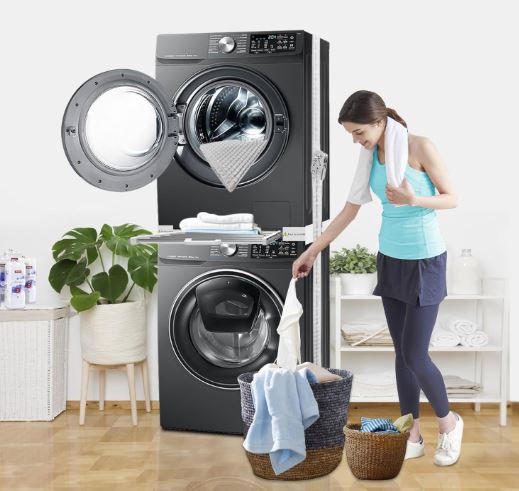
Advanced Diagnostic Techniques for Maytag Stackable Washer and Dryer Units
Some problems require deeper investigation beyond surface-level checks.
Interpret Error Codes Correctly
Maytag stackable units display alphanumeric error codes that specify exactly what the control board detected. Common codes include “F” followed by numbers (component failure) or letter codes like “LF” (long fill) and “dr” (door problem).
Write down the exact code and look it up in your owner’s manual or online service documentation. Error codes sometimes appear briefly before disappearing, so knowing the code guides troubleshooting even after it clears.
Some codes indicate transient problems that reset on their own, while others signal permanent component failure. If a code returns repeatedly after resets, focus on replacing the component it references rather than troubleshooting broadly.
Use Diagnostic Test Modes
Many Maytag models have hidden diagnostic modes that test individual components. Entering test mode usually involves a specific button sequence while powering on, and the washer or dryer then cycles through functions like fill, drain, spin, and heat, allowing you to observe each component independently.
Consult online service manuals for your exact model’s test mode entry sequence. These tests dramatically speed troubleshooting by isolating problems to specific systems.
When Professional Service Makes Sense
Certain stackable unit repairs exceed typical DIY capability.
Complex Disassembly Requirements
Accessing internal components in stacked units often requires separating the appliances and removing multiple panels. This process demands careful tracking of screws, wires, and reassembly sequences. If you’re uncomfortable with extensive disassembly, professional service prevents costly mistakes.
Gas dryer repairs always require certified technicians. Any work involving gas lines, valve replacement, or ignition system repair presents safety hazards that mandate professional expertise.
Warranty Considerations
If either appliance remains under warranty, DIY repairs may void coverage. Check warranty status before attempting repairs that involve opening cabinets or replacing major components since manufacturers sometimes require authorized service to maintain warranty validity.
Document all DIY work with photos and keep records of parts purchased. This helps if you later need professional service or warranty support.
Cost-Benefit Analysis for Aging Units
Stackable units more than 10-12 years old may not justify expensive repairs. Calculate repair costs versus replacement, and if repairs exceed 50% of new unit cost, replacement often makes better financial sense.
Modern stackables offer significantly better efficiency. Energy savings can partially offset replacement costs over 5-10 years, so factor in potential resale value if you’re repairing appliances in a property you plan to sell.
Maintenance Schedule for Long-Term Reliability
Preventive maintenance dramatically extends stackable unit lifespan.
Monthly Tasks
- Run a washer cleaning cycle with commercial washer cleaner or 2 cups of white vinegar to remove detergent residue
- Clean the washer dispenser drawer by removing it completely and washing in hot soapy water
- Wipe down moisture sensor bars with rubbing alcohol to prevent false dry readings
- Inspect all hose connections for leaks or mineral deposits
Quarterly Tasks
- Clean the entire dryer vent system from the dryer to the exterior termination
- Check the stacking bracket bolts and tighten if loose, inspect for cracks
- Test the washer’s drain pump filter by removing and cleaning it
- Vacuum lint and dust from around both appliances
Annual Tasks
- Deep clean behind and under the stack by pulling units away from the wall
- Inspect all hoses (supply, drain, and vent) for wear and replace if needed
- Test all safety devices including door locks, thermal fuses, and pressure switches
- Check floor levelness and re-level if necessary
Usage Best Practices
Don’t overload either appliance since clothes need room to tumble properly. Clean out pockets before washing to prevent foreign objects from damaging components. Use only HE detergents (View on Amazon) in front-load washers to prevent excessive suds, and leave the washer door open between uses to promote drying and prevent mold.
Frequently Asked Questions
Can I stack different brands of washers and dryers together?
Stacking different brands is possible but not recommended. Stacking kits are engineered for specific model combinations to ensure stability and proper fit. Mixing brands often results in poor fit, increased vibration, and safety concerns. If you must mix brands, use a universal stacking frame rather than brand-specific brackets.
Why does my stackable washer take longer to fill than it used to?
Slow filling indicates clogged inlet screens in the water valve or low home water pressure. Shut off water supply, disconnect fill hoses, and remove the small mesh screens from the valve inlets. Clean screens under running water and reinstall. If the problem persists, your home’s water pressure may be inadequate.
What causes the dryer to shut off before clothes are dry?
Premature cycle ending usually means the moisture sensors are dirty or the exhaust vent is severely restricted. Clean sensor bars inside the drum with rubbing alcohol. Check vent airflow by feeling the exterior vent while the dryer runs. Strong airflow is normal, while weak airflow indicates blockage requiring immediate cleaning.
How much clearance do I need around a Maytag stackable unit?
Maytag recommends minimum 1 inch on each side, 6 inches at the rear, and adequate front clearance for door opening. Installations in closets require ventilation through louvered doors or dedicated vents. Insufficient clearance causes overheating, poor performance, and shortened appliance lifespan.
Is it normal for the whole stack to shake during spin cycle?
Some vibration is normal during high-speed spinning, but excessive shaking indicates problems. Verify the unit sits level, the load is balanced, and suspension components function properly. Violent shaking can loosen plumbing connections and damage both appliances, requiring immediate attention.
Can I use regular detergent in a stackable front-load washer?
Always use HE (High Efficiency) detergent in front-load washers. Regular detergent creates excessive suds that prevent proper cleaning, confuse the control board, and leave residue. HE detergent costs slightly more but you use less per load, making it cost-effective overall.
What do I do if water leaks from the washer onto the dryer?
Immediately stop using the washer and identify the leak source. Common sources include door seals, hose connections, and tub seals. Water on the dryer’s control board causes permanent damage, so dry the dryer thoroughly and test for proper operation before using again. Fix the washer leak before operating the stack.
Should I run both appliances simultaneously or separately?
Running both simultaneously is safe if your electrical system is properly configured. However, stagger starting times by 5-10 minutes to avoid peak current draw that might trip breakers. Never start a dryer cycle while the washer is in spin mode since the combined vibration can affect stack stability. Wait for spin to complete first.
Keep Your Maytag Stackable Washer and Dryer Unit Running Smoothly
Maytag stackable washer and dryer troubleshooting demands more attention than standalone units, but systematic maintenance and prompt repairs prevent most serious problems. Focus on the unique challenges these configurations create including shared electrical systems, vibration amplification, water damage risks, and restricted access for service.
Address small issues immediately before they cascade into bigger failures affecting both appliances. With proper care, your stackable unit should deliver reliable service for 12-15 years, making it worth the extra maintenance effort required.