Water heater maintenance on a tank model comes down to four jobs: flush the sediment out, look at the anode rod, test the temperature and pressure (T&P) relief valve, and keep the thermostat near 120°F. A. O. Smith and Rheem both say you should flush at least once a year, and Rheem says every 6 months if your water is hard.
That’s the routine for a tank that’s had care all along. If yours is eight years old and nobody’s ever opened the drain valve, the plan is different. So find out how old your tank is first. The age decides which routine you’re on.
How often each water heater maintenance job comes around
A. O. Smith and Rheem don’t print the same maintenance schedule for their tank heaters. You’ll want the one that matches the brand on your rating plate.
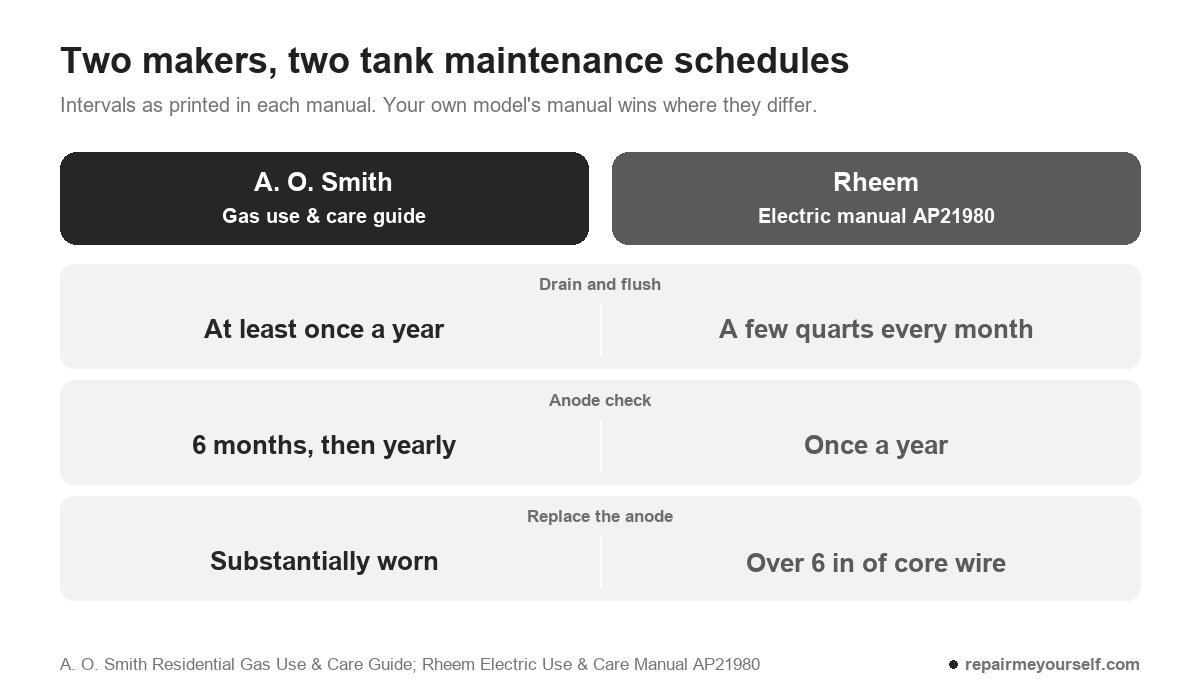
A. O. Smith’s gas Use & Care Guide wants the first drain and flush after the first six months of operation. That first flush tells you how much sediment your water leaves behind.
After that, the guide says you should repeat it at least once a year, or more often if needed. The anode rod gets its first look at that same six-month flush. So on an A. O. Smith gas tank, the anode schedule is 6 months, then yearly.
Rheem’s electric manual (AP21980) works differently. It suggests you drain a few quarts every month to clear out hard water deposits. It also says to pull the anode rod once a year.
Rheem’s flushing guide puts the full flush at once a year for most homes. With hard water, it’s every 6 months.
The relief valve and the thermostat take less time. A. O. Smith says you should inspect the T&P valve once a year and have a professional look at it every 5 years. Rheem’s manual says to lift the lever at least once a year.
Your tank’s own manual wins wherever it differs from either one. You’ll find the model and serial number on the rating plate, the label on the side of the tank.
On service calls I always pulled the tech sheet before touching a part. On a water heater, the rating plate is your tech sheet.
Flushing the tank, gas or electric
A flush is a full drain with cold water running through until it comes out clear. A. O. Smith’s drain and flush guide says draining takes 20 to 40 minutes on most tanks. Heavy sediment makes it slower.
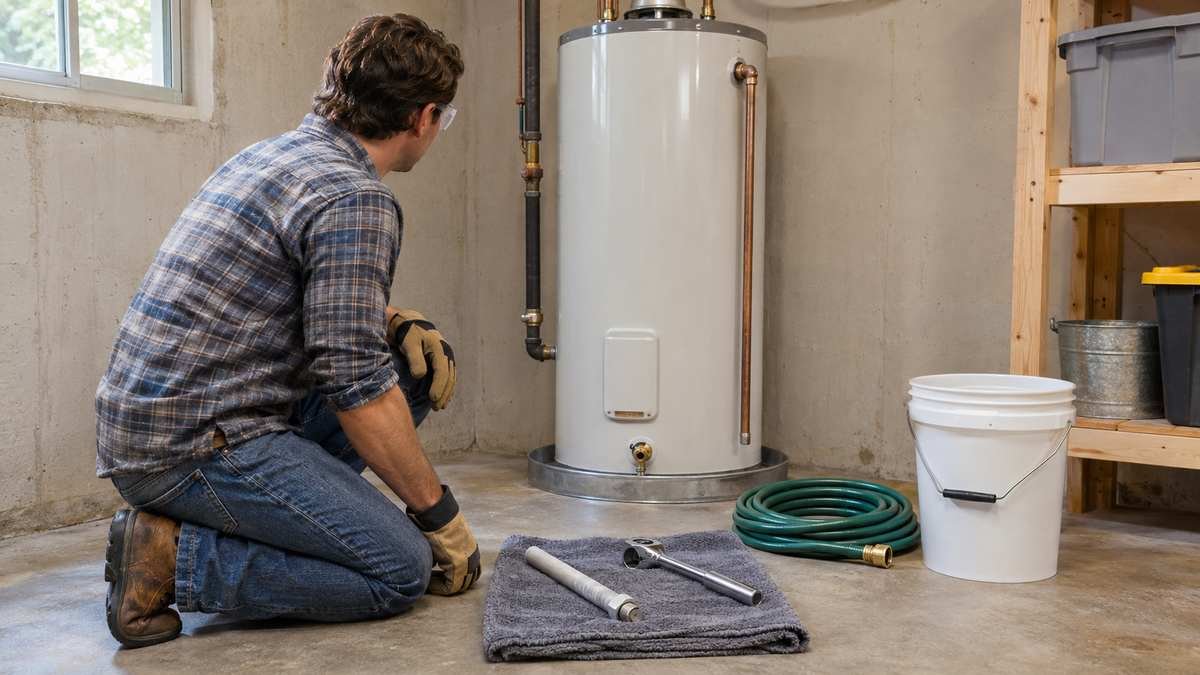
You’ll need a garden hose, a bucket or a floor drain, and a flathead screwdriver for the drain valve. Wear gloves and safety glasses, since you’re dealing with hot water.
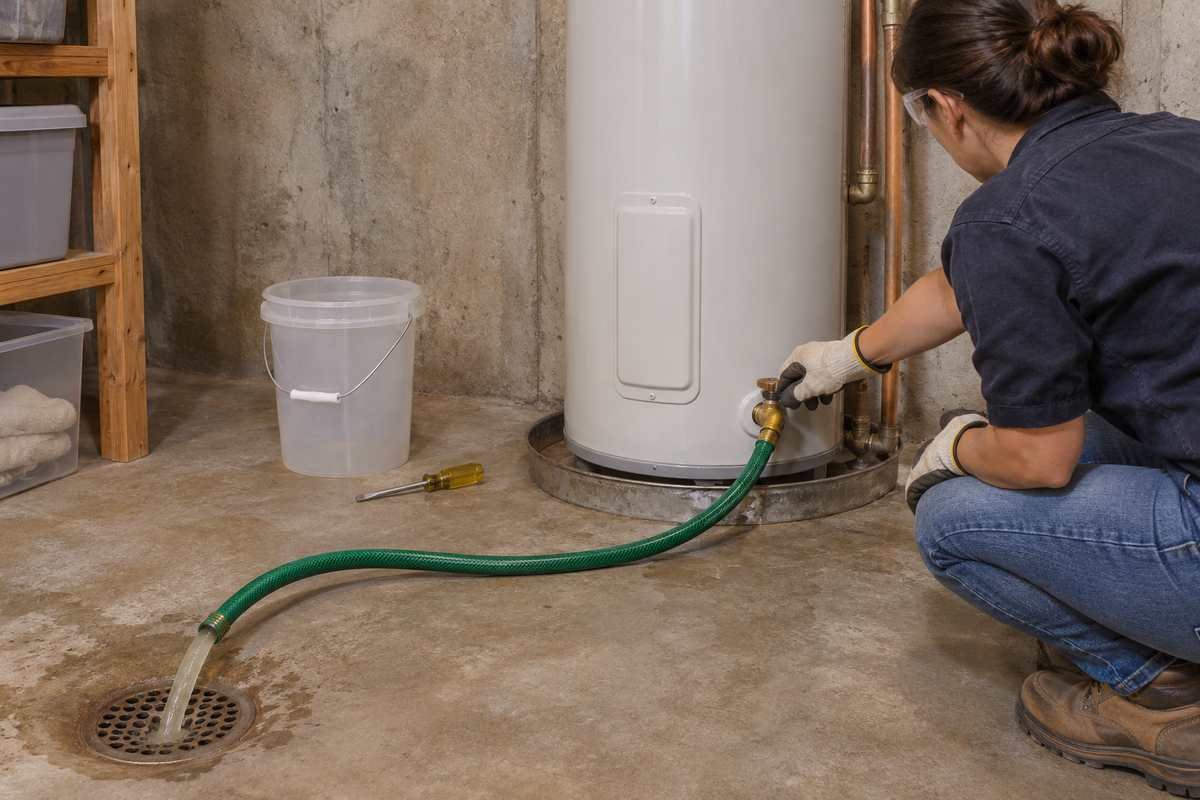
- Shut off the heat. On an electric tank, turn off the breaker. On a gas tank, turn the control knob to OFF. A. O. Smith suggests you let the water cool for a few hours first.
- Run a hot faucet nearby until the water runs cool. That also keeps pressure from building while you drain.
- Close the cold water supply valve on the pipe going into the tank.
- Connect the hose to the drain valve at the bottom and run the other end to a floor drain, outside, or a bucket.
- Open the drain valve. The first gallons usually come out cloudy and gritty, and you can hear grit hit the bucket.
- Once it’s empty, open the cold supply again and let water run through the open drain until no more sediment comes out.
- Close the drain valve, take the hose off, and let the tank refill with a hot faucet open.
- Let that hot faucet run full for at least three minutes, so the tank has no air left, then close it.
- Turn the breaker back on, or relight the pilot using the lighting instructions on the tank’s label.
Don’t skip step 8. Rheem’s manual says to make certain the tank is completely full before you put it back in operation.
An electric element that powers up in an empty tank is called a dry fire. Rheem’s control lists it as an alarm code. A. O. Smith’s gas guide says the same in its own words: don’t light the heater unless the tank is completely full.
If the drain valve won’t open, or barely trickles, sediment has probably clogged it. Don’t force it with pliers. A. O. Smith tells you to call a plumber when you can’t get the tank to drain.
Rumbling, crackling or popping from the tank is the sound A. O. Smith’s Technical Bulletin 13 lists for lime buildup. Lime comes out of water faster the hotter it gets, so a hard-working tank collects more of it.
For a limed-up tank, the bulletin has you pour one gallon of household cider vinegar into the drained tank, undiluted. It sits at least six hours before you flush it out. You have to take off the cold inlet, the hot outlet or the T&P valve to get the vinegar in, so it’s a bigger job than a flush.
Pulling the anode rod and judging it
The anode rod is a metal rod hanging down from the top of the tank. It corrodes on purpose so the steel tank doesn’t, which is why A. O. Smith calls it sacrificial. Once it’s gone, the tank is next.
To pull it, shut off the heat and the cold supply, run a hot faucet, and drain a few gallons from the tank. A. O. Smith’s guide uses a 1 1/16 deep well socket on an impact wrench.
On some tanks the rod is built into the hot water outlet nipple instead. The gas guide says you should use a pipe wrench there and not damage the nipple threads.
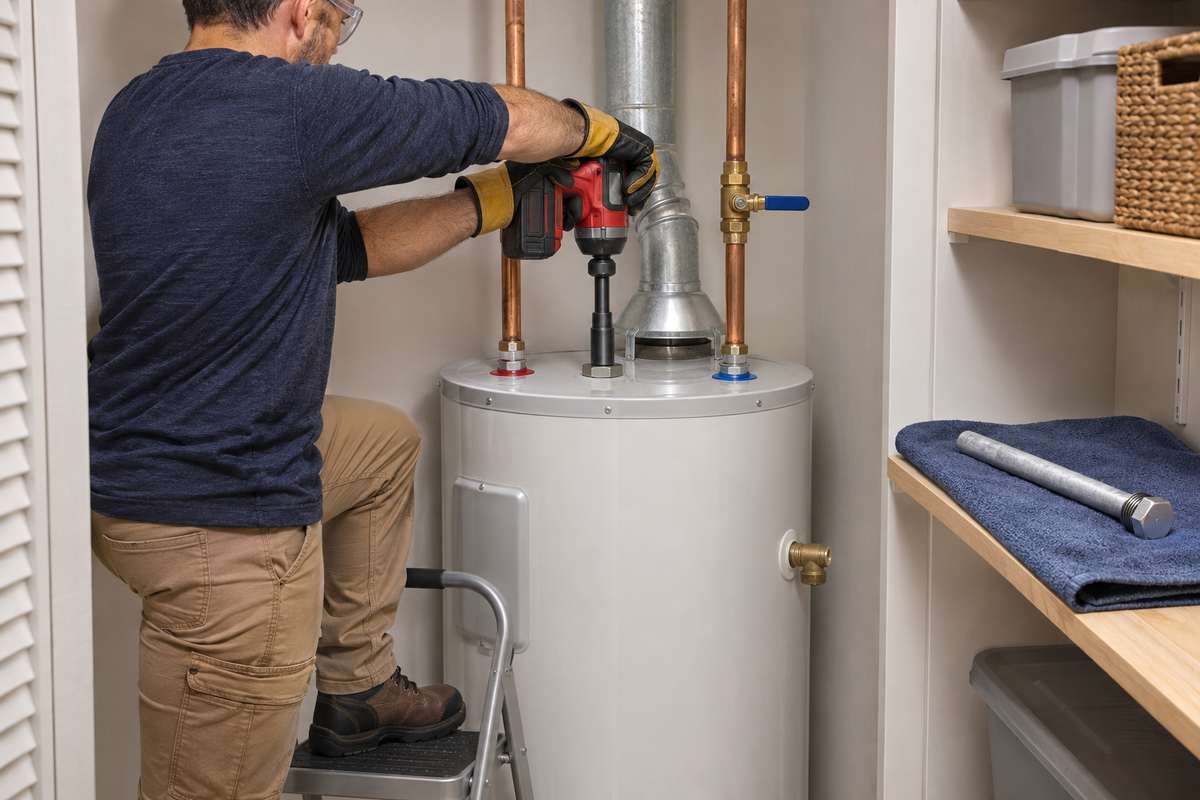
Here’s how the two makers say to judge what comes out:
- Rheem electric manual: replace the rod when more than 6 inches of core wire is exposed at either end. In the infographic that’s “over 6 in of core wire.”
- A. O. Smith maintenance guide: a good rod is smooth and around a half inch in diameter. Replace it if it shows deterioration or several inches of exposed core wire. The gas guide puts it as replacing the rod when it’s substantially worn.
Low ceiling over your tank? A. O. Smith points to a segmented anode rod, which comes in sections. You can pull the old rod up part way, cut it off, and pull again until it’s out.
Two things change how often you look. A. O. Smith’s gas guide says a water softener makes the rod deplete faster than normal.
Rotten-egg smelling hot water often traces back to the rod, too. Rheem says the sulfur odor can come from bacteria reacting with a magnesium anode. It says switching to an aluminum or powered anode can solve it. A. O. Smith’s guide mentions a special zinc anode for the same problem, fitted by a qualified person.
One post on r/homeowners has that exact mix of a missed schedule and a smell:
“So this is my sisters place. New construction, moved in June 2020. She has a two tank electric AO Smith water heaters. Last year she said the breakers started tripping on both of them, and she’s just been turning them back on. About a month ago a very strong sulfur smell started emanating from the water. She said she’s never had them maintenanced over the past six years. It’s clear the anode rods are totally shot…” [excerpt, 912 characters in full]
– r/homeowners, September 2026 (78 upvotes)
A breaker that keeps tripping on an electric tank isn’t a maintenance item, though. Don’t keep resetting it. Have someone test the elements and the wiring.
Whatever you find, put a rod back in. Rheem’s manual says running the tank without its anode will greatly shorten the tank’s life and exclude warranty coverage.
The relief valve and the thermostat
The T&P valve sits near the top of the tank with a discharge pipe running down from it. Before you lift its lever, make sure the pipe ends at a drain and nobody’s near it. That water can scald.
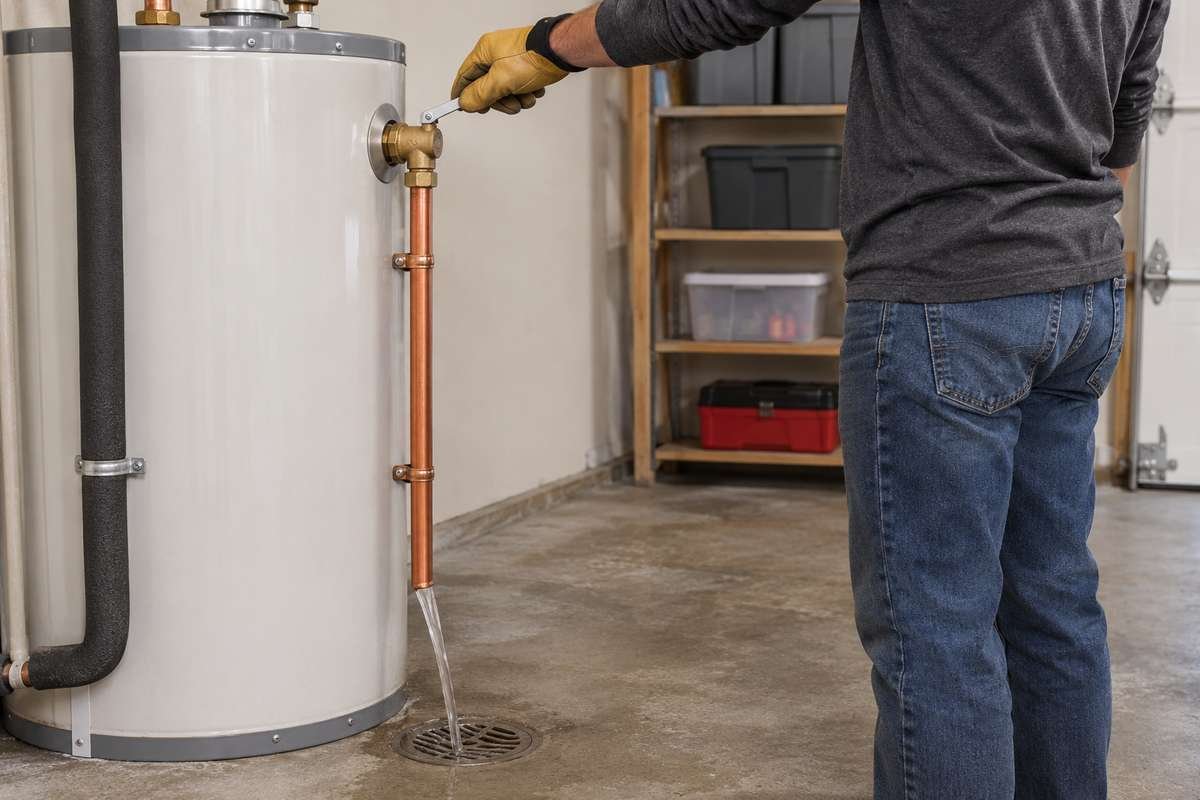
Rheem’s manual says you should lift and release the lever at least once a year and let several gallons flush through to an open drain.
If the valve drips on its own, Rheem’s manual points to thermal expansion in a closed water system. Never plug the outlet. A. O. Smith says you should get the water pressure under control and add a thermal expansion tank before you replace a dripping valve.
For temperature, A. O. Smith’s guide sets the tank at 120°F after relighting. Rheem puts the range at 120°F to 125°F to balance comfort, scald risk and energy use.
A tank that has never been flushed
An old tank that’s never been flushed is the one case where the maintenance itself can cause trouble. Rheem says you should bring in a professional when the unit is 8-12 years old or older.
Rheem’s reason: a tank that hasn’t been flushed in a while may hold hardened sediment, and trying to flush it yourself could lead to leaks.
A plumber’s advice, passed on in a thread on r/HomeMaintenance, says it in plainer words:
“What my plumber said is if the unit is old, has never been flushed and is working fine then don’t bother starting to flush it now you may end up doing it more harm than good. Just run it till it dies then replace it and start doing the flush and anode replacements on the new one.”
– r/HomeMaintenance, August 2026 (50 upvotes)
That’s one plumber’s call, not a rule. Here’s how the manufacturer guidance sorts it by situation:
- Under a year old: do the first flush and anode look at six months, the way A. O. Smith’s gas guide asks, then go yearly.
- A few years old, flushed on schedule: keep the yearly routine, or every 6 months on hard water.
- Middle-aged and never flushed, but quiet: Rheem’s electric manual already has you draining a few quarts at a time, and a few quarts in a bucket show what has settled in there. If the drain valve fights you or the water comes out thick with grit, stop and call a plumber.
- 8-12 years old or older and never flushed: Rheem’s line for calling a pro. Have a plumber flush and inspect it.
- More than 10 years old: Rheem suggests you consider replacement, so budget for one either way.
Our water heater age calculator decodes the build date from the serial number on your rating plate for the common brands.
While you’ve got the model number out, our appliance recall lookup lists the three CPSC water heater recalls since 2021.
Where the DIY part stops
Rheem lists the cases where a flush stops being a homeowner job, and A. O. Smith’s guides add a few. Stop and call a plumber if:
- the drain valve won’t open, or it leaks after you close it
- you see heavy rust or corrosion around the fittings
- the tank keeps rumbling after a flush
- the anode won’t break loose, or the nipple threads look damaged
- the pilot won’t relight from the label’s instructions
- you smell gas
Gas is where I stop, too. Turning the control knob to OFF and relighting from the label are owner steps in A. O. Smith’s guide.
Anything on the gas supply line or its fittings is a job for a licensed plumber. If you smell gas, leave the house and call the gas utility from outside.
Short answers on water heater maintenance, vacations and tankless units
Should I leave my hot water tank on all the time?
A tank water heater can stay on for normal use, and for a long trip Rheem’s manual says to turn off the power and the water if the heater will sit idle for an extended period. Rheem’s electric control has a VACATION mode that drops the thermostat to a preset lower setting, and A. O. Smith’s gas control knob has a VAC position.
After two weeks or more without use, Rheem warns that hydrogen gas can build up in the hot water system. The manual says to open the kitchen hot faucet for several minutes before using any electrical appliance on the hot water system, with no smoking or open flame near the faucet.
Does a tankless water heater need flushing?
A tankless water heater has no tank to flush, so it gets descaled instead, with a pump kit and a descaling solution circulated through it. A. O. Smith says circulation usually runs about 45 minutes, depending on the kit, and Rheem says every six months to a year for tankless gas units.
What is usually the most common water heater problem?
Sediment is the problem both makers come back to most in their maintenance guidance. Rheem lists rumbling or popping, rusty or cloudy hot water, running out of hot water sooner and longer recovery between uses as signs it’s time to flush.
How much does water heater maintenance cost?
Water heater maintenance you do yourself costs the tools you probably own: a hose, a bucket, a screwdriver and a socket for the anode. You can get a replacement anode rod from a plumbing supplier, and A. O. Smith’s guide says to match the rod type, magnesium, aluminum or zinc, to your tank.